Qigong vs Yoga: Which Should You Do? (And Why You Can Do Both)

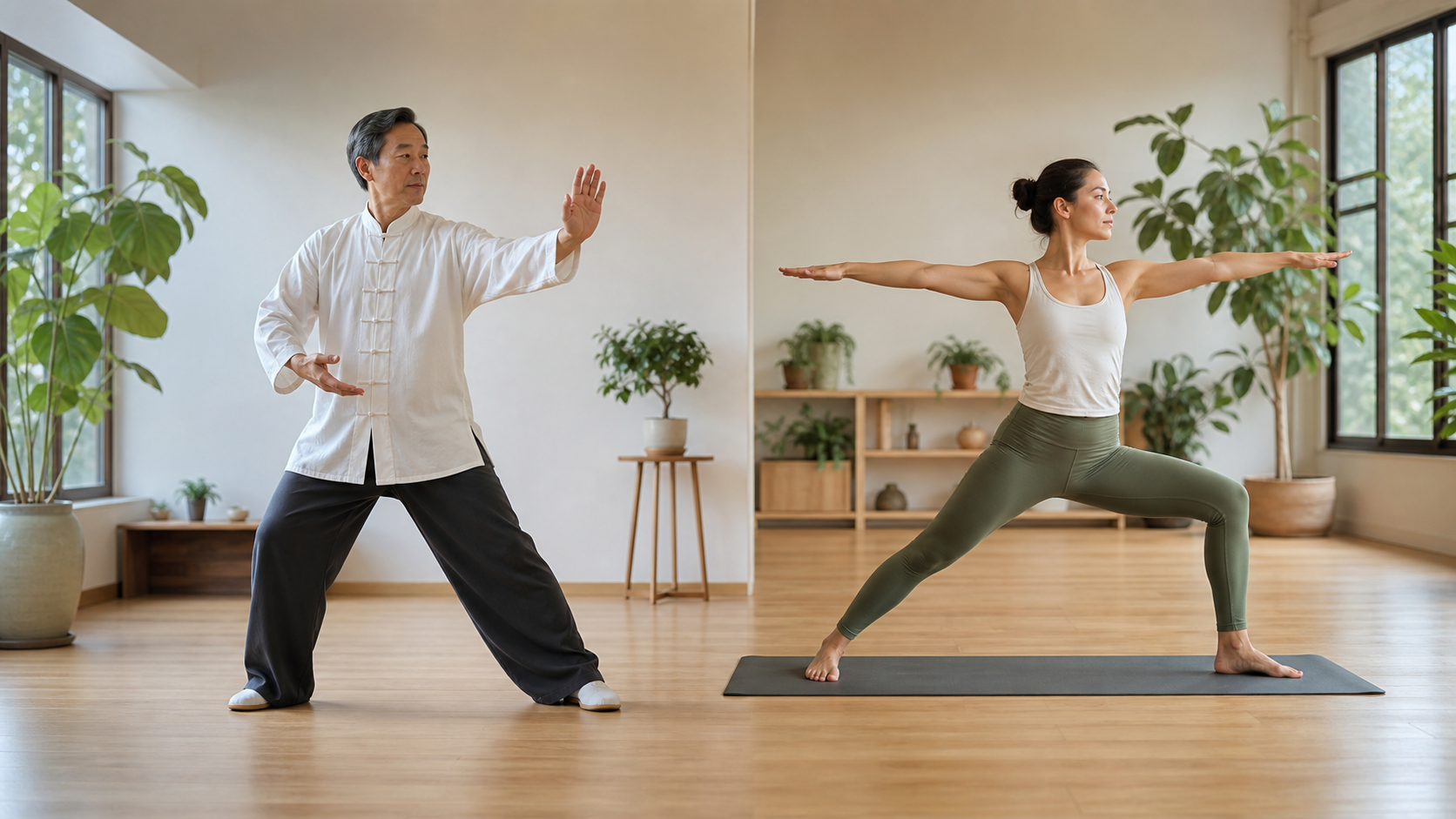
Quick answer: neither is “better” — they train different systems. Yoga typically builds strength, flexibility and effortful alignment through demanding postures. Qigong emphasises regulation, circulation and recovery through slow, repetitive, mostly standing or seated work. Research treats both as close “mind-body” cousins with similar health benefits — and many practitioners do both, because what yoga builds, qigong regulates.
If you have 15 minutes a day and want the most consistently beneficial habit, start with qigong. If you want more strength, flexibility and physical challenge on top of it, add yoga 2–3 times a week. This article compares them honestly — including where each one’s evidence base is strongest.
What each one actually trains
| Yoga | Qigong | |
|---|---|---|
| Origin | India, 3,000–5,000 years (modern Hatha yoga ~19th c.) | China, 2,000–4,000+ years |
| Energy concept | Prana — channelled through breath (pranayama) and postures | Qi — cultivated through posture, breath and attention |
| Movement style | Varies widely: dynamic flows (Vinyasa), power, restorative, inversion-heavy | Slow, repetitive, low-load — standing, seated, or gentle movement |
| Physical demand | Often high: strength, balance poses, inversions, deep stretches | Low: accessible to almost all ages and fitness levels |
| Breathwork | Pranayama — often intense (alternate-nostril, breath retention) | Diaphragmatic, slow, long exhales — always easy on the nervous system |
| Primary systems worked | Muscular strength, flexibility, joint range, core | Autonomic regulation, circulation, core stability, attention |
| Time to feel results | Weeks–months (fitness, flexibility) | Often 2–4 weeks (calm, energy, sleep) |
| Best for | Building a strong, flexible, capable body | Regulating a stressed, tired or dysregulated system |
The NIH’s own framing — “two sides of the same coin” — is about right: both are validated mind-body practices, and the research often studies them together. The difference is direction of travel. Yoga tends to ask the body for effort; qigong tends to ask the nervous system for regulation.
Qigong vs yoga for your goal
| Goal | Better fit | Why |
|---|---|---|
| Chronic stress / anxiety | Qigong (slight edge) | Qigong’s long-exhale breathing and low demand are precisely tuned to downshift the stress response; the evidence base for qigong/tai chi on anxiety is large (40+ studies, 3,800+ participants). |
| Sleep | Qigong (slight edge) | A soft evening practice is an easier daily sleep tool than a yoga session; restorative yoga is a strong alternative. |
| Strength & flexibility | Yoga | Asana is a strength-and-mobility training system; qigong builds a quiet core but won’t build a backbend. |
| Balance & fall prevention (older adults) | Both | Tai chi/qigong has excellent falls evidence; yoga balance poses (tree, warrior) are also well supported. |
| Chronic pain / joint issues | Qigong (often) | Low-impact movement without deep stretching or loading is usually easier on arthritic or injured joints. |
| Back pain | Both | Gentle qigong and yoga (gentle styles) both show benefit; match the style to your flare-ups. |
| Meditation / attention training | Both | Yoga’s dhyana tradition and qigong’s standing stillness are both serious attention training; qigong’s standing form is often easier to learn as a “meditation you can’t do wrong”. |
| Very limited mobility / ill health | Qigong | Seated and supported versions exist for essentially every qigong practice; that’s rarer in yoga. |
The research, side by side
Because both are “mind-body” interventions, much of the evidence overlaps — and in several areas the studies are head-to-head:
- Blood pressure: the landmark 12-month randomised trial (342 adults, JAMA) found tai chi — the moving cousin of qigong — lowered systolic pressure more than aerobic exercise; yoga shows similar benefits in its own trials. Review ?
- Stress & mood: large reviews of qigong/tai chi (40+ studies) and of yoga (dozens of reviews) both find moderate-to-large effects on stress, anxiety and depression. They sit at the same tier of evidence. Review ?
- Falls & balance: tai chi carries the stronger clinical evidence here — the NEJM Parkinson’s trial alone cut falls by about two-thirds versus stretching. Yoga’s balance work is effective but less studied in clinical populations. Review ?
- Mechanism: both work through the same levers — breath-driven autonomic shift, attention training, and gentle movement. The “prana vs qi” difference is language, not physiology.
Bottom line: for health outcomes, they are close competitors with different flavour. For physical building, yoga wins. For regulation and accessibility, qigong wins.
How to combine them (a 4-week starter)
Most people who want both do this: daily qigong as the base, yoga 2–3× as the layer.
| Day | Morning (15 min) | Evening (10 min) |
|---|---|---|
| Mon / Wed / Fri | 15-min qigong (standing + a short set) | — |
| Tue / Thu | Yoga session (30–60 min) | 10-min long-exhale breathing |
| Sat / Sun | 8 Brocades or standing practice | Inner Smile body scan |
The order matters less than the ratio: the daily 15-minute practice is the habit that carries you; the weekly yoga sessions add the strength and flexibility that qigong alone doesn’t. Start with the Qigong 101 system and the free 10-day standing guide as the base, and add yoga classes once the daily habit holds.
Which should you learn first?
If you must pick one with 15 minutes a day: qigong. Three reasons:
- The payoff is faster and more consistent. Calm sleep, steadier energy and lower stress typically appear within 2–4 weeks of daily qigong — before most people have felt a “result” from a new yoga routine.
- It’s easier to keep. No mat, no clothing, no 60-minute block, no class dependence. The lower the friction, the longer the habit survives — and the habit is where all the benefit lives.
- It’s the foundation the internal arts are built on. If you ever add Tai Chi, martial qigong or meditation, the standing/breath foundation transfers directly. Yoga adds on top; qigong sits underneath.
And if you already do yoga: keep it. Add the standing practice in the mornings and you’ll have both halves of the coin — which is, in the end, what the best of each tradition was always aiming at.
Frequently asked questions
Is qigong better than yoga?
Neither is universally better — they train different systems. Yoga typically builds strength, flexibility and effortful alignment; qigong emphasises regulation, circulation and recovery, with gentler, repetitive, mostly standing or seated work. Many practitioners do both, and research treats them as close “mind-body” cousins with similar health benefits.
Is qigong easier on the body than yoga?
For most people, yes — qigong movements are slow, low-impact and rarely demand deep stretching, inversions or core bracing, which makes it the better entry point for beginners, older adults, or anyone with joint pain, fatigue or limited mobility. That’s also why qigong is the practice most often recommended for chronic-condition populations.
Can you do qigong and yoga together?
Yes, and the two complement each other well: a common split is yoga 2–3 times a week for strength and mobility, plus daily 15-minute qigong for breath, regulation and energy. If you only have 15 minutes a day, qigong is the more consistently beneficial daily habit; yoga then adds strength on its own days.
What is the main difference between qigong and yoga?
The framing of energy and effort: yoga (from Indian tradition) works with prana through physically demanding postures (asana) and breath control (pranayama), while qigong (from Chinese tradition) works with qi through gentle movement, standing stillness and slow abdominal breathing aimed at cultivating and circulating energy. Both are validated mind-body practices; the routes differ.
Which should I start with, qigong or yoga?
Start with qigong if your goals are stress, sleep, energy or general health with 15 minutes a day — results typically appear within 2–4 weeks and the practice is easy to sustain. Start with yoga if your goal is strength, flexibility or a more physically challenging practice. Many people do both: daily qigong as the base, yoga 2–3 times a week on top.