
Tai Chi Breathing for COPD and Better Sleep: What the Research Shows (2026)

Quick answer: Breath is where Qigong starts, and it is where two of the best trials landed. In a randomized trial published in CHEST, 12 weeks of Tai Chi matched formal pulmonary rehabilitation for people with COPD, and three months after training stopped, the Tai Chi group was doing better on symptoms, walking distance and leg strength. In a 320-person trial in JAMA Network Open, Tai Chi improved objectively measured sleep in older adults with chronic insomnia as much as conventional exercise, and the benefit lasted two years. Here is what the studies found, why breath retraining changes sleep and lung function, and how to practise.
Jump to: What the studies found · Why it works · How to practise · FAQ · Sources
This article summarises peer-reviewed research for education. It is not medical advice; keep your current treatment and talk to your clinician before starting any new practice.
What the studies found
COPD: Tai Chi versus pulmonary rehabilitation
CHEST, 2018 (Polkey et al.)
120 people with COPD who had never used a bronchodilator were started on medication and randomized to 12 weeks of standard pulmonary rehabilitation or Tai Chi. Both groups improved equally on the St George’s Respiratory Questionnaire and six-minute walk. Twelve weeks after formal training ended, the Tai Chi group had pulled ahead on symptom score, walking distance, breathlessness and quadriceps strength. The lead author concluded that Tai Chi is a viable alternative when no rehabilitation service is available, and one patients can continue unsupervised at home. A 2021 meta-analysis pooling multiple trials confirmed improvements in walking distance, lung function (FEV1) and quality of life versus usual care.
Insomnia: the 320-person Tai Chi trial
JAMA Network Open, 2021
Older adults with chronic insomnia (average duration over 10 years) were randomized to Tai Chi, conventional exercise or control for 12 weeks. Measured by wrist actigraphy, not just questionnaires, both Tai Chi and exercise improved sleep efficiency and cut time awake after sleep onset, with no difference between them, and the gains were still present at the 24-month follow-up.
Back pain trial: sleep as a secondary outcome
North American Spine Society Journal, 2024
In the 350-person online Tai Chi and Qigong trial, sleep quality improved significantly alongside pain, a reminder that the breathing and relaxation components carry benefits well beyond the condition being studied.
Why it works: research and tradition side by side
| What the research measures | What Qigong tradition calls it |
|---|---|
| Diaphragmatic breathing recruits the diaphragm fully, improves ventilation efficiency and reduces the accessory-muscle breathing pattern that exhausts COPD patients | Belly breathing; ‘the breath sinks to the dantien’ |
| Slowing the breath to about six per minute maximises heart-rate variability and shifts the nervous system into rest mode, the precondition for sleep | Long, slow, fine, deep, even breath |
| Extended exhalation (the Six Healing Sounds) empties trapped air and calms the vagus nerve | The Lung sound ‘sss’ and Kidney sound ‘chuii’ |
| Gentle leg work builds the quadriceps strength that predicts COPD outcomes and creates healthy physical tiredness for sleep | Rooting and weight shifting |
How to put it into practice
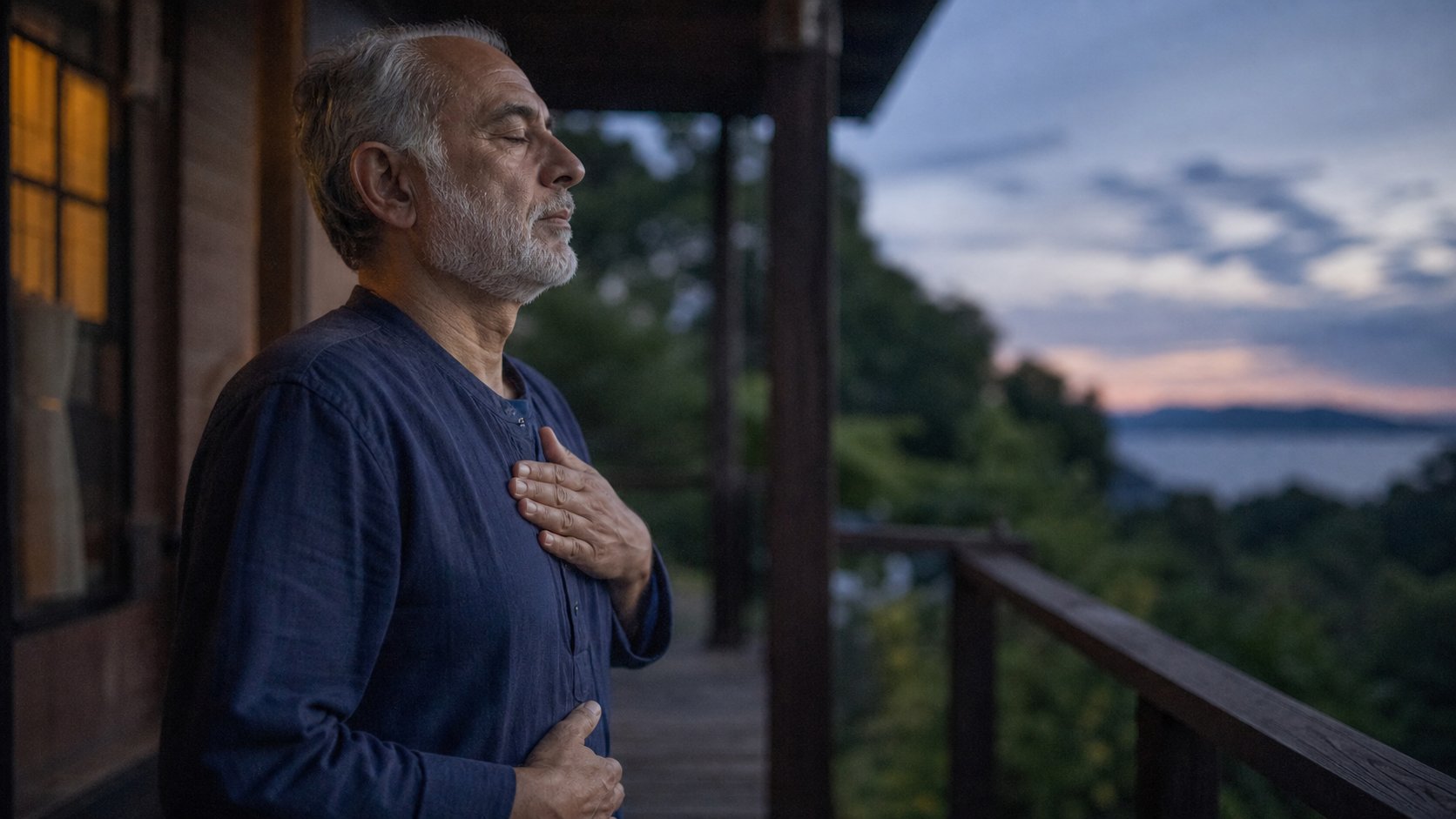
- Relearn the breath first. One hand on the chest, one on the belly; only the lower hand should move. Five minutes, twice a day. This is lesson one of Qigong 101 and the physiology is explained in Secrets of Breathing.
- Use the free Ki Breathing Basic Four. Katsumi Niikura’s four breathing exercises can be done seated or standing and are ideal for anyone with limited lung capacity.
- Lengthen the exhale with the Six Healing Sounds. The Lung sound in particular is designed for exactly this. Free in the Inner Smile & Six Healing Sounds guide.
- For sleep, practise in the evening. Ten minutes of slow breathing and the Inner Smile 30 to 60 minutes before bed. The insomnia trial’s gains came from regular practice over 12 weeks; expect the first changes in two to three weeks.
- For COPD, add gentle standing. The CHEST trial’s late advantage came partly from leg strength. Short bouts of Zhang Zhuang near a support build it safely. Keep your inhaler plan and tell your respiratory team.
Recommended for this goal: Qigong 101 (breath retraining and gentle standing) · Ki Breathing Basic Four (free) (four seated-friendly breathing exercises) · Six Healing Sounds (free) (long-exhale practice for the lungs). Not sure? Use the Start Here guide.
Frequently asked questions
Can Tai Chi help COPD?
Yes. A randomized trial in CHEST found 12 weeks of Tai Chi equal to formal pulmonary rehabilitation for COPD symptoms and walking distance, with the Tai Chi group doing better three months after training ended. A 2021 meta-analysis confirmed improvements in walking distance, FEV1 and quality of life.
Does Tai Chi improve sleep?
Yes. A 320-person randomized trial in JAMA Network Open found Tai Chi improved objectively measured sleep efficiency in older adults with chronic insomnia as much as conventional exercise, with benefits lasting 24 months.
What is the best breathing exercise for COPD?
Diaphragmatic (belly) breathing with a long, slow exhale is the foundation. The Six Healing Sounds, which pair extended exhalation with specific sounds, are a traditional Qigong version of the pursed-lip breathing taught in pulmonary rehabilitation.
How long should I do Qigong breathing to sleep better?
Ten minutes of slow breathing and Inner Smile practice 30 to 60 minutes before bed, done nightly, typically produces noticeable improvement within two to three weeks. The trials measured results at 12 weeks.
Is Qigong safe with a lung condition?
Generally yes; it is low intensity and can be done seated. Do not hold the breath, stop if you become breathless, keep your prescribed medication plan, and let your respiratory team know.
Sources
- Polkey MI, Qiu ZH, Zhou L, et al. Tai Chi and Pulmonary Rehabilitation Compared for Treatment-Naive Patients With COPD: A Randomized Controlled Trial. Chest. 2018;153(5):1116-1124. (summary)
- The effect of Tai Chi on the pulmonary rehabilitation of chronic obstructive pulmonary disease: a systematic review and meta-analysis. Ann Palliat Med. 2021.
- Siu PM, et al. Effects of Tai Chi or Exercise on Sleep in Older Adults With Insomnia: A Randomized Clinical Trial. JAMA Netw Open. 2021;4(2):e2037199.
- Ferrera D. Tai Chi Breathing Exercises for COPD and Better Sleep (companion article, January 2026).
Part of the Qigong & Tai Chi research series: Overview & the 2026 Harvard conference · Anxiety & depression · Blood pressure & heart · Parkinson’s, stroke & brain · Chronic back pain · Cancer recovery · COPD, breathing & sleep
