Qigong for Chronic Back Pain: What Randomized Trials Show (2026)

Quick answer: Yes, and the evidence is recent and strong. A 2024 randomized trial of 350 adults found a 12-week Tai Chi and Qigong program, delivered entirely online, produced clinically significant reductions in low back pain disability, pain intensity and sleep problems, with benefits still present a month after it ended. An earlier Australian trial of 160 people found 10 weeks of Tai Chi reduced pain intensity and disability by clinically worthwhile amounts. Below is what the research found, why standing and slow movement help a painful back, and how to begin without flaring it up.
Jump to: What the studies found · Why it works · How to practise · FAQ · Sources
This article summarises peer-reviewed research for education. It is not medical advice; keep your current treatment and talk to your clinician before starting any new practice.
What the studies found
The 2024 online Tai Chi and Qigong trial (n=350)
North American Spine Society Journal, 2024
Adults aged 21 to 92 with low back pain for at least six weeks were randomized to a 12-week program of Tai Chi, Qigong and meditation delivered in live online classes twice a week, or to a waitlist. The treatment group improved significantly on the Oswestry Disability Index at 8, 12 and 16 weeks, plus pain intensity, sleep quality and quality of life. Nobody withdrew because of adverse effects. The authors, from Mayo Clinic, Weill Cornell and the Center for Taiji and Qigong Studies, note the program is gentle enough for a wide range of abilities and can be practised at home.
The Sydney Tai Chi trial (n=160)
Arthritis Care & Research, 2011
160 volunteers with persistent non-specific low back pain were randomized to 18 Tai Chi sessions over 10 weeks or usual care. Tai Chi reduced pain bothersomeness by 1.7 points and pain intensity by 1.3 points on a 0 to 10 scale, and improved disability by 2.6 points on the Roland-Morris scale, effects both researchers and participants rated as worthwhile. Follow-up exceeded 90 percent, meaning people actually stuck with it.
Why it works: research and tradition side by side
| What the research measures | What Qigong tradition calls it |
|---|---|
| Slow, aligned standing loads the spine evenly and strengthens the deep stabilisers (multifidus, transversus) that switch off in chronic pain | Zhang Zhuang: standing like a tree, spine suspended from the crown |
| Relaxed movement with attention reduces protective muscle guarding and fear of movement, both of which amplify pain | Song: releasing the lower back and hips; sinking the Qi |
| Slow breathing calms the nervous system’s pain amplification and improves sleep, which in turn lowers pain | Regulating the breath; belly breathing |
| Weight shifting mobilises the hips so the lower back stops doing their job | Moving from the dantien and the kua |
How to put it into practice
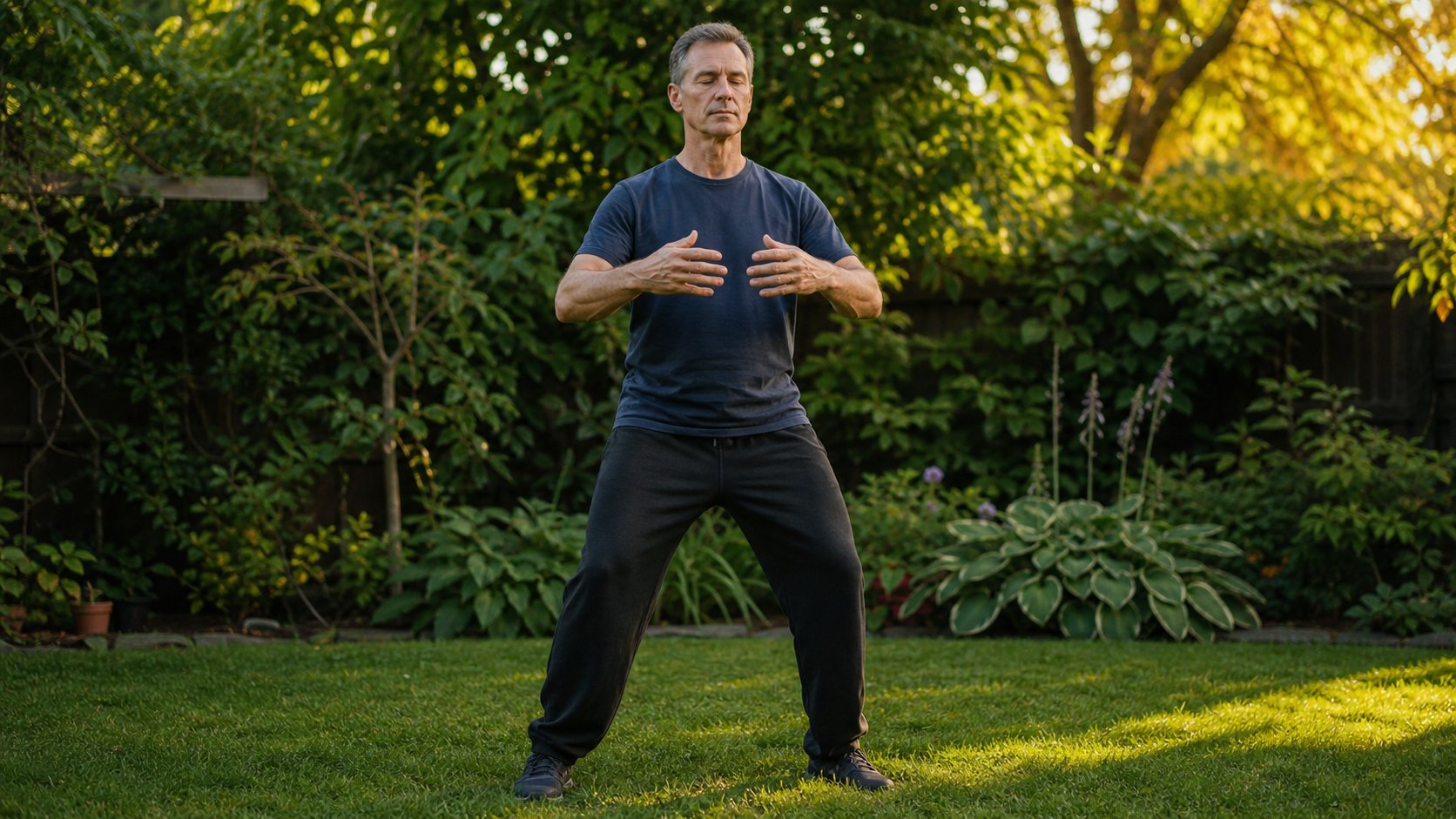
- Stand before you stretch. Two to five minutes of Zhang Zhuang with knees soft and tailbone dropped does more for a painful back than most stretching. Build to 10 to 15 minutes over a month. The free guide walks you through it day by day.
- Breathe into the belly and lower back. Feeling the breath expand the kidneys area teaches the back to release. This is core to Qigong 101.
- Add gentle weight shifting. Tai Chi Ruler Qigong moves the hips and spine slowly through a small, safe range, the same principle the trials used.
- Smaller is better on bad days. Reduce range of motion, practise seated if needed, but do not skip. Consistency over 12 weeks is what produced the results.
- Keep your other care. In both trials participants continued usual treatment. Qigong is additive.
Recommended for this goal: Zhang Zhuang guide (free) (standing practice that rebuilds spinal support) · Qigong 101 (breath, posture and gentle movement foundations) · Tai Chi Ruler Qigong (slow hip and spine mobility). Not sure? Use the Start Here guide.
Frequently asked questions
Is Qigong good for lower back pain?
Yes. A 2024 randomized trial of 350 adults found a 12-week online Tai Chi and Qigong program produced clinically significant reductions in low back pain disability and pain intensity, sustained a month after the program ended. A 2011 trial of 160 people found similar benefits from 10 weeks of Tai Chi.
Can I learn Qigong for back pain online?
Yes. The strongest recent trial delivered every class live online to participants aged 21 to 92 and still produced significant, lasting improvement with no adverse-event withdrawals.
How long before Qigong helps back pain?
In the trials, measurable improvement appeared by week 8 and grew through week 12. Students often notice less morning stiffness within two to three weeks of daily standing practice.
Which Qigong exercise is best for back pain?
Zhang Zhuang standing meditation is the single most useful practice: it strengthens the deep spinal stabilisers while teaching the back to relax. Belly breathing and gentle weight shifting, as in Tai Chi Ruler Qigong, come next.
Can Qigong make back pain worse?
Rarely, and usually from over-reaching or standing too long too soon. Keep movements small, stop before fatigue, and build time gradually. If you have a specific diagnosis such as a herniated disc or spinal stenosis, check with your clinician first.
Sources
- Yang Y, et al. A Tai chi and qigong mind-body program for low back pain: A virtually delivered randomized control trial. N Am Spine Soc J. 2024;20:100557.
- Hall AM, et al. Tai chi exercise for treatment of pain and disability in people with persistent low back pain: a randomized controlled trial. Arthritis Care Res. 2011;63(11):1576-1583.
- Ferrera D. Qigong for Chronic Back Pain: What 19 Studies Reveal (companion article, January 2026).
Part of the Qigong & Tai Chi research series: Overview & the 2026 Harvard conference · Anxiety & depression · Blood pressure & heart · Parkinson’s, stroke & brain · Chronic back pain · Cancer recovery · COPD, breathing & sleep