
The Science of Qigong: What Harvard, Mayo Clinic and 17 Randomized Trials Say (2026)

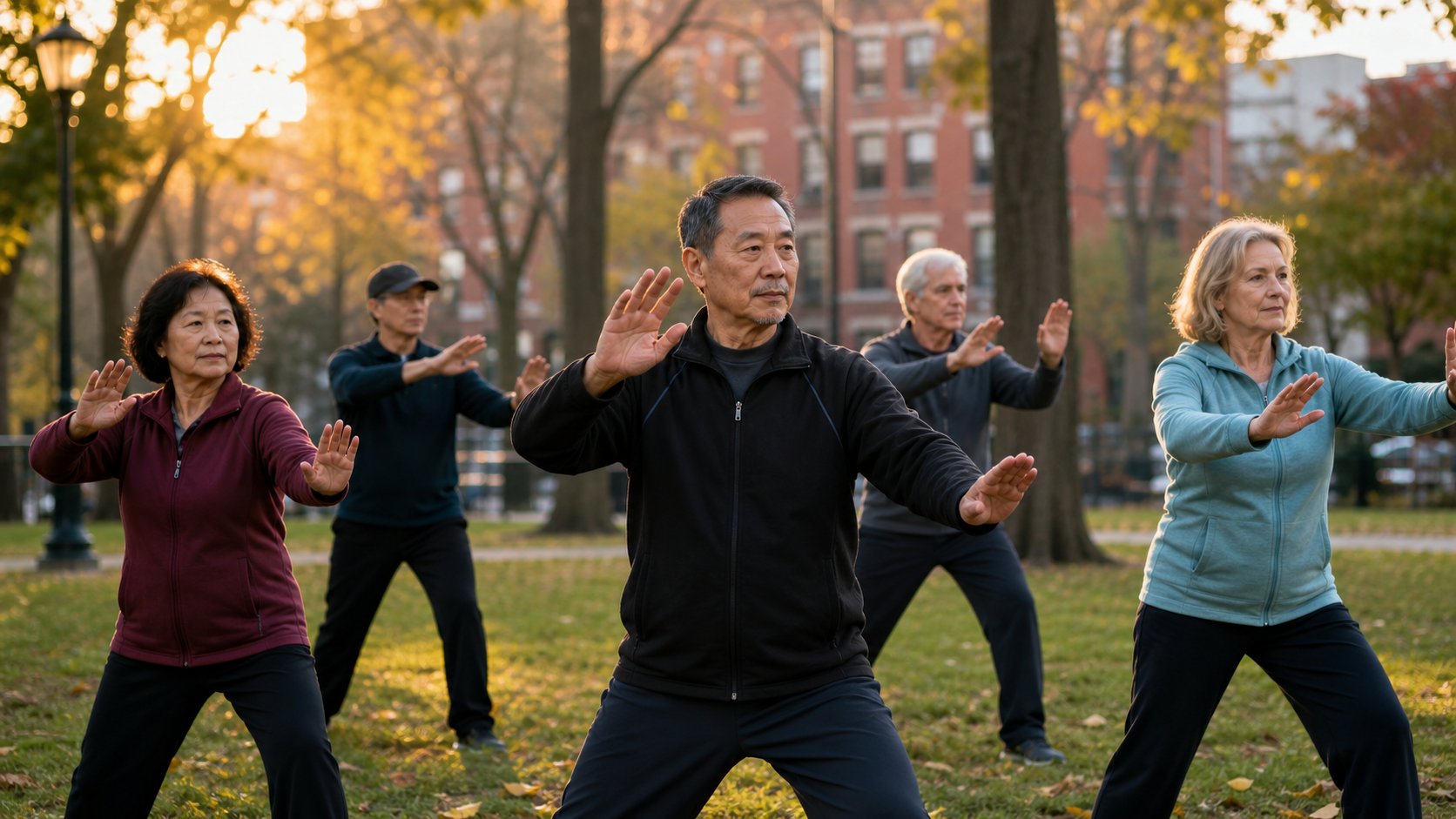
Quick answer: Qigong and Tai Chi are no longer “alternative” claims. A 2024 randomized controlled trial of 350 adults found that a 12-week online Tai Chi and Qigong program produced clinically significant reductions in low back pain disability, better sleep and better quality of life, with gains still present a month later. A 2023 meta-regression of 17 randomized studies (2,365 older adults) found significant improvements in both physical and cognitive function. And in 2026, Harvard Medical School’s Osher Center hosted its second international research conference dedicated to the science of Tai Chi and Qigong. Here is what the evidence actually says, in plain English, and what it means for your practice.
Jump to: The back pain trial · The 17-study meta-analysis · The Harvard conference · Why it works · What it means for your practice · Research by condition · FAQ
1. The 2024 virtual Tai Chi and Qigong trial for low back pain
Published in the North American Spine Society Journal in 2024 by a team from the Center for Taiji and Qigong Studies, Mayo Clinic, Weill Cornell and the National Cancer Institute, this randomized controlled trial is the most important recent study for anyone learning Qigong at home.
- Who: 350 adults with low back pain for at least six weeks, aged 21 to 92 (average 59), none of whom had taken Tai Chi before.
- What: Half received a 12-week program of Tai Chi, Qigong and meditation, delivered as live online 60-minute group classes twice a week. The other half stayed on a waitlist. Everyone continued their usual care.
- Result: The Tai Chi/Qigong group showed statistically and clinically significant improvement in pain-related disability (Oswestry Disability Index) at 8, 12 and 16 weeks, plus improvements in pain intensity, sleep quality and quality of life. The benefit was still there four weeks after classes ended.
- Safety: No participant withdrew because of adverse effects.
Two things stand out. First, the program was entirely online, which is exactly how most of our students train. Second, the age range went up to 92, and the practice still worked. This is the same slow, breath-led, posture-based approach we teach in Qigong 101.
2. The 17-study meta-analysis: physical and cognitive function in older adults
A 2023 systematic review and meta-regression in BMC Geriatrics pooled 17 randomized controlled trials (2,365 participants, mean age 70). Tai Chi and Qigong produced significant improvements in both physical function (balance, gait, strength) and cognitive function (attention, memory, executive function).
The interesting part is the meta-regression. The cognitive benefit remained significant even after the researchers controlled for the physical improvement. In other words, Tai Chi and Qigong appear to help the brain directly, not just because people get fitter. The authors attribute this to the mindfulness and mental-focus components of the practice: memorising movements, coordinating breath, and sustained attention. Traditional teachers would call that yi (intention) leading qi.
3. The 2026 Harvard conference on the science of Tai Chi and Qigong
On April 30 and May 1, 2026, the Osher Center for Integrative Health, jointly based at Harvard Medical School and Brigham and Women’s Hospital, hosted its second international conference, The Science of Tai Chi & Qigong as Whole Person Health, in Boston. The theme was “deepening our physiological understanding of mind-body integration”: how these practices affect the nervous system, immune response, cognition and real-world health outcomes across multiple body systems at once.
The committee was co-chaired by Peter Wayne, PhD (Director of the Osher Center and a Tai Chi practitioner of more than 45 years) and Gloria Yeh, MD, MPH (Director of Clinical Research at the Osher Center). Attendees ranged from basic-science and clinical researchers to hospital program leaders, senior-living wellness directors and traditional teachers, who were explicitly invited to “share traditional knowledge to inform research agendas.”
Sifu Dan Ferrera wrote a detailed preview of the event and what it means for teachers, clinicians and students: Harvard Tai Chi & Qigong Mind-Body Integration Conference 2026: Why This Boston Event Deserves a Spot on Your Calendar (Medium). The short version: the conversation has moved from “does this work?” to “how do we measure it and how do we get it to more people?”
4. Why Qigong produces these effects
Research and tradition describe the same mechanisms in different words:
| What the research measures | What Qigong tradition calls it | Where we teach it |
|---|---|---|
| Slow diaphragmatic breathing shifts the autonomic nervous system toward parasympathetic (rest-and-repair) dominance; heart rate variability rises | Sinking the Qi to the lower dantien; “the breath becomes long, slow, fine and deep” | Qigong 101, Secrets of Breathing |
| Sustained attention on body sensation improves interoception and reduces pain amplification in the brain | Yi (intention) leads Qi; “where the mind goes, the energy follows” | Inner Smile & Six Healing Sounds |
| Weight-shifting in a low stance builds leg strength, proprioception and balance, cutting fall risk | Rooting; Zhang Zhuang (standing like a tree) | Free 10-day Zhang Zhuang guide |
| Memorising sequences and coordinating breath with movement exercises working memory and executive function | Form practice; “regulating body, breath and mind as one” | Tai Chi Ruler Qigong |
| Reduced inflammatory markers and improved immune function reported across multiple trials | Strengthening Wei Qi (defensive energy) | Qigong 202 |
5. What this means for your own practice
- Consistency beats intensity. Every positive trial used two or more sessions a week for 8 to 12 weeks. Ten to twenty minutes daily is the sweet spot for most students.
- Online works. The strongest recent trial was fully virtual. What matters is correct instruction and regular practice, not the room you stand in.
- Age is not a barrier. Participants up to 92 improved. Movements can be adapted seated or standing.
- Track something simple. Researchers use pain scores (0 to 10), sleep quality (1 to 5) and mood ratings. Write yours down weekly. Our students’ own reports follow the same pattern the studies found: sleep first, then pain and energy, then mood.
- Start with the fundamentals. Breath, posture and attention are the active ingredients in every study above. They are the whole of Qigong 101. Not sure where to begin? Use the Start Here guide, or read Qigong vs Tai Chi: which should you learn first?
6. The research by condition
Each article below takes one condition, summarises the strongest randomized trials and meta-analyses in plain English, maps the findings to traditional Qigong principles, and shows exactly how to practise for that goal.
- Qigong and Tai Chi for Anxiety and Depression: What the Research Shows
- Tai Chi and Qigong for Blood Pressure and Heart Health: What the Research Shows
- Tai Chi for Parkinson’s, Stroke Recovery and Brain Health: What the Research Shows
- Qigong for Chronic Back Pain: What Randomized Trials Show
- Tai Chi and Qigong for Cancer Recovery: Fatigue, Sleep and Quality of Life Research
- Tai Chi Breathing for COPD and Better Sleep: What the Research Shows
- Weight Loss and Appetite Qigong (Gingwa-Gong): a free practice for diets, GLP-1 medications such as Wegovy, Ozempic, Zepbound and Mounjaro, and bariatric surgery
Frequently asked questions
Is there scientific evidence that Qigong works?
Yes. Randomized controlled trials and meta-analyses published in peer-reviewed journals show that Tai Chi and Qigong improve balance, physical function, cognitive function, sleep, quality of life and chronic pain, including low back pain. A 2024 randomized trial of 350 adults found a 12-week online Tai Chi and Qigong program produced clinically significant reductions in pain-related disability, and a 2023 meta-regression of 17 randomized studies found benefits for both physical and cognitive function in older adults.
Does online or virtual Qigong training work as well as in-person classes?
The best current evidence says yes for measurable health outcomes. The 2024 low back pain trial delivered all classes live online to adults aged 21 to 92 and still produced statistically and clinically significant improvements that were maintained one month after the program ended, with no participants withdrawing because of adverse effects.
What is the Harvard Tai Chi and Qigong conference?
The Science of Tai Chi and Qigong as Whole Person Health is an international research conference hosted by the Osher Center for Integrative Health, jointly based at Harvard Medical School and Brigham and Women’s Hospital. The 2026 conference took place in Boston on April 30 and May 1, 2026, and brought together researchers, clinicians, teachers and program leaders to review the physiological effects of mind-body movement practices.
How long do you have to practice Qigong before you see results?
In clinical studies, measurable changes typically appear within 8 to 12 weeks of practicing two or more times a week. Our students commonly report better sleep and warmth or tingling in the hands within the first two to four weeks of daily practice; deeper changes in pain, anxiety and energy usually follow over several months.
Is Qigong safe for older adults and people with health conditions?
Tai Chi and Qigong are consistently reported as low risk in clinical trials, including trials in adults in their 80s and 90s, and are widely used in hospital and senior programs for fall prevention and chronic pain. Movements are slow, low impact and can be done seated or standing. As with any exercise program, check with your doctor if you have a medical condition.
Does the research match what traditional Qigong teachers say?
On outcomes, largely yes: better sleep, less pain, calmer mood, better balance and more energy are exactly what teachers have described for centuries. Where they differ is language. Research measures nervous system, immune, cognitive and musculoskeletal changes; tradition speaks of Qi, meridians and the dantien. Both are describing the same body from different angles.
Sources
- Yang Y, McCluskey S, Bydon M, et al. A Tai chi and qigong mind-body program for low back pain: A virtually delivered randomized control trial. North American Spine Society Journal, 2024;20:100557.
- Effects of Tai Chi and Qigong on cognitive and physical functions in older adults: systematic review, meta-analysis, and meta-regression of randomized clinical trials. BMC Geriatrics, 2023.
- Osher Center for Integrative Health, Harvard Medical School / Brigham and Women’s Hospital. The Science of Tai Chi & Qigong as Whole Person Health, 2026 conference.
- Ferrera D. Harvard Tai Chi & Qigong Mind-Body Integration Conference 2026. Medium, January 2026.
