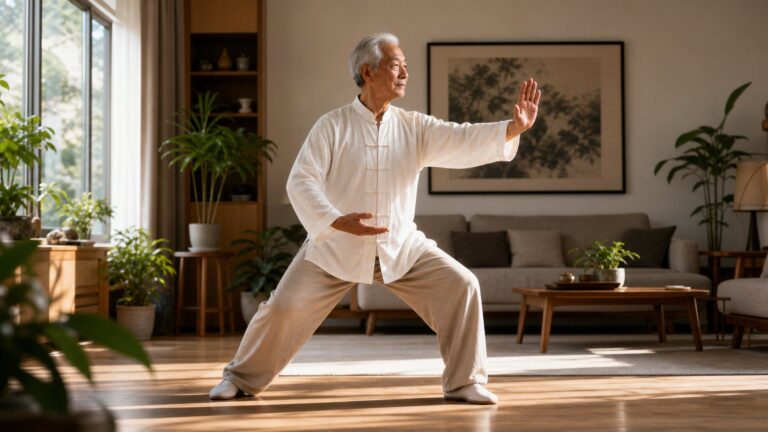
Chair Tai Chi and Qigong for Seniors: The Complete Guide to Seated Movement Practice

Meta Description: Discover the transformative benefits of chair tai chi and qigong for seniors. Learn 12+ gentle seated exercises, safety tips, and a 4-week beginner program. No standing required!
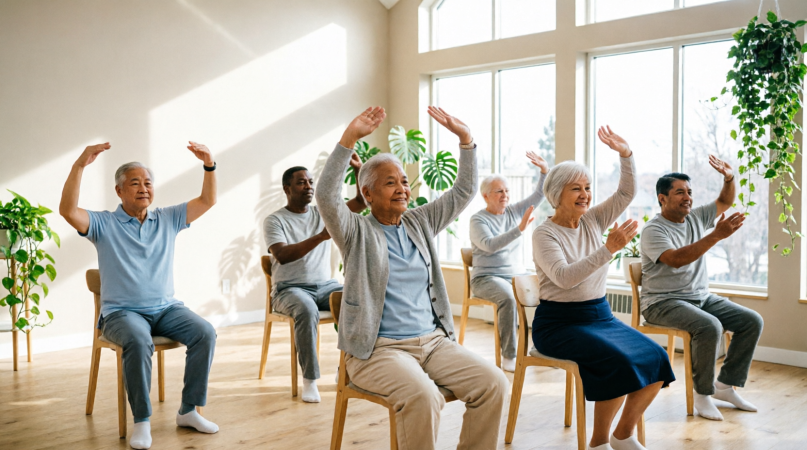
Introduction
Are you looking for a gentle, effective way to improve your balance, strength, and overall well-being—but concerned about standing exercises or complex movements? Chair tai chi and qigong might be precisely what you need.
These ancient movement practices, adapted for seated practice, offer remarkable health benefits without requiring you to stand, balance on one foot, or memorize complicated sequences. Whether you’re managing mobility challenges, recovering from injury, or simply prefer the safety and comfort of a chair, this comprehensive guide will show you how to harness the power of seated movement.
What you’ll discover in this guide:
- The science-backed health benefits of chair tai chi and qigong
- 12+ easy-to-follow seated exercises with step-by-step instructions
- The key differences between tai chi and qigong (and which is right for you)
- A progressive 4-week beginner program
- Safety tips and modifications for every ability level
Let’s begin this journey toward better health, one gentle movement at a time.
What Is Chair Tai Chi and Qigong?
Understanding the Practice
Chair tai chi and qigong are adapted versions of traditional Chinese movement practices that can be performed entirely while seated. These gentle exercises combine slow, flowing movements with deep breathing and mental focus to promote physical health, mental clarity, and emotional balance.
Tai chi is actually a form of qigong, but while both use breath and movement to improve flexibility, balance, and well-being, qigong focuses more on building the body’s energy (called “qi”) through breathing, posture, and focus.

The beauty of chair-based practice is its accessibility:
- No standing required
- No floor work or gym membership needed
- Can be practiced in a wheelchair
- Suitable for all fitness levels and ages
- Requires only a stable, armless chair
- ymcanyc.org
- www.danlitaichi.com
Research shows that sitting tai chi can be an effective therapy option for older adults with poor standing balance, offering similar benefits to standing practice without the fall risk
pubmed.ncbi.nlm.nih.gov
Science-Backed Health Benefits
Why Chair Tai Chi and Qigong Work
The health benefits of seated tai chi and qigong aren’t just anecdotal—they’re supported by extensive scientific research:
1. Improved Balance and Fall Prevention
Sitting tai chi improves balance control and muscle strength, which are essential for maintaining independence as we age
pubmed.ncbi.nlm.nih.gov
Regular practice has been found to significantly increase lower body strength, which is crucial for preventing falls.
www.sciencedirect.com
2. Enhanced Cognitive Function
Dozens of studies have found that tai chi can boost cognition and brain health, helping to maintain mental sharpness.
www.aarp.org
Research shows improvements in cognitive function, making it particularly valuable for aging adults.
www.mcmasteroptimalaging.org
3. Cardiovascular Health
Chair tai chi can help reduce blood pressure and improve cardiovascular endurance, contributing to better heart health.
www.aarp.org
dailycaring.com
4. Mental Health and Mood
Participants in seated tai chi programs have shown significant reductions in symptoms of depression and anxiety.
newsroom.heart.org
The practice also improves sleep quality and reduces stress.
sharedfiles.mayoclinic.org
5. Pain Management and Joint Health
The gentle, low-impact nature of chair exercises helps ease joint discomfort, improve flexibility, and manage chronic pain without strain.
health.clevelandclinic.org
6. Increased Strength and Mobility
Chair-based exercises improve strength and functional mobility, allowing you to stay independent as you age
www.goodrx.com
Both lower-body and upper-body strength can be improved through regular practice.
www.health.harvard.edu
7. Better Breathing and Energy
Seated qigong specifically focuses on deepening and slowing the breath, which improves oxygen flow and supports overall vitality.
notes.taichiapp.com
Chair Tai Chi vs. Chair Qigong: What’s the Difference?
While often used interchangeably, there are subtle differences between these practices:
| Chair Tai Chi | Chair Qigong |
| Follows specific movement sequences (forms) | More flexible, often individual movements |
| Emphasizes flowing, martial arts-inspired movements | Focuses more explicitly on energy cultivation |
| Movements are predetermined and linked together | Can be more spontaneous or varied |
| Often practiced as a complete routine | Can be practiced as individual exercises |
In summary, both practices offer similar health benefits and can be adapted for chair practice. Qigong movements can be practiced from bed, chair, supported, or standing positions.
www.piedmont.org
Choose based on your preference—many people enjoy elements of both.
Essential Equipment and Setup
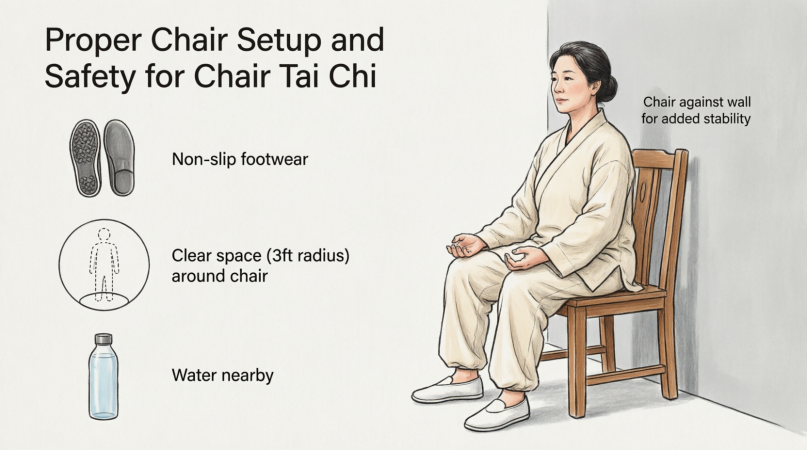
What You Need to Get Started
One of the greatest advantages of chair tai chi and qigong is their simplicity:
Required:
- A stable, armless chair that won’t slide around
- ymcanyc.org
- Comfortable clothing that allows free movement
- Bare feet or flat, non-slip shoes
Optional:
- A cushion for additional comfort
- A small towel for perspiration
- Water bottle nearby
- Calm, quiet space with good ventilation
Chair positioning tips:
- Sit on a firm surface (avoid overly soft chairs)
- Ensure your feet can rest flat on the floor
- Position the chair against a wall if extra stability is needed
- Leave space around you for arm movements
12 Essential Chair Tai Chi and Qigong Exercises
Beginner-Friendly Movements with Step-by-Step Instructions
Here are twelve foundational exercises you can start practicing today. Each movement should be performed slowly, with deep, natural breathing.
Exercise 1: Rising Hands (Commencing Form)
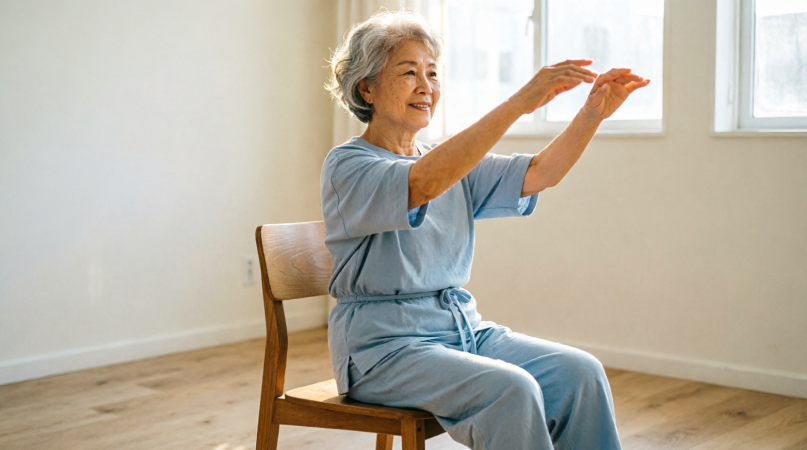
Benefits: Opens the chest, improves shoulder mobility, establishes breathing rhythm
Instructions:
- Sit tall with feet flat on the floor, hands resting on your thighs
- Inhale slowly as you raise both hands in front of you to chest height, palms facing down
- Exhale as you gently lower your hands back to the starting position
- Repeat 5-8 times
Breathing cue: Inhale as hands rise, exhale as hands lower.
Modification: Reduce range of motion if shoulder discomfort occurs.
Exercise 2: Seated Marching
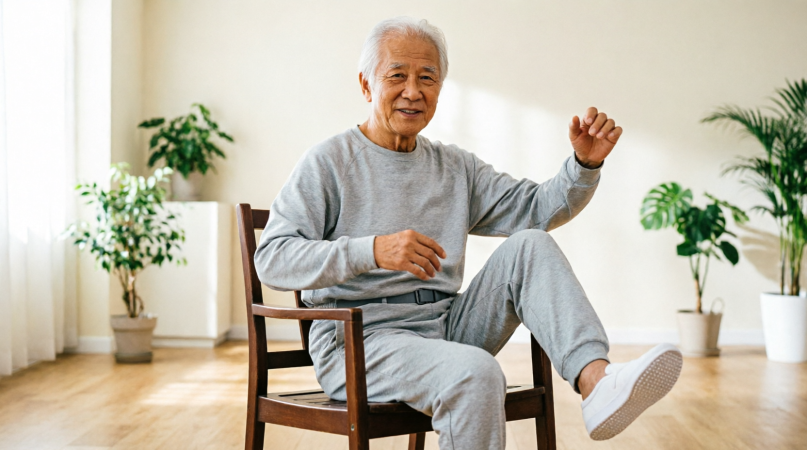
Benefits: Improves circulation, engages core, enhances coordination
Instructions:
- Sit tall with hands resting on thighs
- Slowly lift your right knee toward your chest (as high as comfortable)
- Lower right foot and lift left knee
- Continue alternating legs in a slow, controlled march
- Add arm movement: swing opposite arm forward as knee lifts
Duration: 30-60 seconds
Tip: Keep movements slow and deliberate—this isn’t aerobic exercise
Exercise 3: Waist Turn (Seated Spinal Twist)
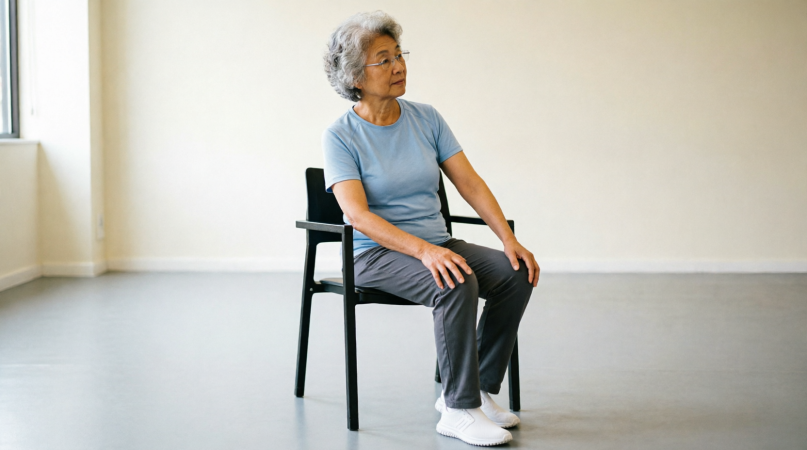
Benefits: Increases spinal mobility, aids digestion, relieves back tension
Instructions:
- Sit tall with feet flat, hands resting on knees
- Inhale to lengthen your spine
- Exhale as you gently twist to the right, placing your left hand on your right knee and right hand behind you on the chair back
- Hold for 2-3 breaths, looking over your right shoulder
- Return to center and repeat on the left side
- Perform 3-5 twists per side
Safety note: Move only within your comfortable range of motion
Exercise 4: Cloud Hands (Seated Version)
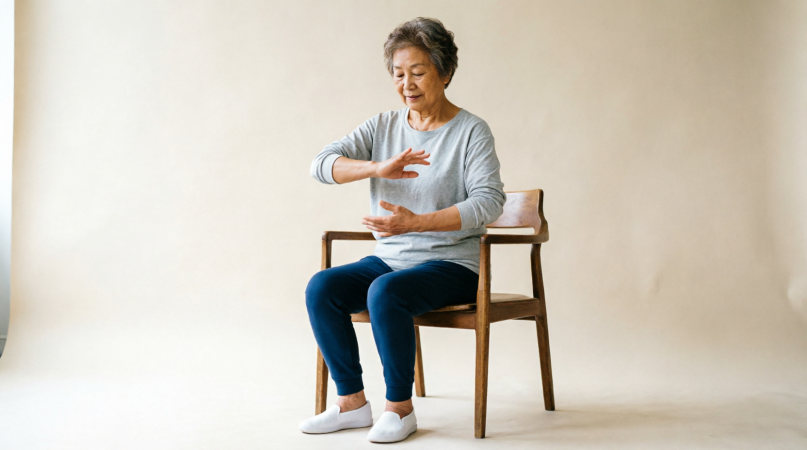
Benefits: Enhances hand-eye coordination, improves focus, gentle shoulder mobility
Instructions:
- Sit tall with feet shoulder-width apart
- Raise hands to chest height, palms facing each other as if holding a ball
- Slowly shift your upper body to the right while moving hands in a circular motion
- Right hand moves up and out, left hand moves down and in
- Reverse direction, shifting left while hands circle oppositely
- Continue flowing side to side for 1-2 minutes
Visualization: Imagine you’re gently parting clouds with your hands
Exercise 5: Single Push (Forward Palm Press)

Benefits: Strengthens arms, improves wrist flexibility, cultivates focused energy
Instructions:
- Begin with hands at chest height, palms facing each other
- Inhale as you draw hands toward your chest
- Exhale as you extend one hand forward, palm facing out, as if gently pushing against a wall
- Hold for 2 breaths, feeling the stretch through your arm and palm
- Return hand to chest and switch to the other side
- Repeat 5 times per side
Focus: Keep your shoulders relaxed and your extended arm slightly bent.
Exercise 6: Ankle and Wrist Circles
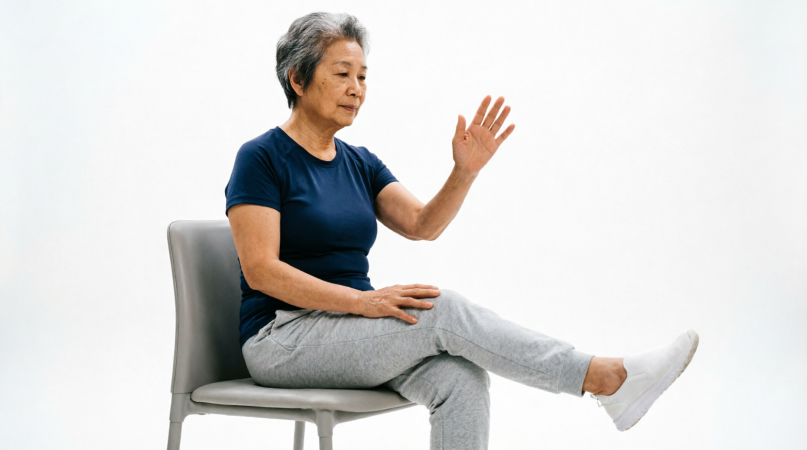
Benefits: Improves joint mobility, enhances circulation to extremities
Instructions:
- Lift your right foot slightly off the floor
- Slowly rotate ankle clockwise 5 times, then counterclockwise 5 times
- Simultaneously, rotate wrists in opposite directions
- Switch to left foot and repeat
- Perform 2-3 rounds per foot
Tip: Make circles as large as comfortable to maximize joint mobility
Exercise 7: Seated Cat-Cow (Spinal Flexion and Extension)
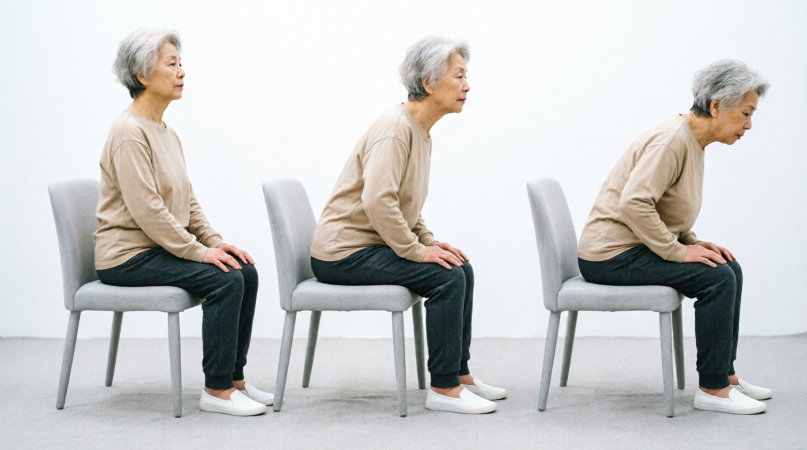
Benefits: Increases spinal flexibility, relieves back tension, improves posture
Instructions:
- Sit tall with hands on knees or thighs
- Cow position (inhale): Arch your back, lift your chest, look slightly upward, pull shoulders back
- Cat position (exhale): Round your spine, tuck your chin to chest, let shoulders roll forward
- Flow between these two positions slowly with your breath
- Repeat 8-10 times
Movement quality: Make transitions smooth and continuous
Exercise 8: Side Reach (Lateral Stretch)
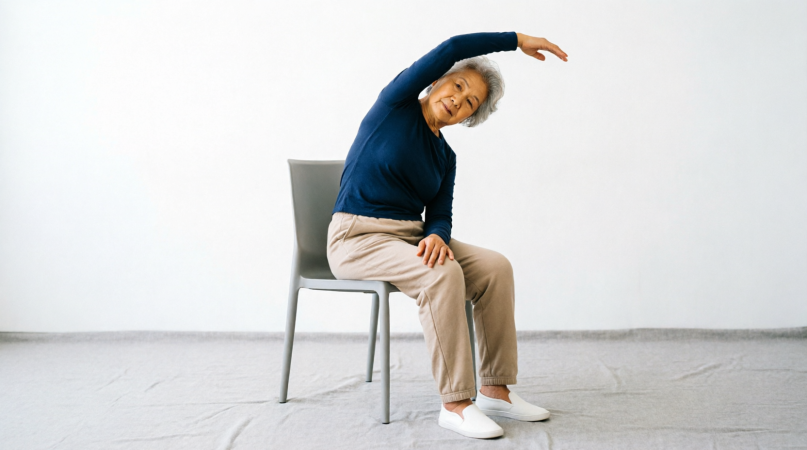
Benefits: Stretches side body, improves rib cage mobility, enhances breathing capacity
Instructions:
- Sit tall with feet flat, left hand resting on left thigh
- Inhale as you reach your right arm overhead to the left side
- Feel the stretch along your right side from hip to fingertips
- Hold for 2-3 breaths
- Exhale as you return to center
- Repeat on the other side
- Perform 3-5 reaches per side
Alignment cue: Keep both sitting bones connected to the chair
Exercise 9: Knee Extension (Leg Strengthening)
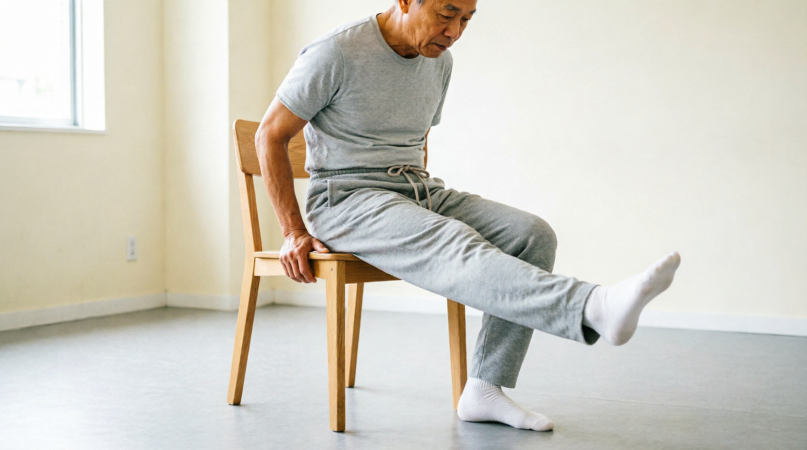
Benefits: Strengthens quadriceps, improves knee stability, enhances leg circulation
Instructions:
- Sit tall with feet flat on floor
- Slowly extend your right leg straight out in front of you
- Flex your foot, pointing toes toward ceiling
- Hold for 2-3 breaths, engaging thigh muscles
- Lower leg slowly back to floor
- Repeat with left leg
- Perform 8-10 extensions per leg
Progression: Add ankle weights (1-2 lbs) as strength improves
Exercise 10: Shoulder Rolls and Neck Release
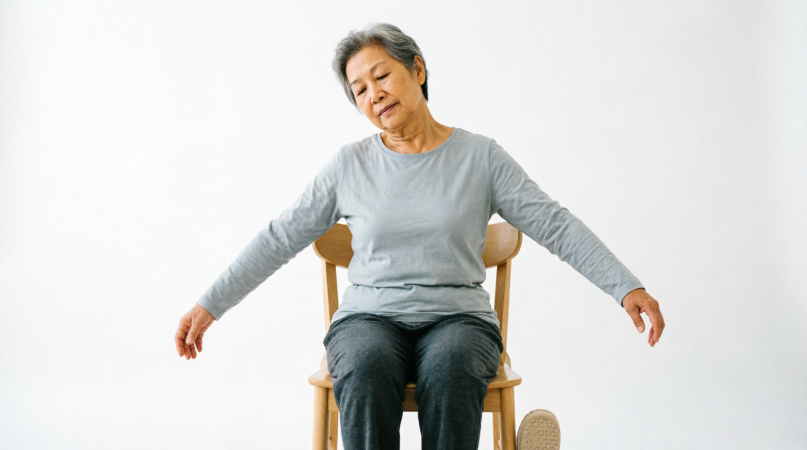
Benefits: Relieves neck and shoulder tension, improves posture, reduces headaches
Instructions:
- Sit tall with arms relaxed at your sides
- Slowly roll shoulders up toward ears, back, and down in a circular motion
- Perform 5 rolls backward, then 5 forward
- For neck release: gently tilt head to the right, bringing ear toward shoulder
- Hold for 2 breaths, then return to center
- Repeat on left side
- Finish with gentle chin-to-chest and looking-up stretches
Important: Never force neck stretches; move gently and slowly
Exercise 11: Abdominal Breathing (Diaphragmatic Breath)

Benefits: Reduces stress, improves oxygen exchange, activates relaxation response
Instructions:
- Sit comfortably with one hand on your chest, one on your belly
- Inhale slowly through your nose, allowing your belly to expand (chest should move minimally)
- Exhale slowly through pursed lips, feeling belly gently contract
- Continue for 2-5 minutes
- Focus on making exhalation longer than inhalation
Breathing ratio: Try inhaling for 4 counts, exhaling for 6-8 counts
Exercise 12: Closing Form (Gathering Qi)
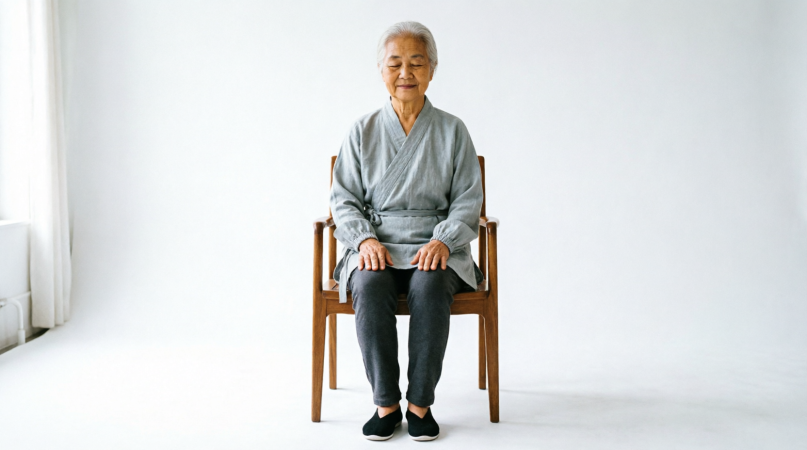
Benefits: Completes practice, integrates energy, promotes sense of calm
Instructions:
- Sit tall with hands resting on thighs
- Inhale as you raise hands in wide circles out to the sides and overhead
- Exhale as you bring hands down the centerline of your body, palms facing down
- Imagine gathering peaceful, healing energy with each movement
- Rest hands on your lap, palms up or down as feels comfortable
- Sit quietly for 1-2 minutes, noticing how you feel
Practice tip: This is an excellent meditation posture
Your 4-Week Chair Tai Chi Beginner Program
Progressive Plan for Building Your Practice
Following research-backed protocols, this progressive program gradually builds your practice from 10 minutes to 20 minutes daily
www.zenfit.health
www.strandbooks.com
Week 1: Foundation Building
Duration: 10 minutes daily
Routine:
- Abdominal Breathing (2 minutes)
- Rising Hands (2 minutes)
- Seated Marching (2 minutes)
- Waist Turn (2 minutes)
- Closing Form (2 minutes)
Goal: Establish daily practice habit and learn proper breathing
Week 2: Adding Movements
Duration: 12-15 minutes daily
Routine:
- Abdominal Breathing (2 minutes)
- Rising Hands (2 minutes)
- Cloud Hands (3 minutes)
- Single Push (2 minutes)
- Seated Cat-Cow (2 minutes)
- Closing Form (2 minutes)
Goal: Begin linking movements smoothly together
Week 3: Building Endurance
Duration: 15-18 minutes daily
Routine:
- Abdominal Breathing (2 minutes)
- Rising Hands (2 minutes)
- Seated Marching (2 minutes)
- Cloud Hands (3 minutes)
- Waist Turn (2 minutes)
- Side Reach (2 minutes)
- Knee Extension (2 minutes)
- Closing Form (2 minutes)
Goal: Increase practice duration and movement variety
Week 4: Complete Practice
Duration: 20 minutes daily
Routine:
- Abdominal Breathing (3 minutes)
- Rising Hands (2 minutes)
- Seated Marching (2 minutes)
- Waist Turn (2 minutes)
- Cloud Hands (3 minutes)
- Single Push (2 minutes)
- Ankle/Wrist Circles (2 minutes)
- Shoulder Rolls (2 minutes)
- Closing Form (2 minutes)
Goal: Establish a complete, sustainable daily practice
Safety Considerations and Modifications
Practicing Safely with Confidence
While chair tai chi and qigong are inherently safe, following these guidelines ensures a positive experience:
General Safety Tips:
- Consult your physician before beginning any new exercise program, especially if you have chronic health conditions
- www.zenfit.health
- Move only within your comfortable range of motion—never push into pain
- Keep movements slow and controlled; this isn’t about speed
- Stay hydrated by keeping water nearby
- Stop immediately if you experience dizziness, chest pain, or unusual discomfort
Common Modifications:
For Limited Shoulder Mobility:
- Reduce the height of arm movements
- Keep elbows slightly bent
- Focus on smaller, more comfortable ranges
For Back Pain:
- Place a small cushion behind your lower back for support
- Reduce the depth of twists
- Emphasize breathing exercises over movement
For Knee or Hip Issues:
- Keep feet closer together or farther apart for comfort
- Reduce leg lift height during marching
- Skip knee extensions if uncomfortable
For Wheelchair Users:
- Lock wheels before beginning practice
- All exercises can be adapted; focus on upper body and breathing
- Integrate wheelchair motions with flowing tai chi movements
- www.utc.edu
For Balance Concerns:
- Chair tai chi is ideal—you’re already seated!
- Research shows sitting tai chi improves balance control for those with poor standing balance
- pubmed.ncbi.nlm.nih.gov
Frequently Asked Questions (FAQ)
Answering Your Most Common Questions
Q: How long does it take to see benefits from chair tai chi?
A: Many people report feeling more relaxed and energized after just one session. Research-backed benefits like improved balance, strength, and cognitive function typically show significant improvement within 6 weeks of regular practice
taichihealth.com
. Even short 10-minute daily sessions can produce measurable results.
Q: Can I do chair tai chi if I’ve never exercised before?
A: Absolutely! Chair tai chi is specifically designed for beginners and requires no prior exercise experience. The movements are gentle, low-impact, and can be modified to suit any fitness level. Both tai chi and qigong are particularly suitable for older adults and beginners, as they’re implemented without aerobic and musculoskeletal strain
pmc.ncbi.nlm.nih.gov
.
Q: What’s the difference between chair yoga and chair tai chi?
A: While both are gentle seated practices, chair yoga typically involves holding static stretches and poses, while chair tai chi emphasizes continuous, flowing movements. Tai chi also places greater emphasis on martial arts principles and energy flow, though both improve flexibility, balance, and well-being.
Q: Do I need to memorize complex sequences?
A: No! Unlike traditional standing tai chi forms that can have 24-108 movements, chair tai chi can be practiced with simple, repetitive exercises. You can start with just 3-5 movements and gradually add more as you feel comfortable. The focus is on quality of movement, not quantity.
Q: Can chair tai chi help prevent falls?
A: Yes! Research has linked tai chi with better balance and fall prevention
www.thehouseofrose.com
. Sitting tai chi improves balance control and muscle strength, which translates to better stability even when standing
pubmed.ncbi.nlm.nih.gov
. Regular practice strengthens the muscles and improves proprioception (body awareness) needed for fall prevention.
Q: How is chair qigong different from meditation?
A: While both practices cultivate mindfulness and relaxation, chair qigong combines gentle physical movement with breath work and mental focus. Meditation is typically still and focuses primarily on the mind. Qigong integrates mind, body, and breath through movement, making it more accessible for those who find still meditation challenging.
Q: Can I practice if I have arthritis?
A: Yes, chair tai chi is excellent for arthritis management. The gentle movements help lubricate joints, increase blood flow, and reduce stiffness without putting stress on inflamed joints
www.carelink.org
. Many people with arthritis find that regular practice reduces pain and improves joint mobility. Always consult your healthcare provider first.
Q: Is chair tai chi effective for weight loss?
A: While chair tai chi isn’t primarily a weight-loss exercise, it can support healthy weight management by improving metabolism, reducing stress (which can lead to emotional eating), and increasing overall activity levels. For significant weight loss, combine chair tai chi with dietary changes and other forms of exercise as able.
Q: Can I practice chair tai chi at work?
A: Absolutely! Chair tai chi is perfect for the workplace. Simple exercises like seated marching, waist turns, and shoulder rolls can be done discreetly at your desk to reduce stress, improve circulation, and combat the negative effects of prolonged sitting.
Q: How often should I practice?
A: For best results, practice daily—even 10 minutes is beneficial. Research shows that consistent, shorter practices are more effective than occasional longer sessions. Aim for at least 3-5 times per week, gradually working up to daily practice
www.zenfit.health
.
Advanced Tips for Deepening Your Practice
Taking Your Chair Tai Chi to the Next Level
Once you’ve established a consistent practice, consider these enhancements:
1. Integrate Mindfulness
- Focus completely on each movement
- Notice sensations in your body without judgment
- Use visualization: imagine moving through water or parting clouds
2. Refine Your Breathing
- Gradually extend exhalation longer than inhalation
- Coordinate breath precisely with movement
- Practice abdominal breathing throughout the day
3. Explore Energy Awareness
- Notice warmth, tingling, or heaviness in your hands
- Visualize qi (energy) flowing through your body
- Practice sensing energy before and after each session
4. Add Variety
- Learn new movements from videos or classes
- Practice outdoors when possible for fresh air and nature connection
- Join online chair tai chi communities for support and inspiration
5. Track Your Progress
- Keep a practice journal noting how you feel before and after
- Record improvements in balance, flexibility, or mood
- Celebrate small victories and be patient with yourself
Resources and Next Steps
Continue Your Journey
Recommended Resources:
- Video tutorials: Look for seated tai chi and qigong videos from certified instructors
- Printable guides: Download exercise charts for easy reference (like the poster shown in our hero image)
- Online classes: Many instructors now offer virtual chair tai chi classes via Zoom
- Community programs: Check with local senior centers, YMCAs, and community centers
Books Worth Exploring:
- “Chair Tai Chi for Seniors Over 60” – Illustrated guides with 4-week programs
- www.strandbooks.com
- “Tai Chi Fundamentals Adapted Program: Seated Version” – Evidence-based approach
- www.zenfit.health
Finding an Instructor:
- Look for teachers certified in adaptive tai chi or tai chi for arthritis
- Many instructors now offer online one-on-one sessions
- Ask about their experience working with seniors and mobility limitations
Conclusion: Your Journey Starts Today
Chair tai chi and qigong offer a gentle, accessible path to better health, balance, and well-being—no standing, complex sequences, or expensive equipment required. Whether you’re managing mobility challenges, recovering from injury, or simply seeking a sustainable way to stay active as you age, these ancient practices adapted for modern needs can transform your daily life.
Remember:
- Start small with just 10 minutes a day
- Focus on consistency over perfection
- Listen to your body and honor your limits
- Celebrate every small improvement
- Be patient with yourself—this is a journey, not a destination
The research is clear: regular practice can improve balance, strengthen muscles, enhance cognitive function, reduce stress, and boost your overall quality of life
www.aarp.org
www.mcmasteroptimalaging.org
But you don’t need to take our word for it—experience the benefits yourself.
Your first practice is just a chair away.
Take a deep breath, sit tall, and begin with Rising Hands. Your future self will thank you.
Call to Action
Ready to begin your chair tai chi journey?
Remember: Every expert was once a beginner. Your practice starts where you are, with what you have. Today is the perfect day to begin.