Qigong Breathing, Taoist Breathing and Pranayama: Ida, Pingala and Niikura Ki Breathing Explained

By Sifu Dan Ferrera · Published October 11, 2026 · 14 min read
Quick answer: Qigong breathing, Taoist breathing and pranayama all train the same basics: slow, quiet, nasal breathing that moves the lower abdomen. They differ in language and technique. Qigong and Taoist methods usually focus on the lower dantian and abdominal breathing (natural or reverse). Pranayama adds named techniques like alternate nostril breathing, which works with the traditional channels ida (left, moon) and pingala (right, sun). Niikura ki breathing uses resistance through the front teeth to slow the inhale. Research on slow breathing shows benefits for heart rate variability and blood pressure. Claims about “energy” remain traditional and are not measured by current instruments.
Breath is the one part of your autonomic nervous system you can control directly. That is why almost every energy tradition, from Chinese qigong to Indian yoga to Japanese ki arts, starts with breathing. This guide explains how the major systems differ, what ida and pingala mean, how to practice Katsumi Niikura’s teeth breathing, and what modern studies say. Where a claim comes from tradition and not from measurement, I say so.
1. How qigong, Taoist and pranayama breathing compare
| Qigong breathing | Taoist (Daoist) breathing | Pranayama | |
|---|---|---|---|
| Origin | Chinese energy cultivation (qi gong, “energy work”) | Daoist internal practice; often linked to daoyin, sometimes called “Taoist yoga” | Indian yoga; “prana” (life force) + “ayama” (extension or control) |
| Typical focus | Lower dantian, breath coordinated with movement or standing posture | Abdominal, dantian, reverse and embryonic breathing | Named techniques: nadi shodhana, ujjayi, bhramari and others |
| Energy language | Qi, meridians, dantian | Qi, jing, shen, dantian | Prana, nadis (ida, pingala, sushumna), chakras |
| Common posture | Standing, moving or seated | Seated, meditation | Seated |
All three share a core idea: breathe slowly through the nose, let the lower abdomen move, and keep the mind quiet and aware. For a wider comparison of the arts, see Qigong vs. Tai Chi.
2. Qigong and Taoist breathing methods
Daoist teacher Zhou Xuan Yun describes four common types, summarized here (Daoist Breathing Techniques):
Embryonic breathing (tai xi): the breath becomes so quiet and effortless that you barely notice it.
Natural breathing (shun hu xi): the belly rises as you inhale and draws in as you exhale. It should be slow, deep, fine and even. This is where every beginner starts.
Reverse breathing (ni hu xi): the belly draws in as you inhale and pushes out as you exhale. It is used before meditation and is not meant to become your everyday breathing.
Dantian breathing: attention rests on the lower dantian, just below and behind the navel, while the belly and lower back move gently with the breath.
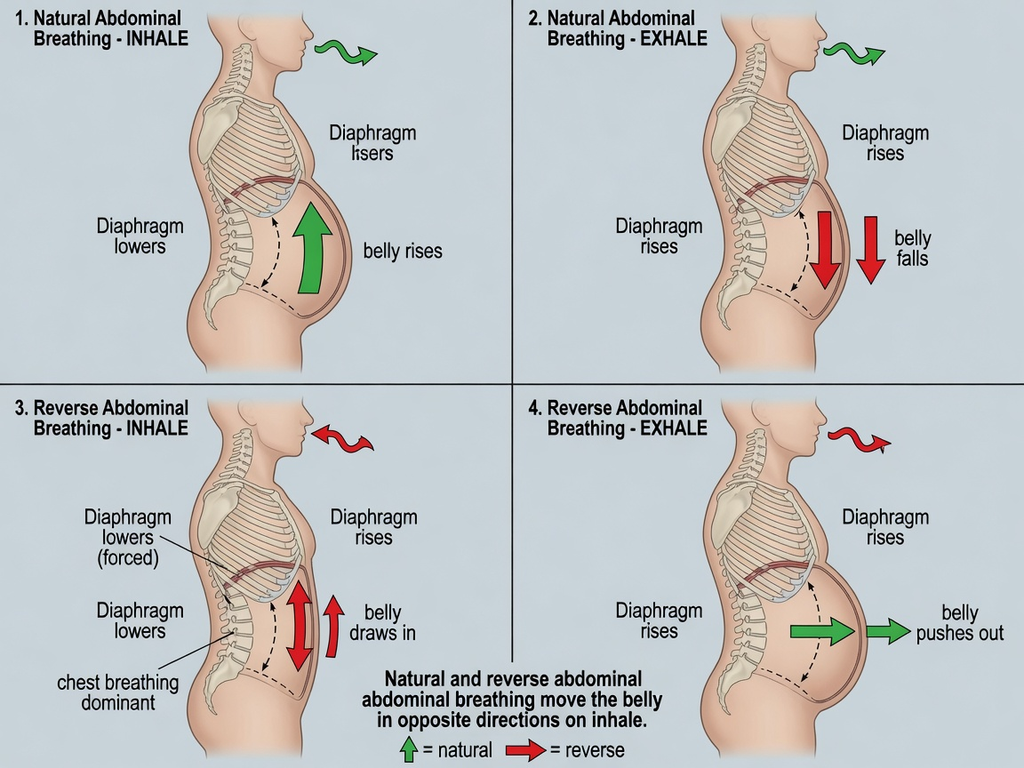
Learn them in order. Start with natural breathing, add smooth abdominal breathing, and try reverse breathing only after that, ideally with a teacher. The same Daoist article cautions that people with high blood pressure should avoid reverse breathing, and that straining the lower abdomen or pushing too hard upward can cause problems. In the lab, a 2025 study of 15 experienced tai chi practitioners found reverse abdominal breathing raised muscle force in several leg muscles during one movement, but the sample was small and had no control group (Yin et al., 2025).
3. Pranayama, ida and pingala
What are ida and pingala?
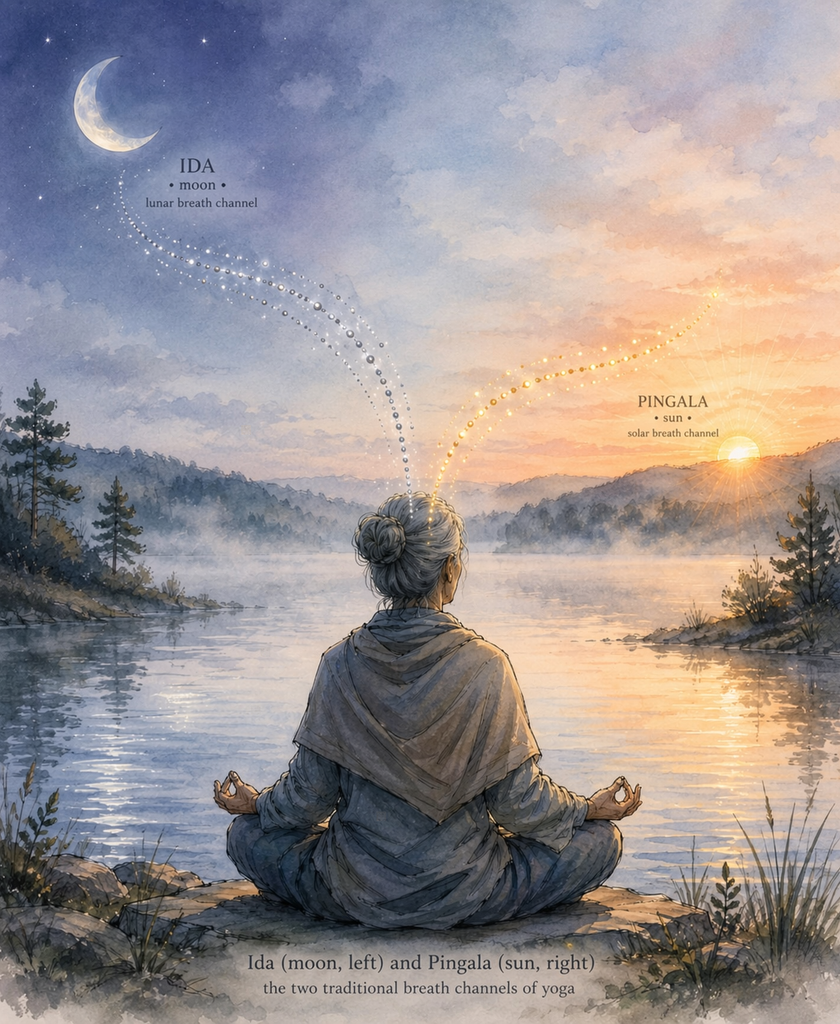
In the Hatha yoga tradition, the body holds thousands of channels called nadis. Three matter most: ida on the left, pingala on the right, and sushumna in the center. Ida is linked with the moon, cooling and calm, and the left nostril. Pingala is linked with the sun, warmth and activity, and the right nostril. Sushumna runs along the spine through the traditional energy centers (Nadi (yoga); Hridaya Yoga). The texts say ida and pingala wind around sushumna and meet at the brow.
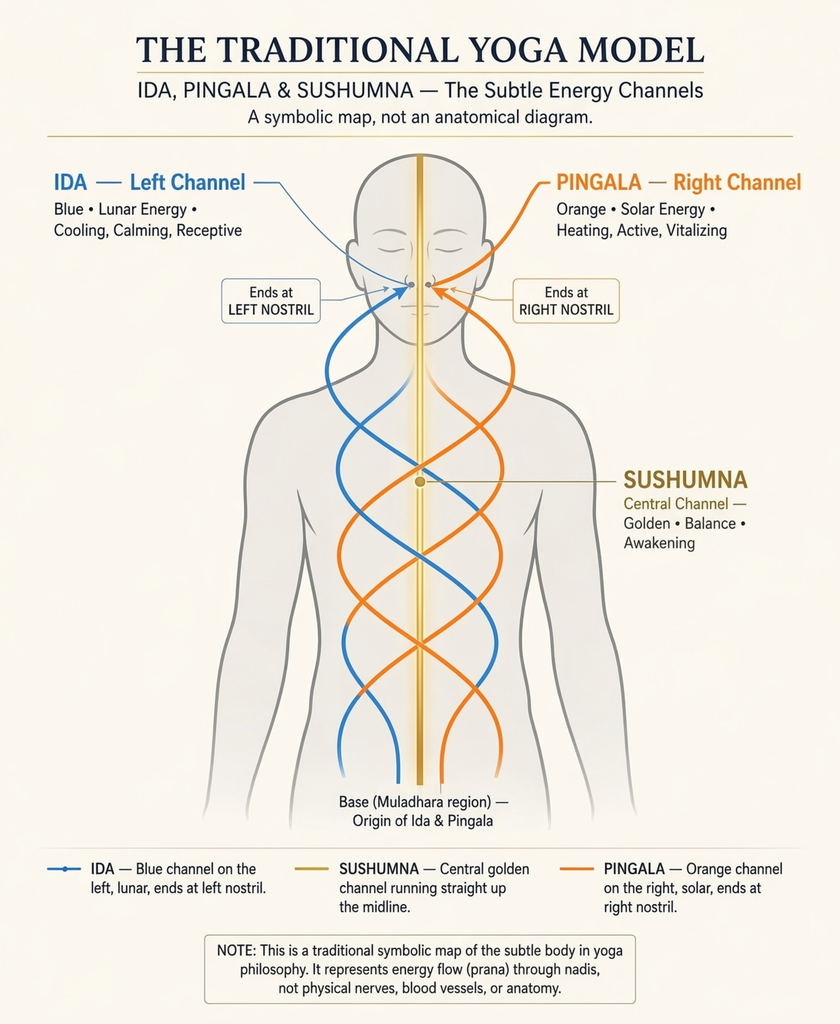
ome modern teachers read ida and pingala as the brain’s two hemispheres. That is an interpretation, and I treat it as such below.
Alternate nostril breathing (nadi shodhana)
Nadi shodhana means “channel purification.” It is the classic way to balance ida and pingala. Use your right hand: thumb closes the right nostril, ring finger closes the left.
- Close the right nostril. Inhale left slowly.
- Close the left nostril. Exhale right.
- Inhale right.
- Close the right nostril. Exhale left. That is one round.
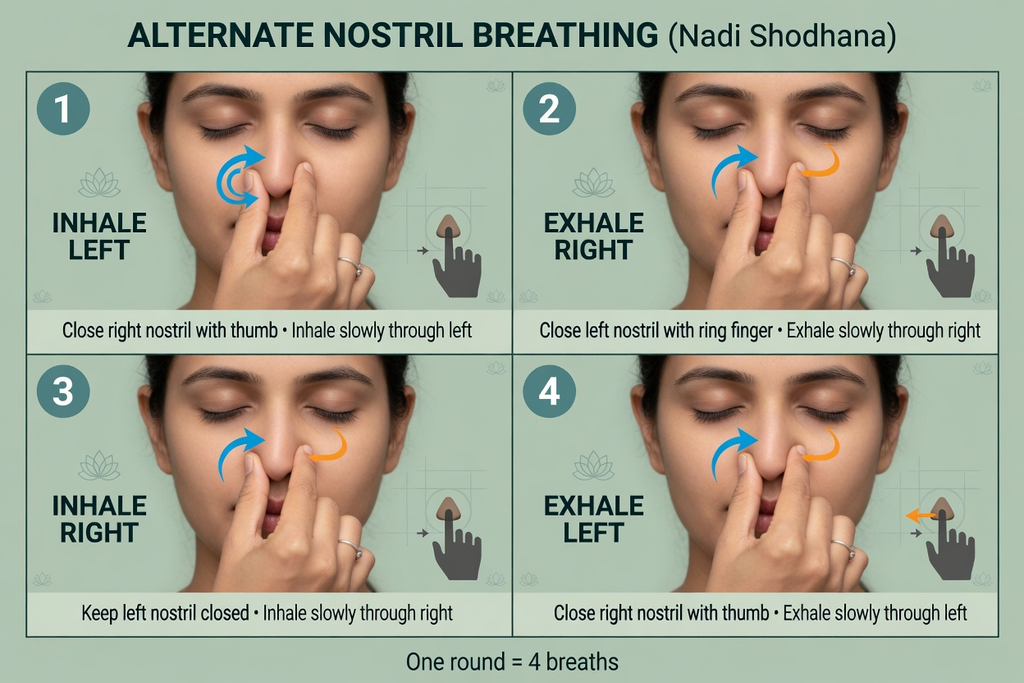
Begin with five rounds and keep the breath quiet, slow and without strain. Do not hold your breath unless an experienced teacher guides you.
Does nostril breathing stimulate one side of the brain?
The nose has a natural cycle in which one nostril is more open than the other, switching every few hours. A 1987 study in Human Neurobiology of five untrained people found that forcing breath through one nostril raised EEG amplitude in the opposite hemisphere (PubMed). A larger 2022 Scientific Reports study of 30 healthy adults found no simple opposite-side effect. Both nostrils affected both hemispheres, with right-nostril breathing linked to arousal and left-nostril breathing to calm (Niazi et al., 2022). That pattern echoes the traditional pairing of pingala (right, energizing) and ida (left, calming), though the authors call their results preliminary.
4. Niikura ki breathing (teeth breathing)
I trained for years under Katsumi Niikura Sensei and taught his system as a senior instructor. His method is distinctive because it uses teeth breathing exclusively. I have found similar teeth-breathing methods in some Malaysian and Indonesian energy systems, but Niikura’s system is built on it. The basic instructions I teach:
- Shape the mouth as if you were going to whistle.
- Inhale so the air passes through the two large front teeth. The resistance is the point: the more resistance, the better.
- Have the intent that the body is gathering ki or “life force” like a dry sponge absorbing water.
- Exhale with a soft “Shhhh,” radiating energy like a light bulb glowing brighter and brighter, toward the horizons and outer space.
Niikura Video Example

A simple practice to build your hara
Standing or lying down, do about a minute of full belly breaths with the teeth method. On the exhale the belly softens in a little, and on the inhale it slightly expands, like a balloon filling and releasing. Then feel the space between your palms. Practice for several minutes. If you want a guided version, see Katsumi Niikura’s Ki Breathing: Basic Four.
Tradition and measurement. In my teaching, restricting the inhale through the teeth is said to make the body “seek out” more life force than ordinary breathing. That is a traditional claim that current instruments cannot test. What we can say is more modest: the resistance slows the breath, and slow, quiet breathing is associated with calmer autonomic activity (see below). That second point is my inference, not a finding specific to teeth breathing. Practice gently and stop if you feel dizzy.
5. What the research shows about slow and yogic breathing
- Slow breathing and heart rate variability (HRV). A systematic review and meta-analysis of 223 studies found that voluntary slow breathing increased vagally mediated HRV during practice, right after a session and after multi-session training (Neuroscience & Biobehavioral Reviews).
- Blood pressure. A 2023 meta-analysis of 15 randomized trials of breathing exercises found systolic pressure fell by about 7 mm Hg and diastolic by about 3.4 mm Hg, with a small drop in heart rate (Garg et al., 2023).
- Alternate nostril breathing. A systematic review of 44 randomized trials, mostly in healthy people aged 8 to 70, reported positive effects on autonomic and cardiorespiratory measures and cognition. The author noted that techniques vary, and effects in clinical populations are not yet established (Ghiya, 2017).
- Pranayama for mental health conditions. A 2025 meta-analysis of six randomized trials (517 patients) found small short-term benefits for symptom severity versus passive controls, but the evidence was weak. Fast breathing such as kapalabhati had more reported side effects, and the authors said pranayama should not replace standard therapies (Mütze et al., 2025).

| What research measures | What tradition calls it | Practice |
|---|---|---|
| Higher vagally mediated HRV, lower blood pressure | Calming and harmonizing qi or prana | Slow natural breathing, 5 seconds in and out |
| Autonomic and cardiorespiratory changes | Balancing ida and pingala | Alternate nostril breathing |
| Slowed, resisted breath (my inference) | Gathering and radiating ki | Niikura teeth breathing |
For more on breathing and health outcomes, see our research summaries on blood pressure and heart health, breathing, COPD and sleep, and the science of qigong.
6. A 10-minute routine that combines all three
- Settle (1 minute). Sit tall on a chair or cushion, shoulders relaxed, jaw soft. Breathe through the nose.
- Natural abdominal breathing (2 minutes). Belly rises gently on the inhale and softens on the exhale. Attention rests on the lower dantian.
- Slow the pace (2 minutes). Breathe in for about 5 seconds and out for about 5.
- Alternate nostril breathing (3 minutes). Five rounds: inhale left, exhale right, inhale right, exhale left.
- Optional teeth breathing (2 minutes). Resisted inhale, soft “Shhh,” with the visualization described above.
- Rest (1 minute). Return to normal nasal breathing and notice how you feel.
If you are new to qigong, a good next step is the free 10-day standing practice or Qigong 101. For emotional balance, pair breathing with the Inner Smile and Six Healing Sounds.
7. Safety notes
- Never strain. The breath should feel quiet and easy, never forced.
- Stop if you feel dizzy, lightheaded, tingling or short of breath, and return to normal breathing.
- Skip breath holding and fast breathing (such as kapalabhati) unless an experienced teacher guides you.
- Learn reverse breathing only after natural abdominal breathing, and avoid it if you have high blood pressure, reflux or hernia concerns without medical advice.
- If you have a heart, lung or blood-pressure condition, are pregnant, or take medication, check with your doctor first. Breathing practice supports medical care. It does not replace it.
8. Frequently asked questions
What is the difference between qigong breathing and pranayama?
Qigong breathing is usually coordinated with movement or standing posture and focuses on the lower abdomen (dantian). Pranayama is the yogic practice of regulating breath, often seated, with named techniques like alternate nostril breathing. Both slow and deepen the breath, and each describes a life force (qi or prana) in its own language.
What are ida and pingala?
They are two traditional energy channels that run on either side of the spine and cross the central channel, sushumna. Ida is linked with the left side, the moon and calm. Pingala is linked with the right side, the sun and energy. They are a traditional model, not anatomical structures.
What is alternate nostril breathing good for?
Traditionally it balances ida and pingala and calms the mind. A review of 44 randomized trials reported benefits for autonomic and cardiorespiratory measures, mostly in healthy people, with effects in clinical populations still unestablished.
Does breathing through one nostril activate one side of the brain?
A small 1987 study of five people found higher EEG amplitude in the hemisphere opposite the open nostril. A 2022 study of 30 adults did not support a simple opposite-side effect and suggested right-nostril breathing relates to arousal and left-nostril breathing to calm. The evidence is preliminary.
What is Niikura ki breathing?
It is the teeth breathing method taught by Katsumi Niikura Sensei. You shape the mouth as if to whistle, inhale through the two large front teeth to create resistance, and exhale a soft “Shhh” while visualizing energy drawn in and radiated out.
Is reverse abdominal breathing safe?
Learn natural abdominal breathing first. One Daoist teacher advises people with high blood pressure to avoid reverse breathing, and warns that too much pressure on the lower abdomen can cause problems. Learn it from an experienced teacher and check with your doctor.
How long should I practice each day?
Ten minutes a day is a good start. Regular, gentle practice is easier to sustain than occasional long sessions.
Does slow breathing improve heart rate variability?
Yes. A meta-analysis of 223 studies found voluntary slow breathing increased vagally mediated HRV during practice, immediately afterward and after multi-session training.
Put the breathing to work
Start with the free 10-day standing practice, learn Niikura’s method in Ki Breathing: Basic Four, or go deeper with Qigong 101. Not sure where to begin? Start here.
Sources
- Zhou Xuan Yun. Daoist Breathing Techniques (YMAA).
- Yin Y, et al. 2025. Reverse abdominal breathing in Tai Chi Chuan. Frontiers in Bioengineering and Biotechnology, 13:1579139. Link
- Nadi (yoga), Wikipedia; The Three Main Nadis, Hridaya Yoga.
- Selective hemispheric stimulation by unilateral forced nostril breathing. Human Neurobiology, 1987;6(3):165-71. PubMed
- Niazi IK, et al. 2022. Scientific Reports, 12:520. Link
- Effects of voluntary slow breathing on heart rate and heart rate variability: a systematic review and meta-analysis. Neuroscience & Biobehavioral Reviews. Link
- Garg P, et al. 2023. Effect of breathing exercises on blood pressure and heart rate. Int J Cardiol Cardiovasc Risk Prev, 20:200232. Link
- Ghiya S. 2017. Alternate nostril breathing: a systematic review of clinical trials. Int J Res Med Sci, 5(8):3273-3286. Link
- Mütze C, Mitzinger D, Haller H. 2025. Effectiveness of pranayama for mental disorders. Frontiers in Psychiatry, 16. Link
Breathing practices described here are traditional and educational. They are not medical advice. If you have a medical condition, check with your doctor before starting.