Tai Chi for Seniors: Balance and Fall Prevention with Current Research

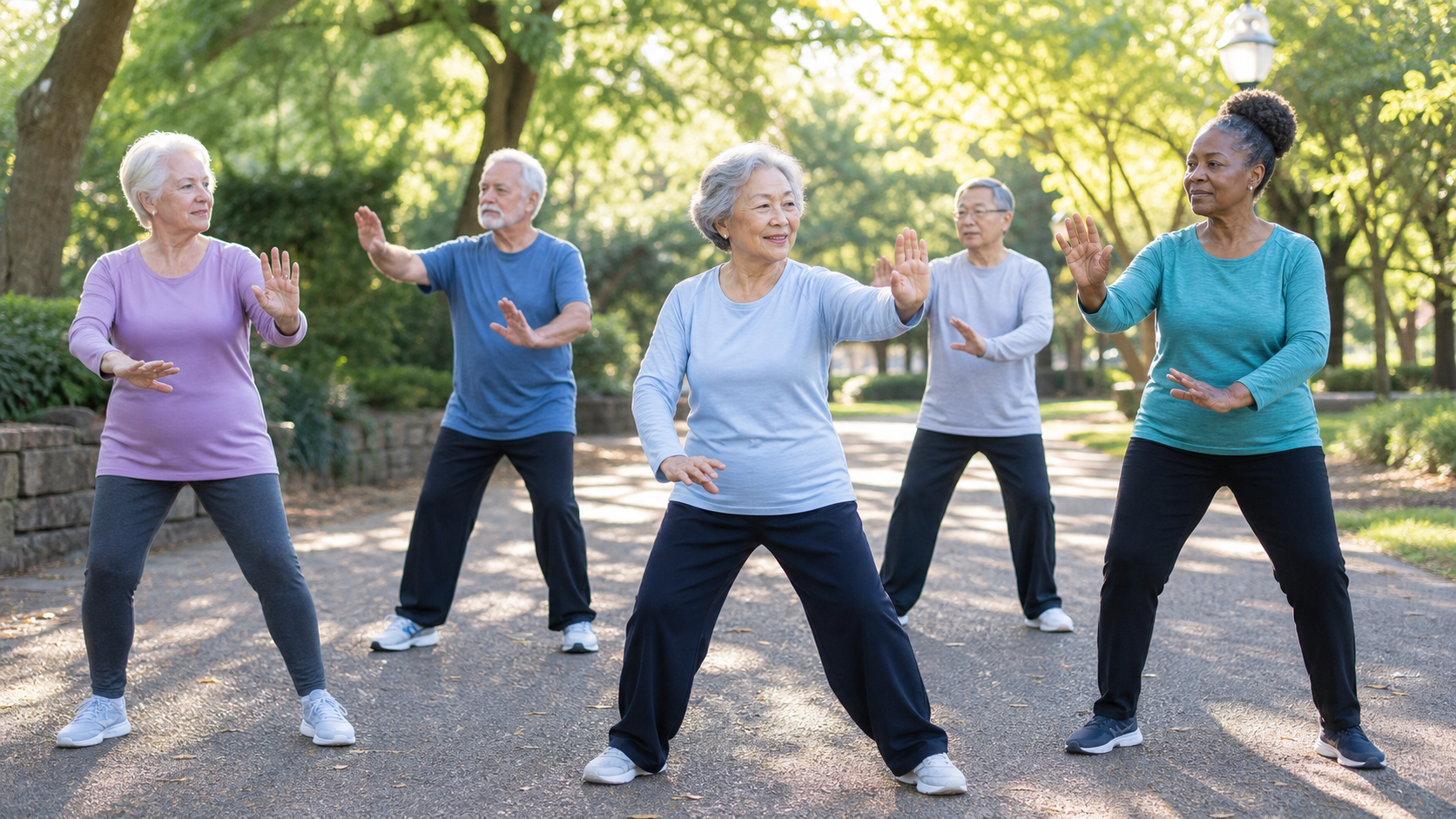
Quick answer: yes — tai chi is one of the better-studied exercises for balance and fall prevention in older adults. A 2026 systematic review and meta-analysis included 21 randomised trials covering 2,408 healthy older adults. Across the included studies, programmes ranged from two to four sessions per week, 30 to 90 minutes per session, and four to 26 weeks; the review found improvements in balance measures, walking speed, and fear of falling while noting substantial variation between studies. In clinical populations the effect is also promising: in the landmark NEJM Parkinson’s trial, tai chi cut falls by about two-thirds versus stretching. And because many tai chi sessions begin with standing qigong, you can adapt the practice to your age, mobility, and balance level.
This article is for the 50+ demographic, for their adult children, and for anyone training balance after injury. It covers what the research actually shows (including the right dose), a 4-week home programme you can start today, and the safety rules that keep tai chi gentle enough for arthritic joints.
What the evidence says (and the right dose)
Three levels of evidence, each stronger than the last in a different way:
- Healthy older adults — the 2026 meta-analysis. 21 randomised trials, 2,408 participants: tai chi significantly improved balance ability, walking speed and confidence in preventing falls. The included programmes ranged from two to four sessions per week, 30 to 90 minutes per session, and four to 26 weeks. Subgroup analyses found stronger Timed Up and Go results in the 10–26-week and under-one-hour groups, but the review reported substantial heterogeneity; these findings should not be treated as a universal prescription. (Figures from the published meta-analysis; we’ve linked the review in our research hub.)
- Older adults overall — falls reduction. A 2023 systematic review and meta-analysis of 24 randomised trials found tai chi significantly reduced the risk of falling (roughly a quarter fewer falls) and reduced the number of falls per person, with effects growing as practice duration and frequency increased.
- Clinical populations — the NEJM Parkinson’s trial. The most cited result in the whole field: tai chi improved balance and motor function in people with Parkinson’s disease and cut fall incidence by about two-thirds compared with a stretching programme. That trial is the reason physical therapists now routinely prescribe tai chi. Our review of the Parkinson’s and brain research ?
The pattern across all three: tai chi works for balance because it trains exactly the things that fail in real falls — slow weight-shifting, single-leg control, pivoting, and reacting while moving. Walking improves aerobic fitness but rarely trains pivots; resistance training builds strength but rarely trains controlled falling. Tai chi does all of it at low impact.
Why it works (three mechanisms)
- Dynamic balance training. Weight shifting between legs at slow speed trains the proprioceptive and reactive systems — the same systems that catch you when you miss a step. The 2026 meta-analysis reported walking-speed improvements in this area: your legs learn to move with intention.
- Leg strength without joint load. Deep, slow stances build the quadriceps, glutes and ankles — the fall-protection muscles — at a fraction of the joint stress of stair work or jumping drills. That’s why it’s tolerable with arthritis.
- The nervous system. Slow breathing and soft attention downshift stress (the same mechanism behind qigong’s anxiety results). A calmer nervous system reacts faster and steadier — and many older adults’ balance problems are as much “startle and stiffen” as they are weakness.
A 4-week home programme (3× per week, 20–30 min)
A practical starting plan within the range studied in the research, 4+ weeks. You need a sturdy chair for support and about 2 m × 2 m of floor. If you’re new to the practice entirely, the free 10-day standing guide is the perfect warm-up layer.
| Week | Each session (20–30 min) | Focus |
|---|---|---|
| 1 | 5 min gentle loosening (wrists, ankles, hips) ? 10 min standing qigong (Zhang Zhuang) holding the “hanging” posture, hands on hips or in the “holding a balloon” position ? 5 min slow weight-shifting in place ? 5 min standing still, eyes closed (spotting the chair) | Find the posture, learn the breath |
| 2 | Same warm-up ? 12 min: slow forward-back and side-to-side weight shifts, then tai chi “cloud hands” (Wave Hands Like Clouds) slowly, arms only or with small steps ? 5 min heel-to-toe standing ? 3 min quiet standing | Weight-shifting control |
| 3 | Warm-up ? 12 min cloud hands with small steps ? 8 min: single-leg stands (hands near the chair), 30 sec each side, 4 rounds ? 5 min slow pivots (turning 90° through the feet) ? 3 min quiet standing | Single-leg & pivot control |
| 4 | Warm-up ? 15 min: a simple 5-movement tai chi sequence (cloud hands, step-and-turn, two hands hold up the heavens, gentle “bow” reach, closing) ? 8 min single-leg stands + pivots ? 4 min quiet standing, eyes closed | Fluency — the movements become automatic |
After week 4, the natural next step is a proper form (24-movement tai chi is the standard) or the structured bridge course: Tai Chi Ruler Qigong, which is the internal-energy foundation every serious tai chi curriculum starts with. And if balance concerns are serious — more than one fall a year, unsteadiness with daily tasks — get a balance assessment first; tai chi is a superb companion to physiotherapy, not a substitute for evaluation.
Safety rules (keep it gentle enough for arthritic joints)
- Support is allowed. Do everything within reach of a sturdy chair or wall. Using support is not cheating; it’s how the programme stays safe while you build capacity.
- Stay in the pain-free range. Knees should never grind, hips should never ache. Reduce depth rather than skip the movement — a shallow stance still trains the system.
- Lower slowly, never collapse. The most common tai chi injury is a hurried descent. Control the way down like you’re lowering a lantern on a string.
- Stop for dizziness. If standing still makes you dizzy, sit down and resume with shorter holds. Persistent dizziness deserves a doctor’s check.
- Feet on stable ground. No carpet edges, no rugs that slide, no wet floors. The practice is safe because it’s controlled — the floor should be too.
Tai chi vs walking vs strength training — for falls, which wins?
All three matter; they train different things:
| Tai chi | Walking | Strength training | |
|---|---|---|---|
| Dynamic balance & pivots | Excellent | Poor | Poor–moderate |
| Leg strength | Moderate | Moderate | Excellent |
| Aerobic fitness | Moderate | Excellent | Moderate |
| Joint impact | Very low | Low | Variable |
| Neural calming | Excellent | Moderate | Moderate |
The research-optimal combination for older adults is tai chi 3×/week + daily walking + strength work 2×/week. If you can only add one thing and balance is the concern, the evidence says: tai chi.
Starting younger? Same practice, longer runway
If you’re reading this at 35–50, the same programme is arguably the best insurance you can buy: fall risk compounds silently, and the balance systems respond to training at any age. Our Qigong 101 course is the natural entry — posture, breath, and the felt sense of energy — with the standing work as your daily base. The 2025 dose (3×/week, 10–26 weeks) is exactly how long most people take to build a stable daily practice, which is nice alignment.
Frequently asked questions
Is tai chi good for seniors?
Yes — it’s one of the best-evidenced exercises for older adults. A 2026 meta-analysis of 21 randomised trials (2,408 healthy older adults) found tai chi significantly improved balance, walking speed and confidence in preventing falls, with the strongest results at three or more sessions per week over 10–26 weeks, with sessions under an hour.
How does tai chi prevent falls?
Through three mechanisms: weight-shifting practice improves dynamic balance and reaction time, slow stepping builds leg strength and ankle stability, and the single-leg and pivot positions train the exact movements that fail in real-life falls. In the landmark NEJM Parkinson’s trial, tai chi cut fall incidence by about two-thirds versus a stretching programme.
How much tai chi do you need for balance benefits?
The evidence-based dose is three or more sessions per week, each under an hour, sustained over 10–26 weeks. Effects grow with both frequency and total duration; shorter or sparser practice still helps but shows smaller improvements. For most people, 3×20-minute home sessions a week is the practical target.
Can people with arthritis do tai chi?
Yes — tai chi’s low-impact, slow, controlled movements make it one of the more joint-friendly balance trainings. Stay in the pain-free range, reduce stance depth rather than skipping movements, and use a sturdy chair for support. If you have a diagnosed joint condition, check the specific movement limits with your doctor or physiotherapist first.
Which is better for fall prevention: tai chi, walking or strength training?
For balance and pivot control specifically, tai chi is the most direct training and has the strongest clinical evidence (including a two-thirds fall reduction in the NEJM Parkinson’s trial). Walking adds aerobic fitness; strength training adds leg strength. The optimal combination is all three — tai chi 3×/week, daily walking, strength 2×/week.
Primary sources: Dong et al., Frontiers in Public Health (published January 5, 2026), a 21-trial review of 2,408 healthy older adults; and Chen et al., 2023, a 24-trial review reporting a relative risk of 0.76 for falls.