Eight Brocades (Ba Duan Jin) Qigong: The Complete Beginner’s Guide

Quick answer: the Eight Brocades (Ba Duan Jin, ???) is the world’s most popular beginner qigong set — eight slow, full-body movements, each one simple enough to learn on day one, performed as a complete 8–12 minute routine. It dates back at least to the Song dynasty (960–1279), is taught today in Chinese schools, hospitals and parks, and is the standard first prescription for elderly health programmes in China. You need no equipment, no experience and no belief system — just a few square metres of floor.
Each of the eight movements is traditionally paired with an organ system in Chinese medicine, and together the set gives you: a spine mobility pass, a lung-opening pass, a digestion pass, a kidney-and-waist pass, a strength pass, and a full-body nervous-system shake-out. In this guide you get every movement in plain English, a complete 12-minute routine, and an honest comparison with the standing methods we teach here.
What “Eight Brocades” means
The name comes from the set’s structure: eight pieces, each as valuable as a brocade cloth — rich, distinct, and woven into one whole. The oldest written descriptions appear in Song dynasty texts, and the form has been refined by generations of practitioners since. What you see in any modern park in China — hundreds of people moving through the same eight postures in the morning — is the same core set, done at a comfortable pace and held with quiet attention.
Three things make it the ideal first qigong set:
- It’s complete. Eight movements cover the whole body — no missing piece, no “advanced” secret you’re locked out of.
- It’s scalable. Each posture can be done sitting, standing, small, or large. An 80-year-old with knee pain does the same set as a young office worker, just with a different range.
- It’s a routine, not a puzzle. Once learned, the whole set runs 8–12 minutes. There is no memorising 60 postures (as in a Tai Chi form) before the internal work begins.
The eight movements
Names vary between teachers; below are the most common English names, the Chinese, and what each movement actually does in your body. Repeat each posture 6–12 times (or hold the flowing ones for 6–12 breaths), breathing naturally and slowly throughout. Learn one per day if you like — most people complete the basic set within two or three sessions.
1. Two Hands Hold Up the Heavens (Shuang Shou Tuo Tian)
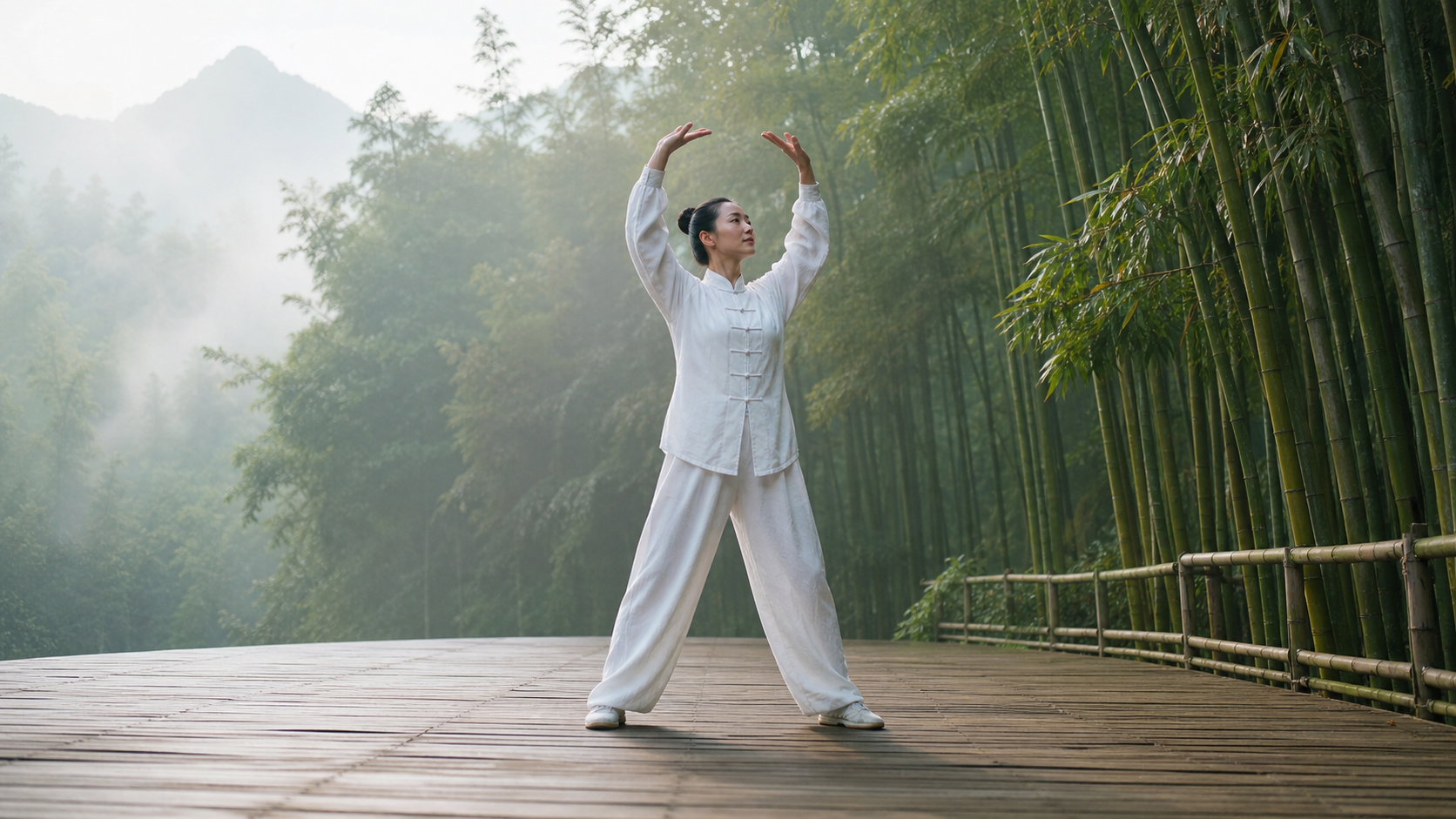
The classic opening posture: hands clasped low in front of the dantian, then raised overhead with the palms turning to face the sky as you rise onto the toes; lower slowly in a wide arc. In traditional terms it opens the triple-warmer channel and improves overall circulation; practically, it gives you a full-body stretch that lengthens the side body, wakes the arms, and sets a slow tempo for the whole routine. It is the movement most often taught to people who are stiff, tired, or sitting all day.
2. Drawing the Bow to Shoot the Eagle (Zuo You Kai Gong Si She Diao)
Step wide, then “draw the bow”: one arm pushing, one arm drawing a bowstring back to the temple, eyes following the drawing hand — switching sides each repetition. Traditionally it strengthens the lungs and opens the chest. In practice it’s a gentle isometric that opens the ribs, builds shoulder stability, and improves the posture of breathing — which is why it’s a standard element of respiratory health programmes.
3. Separating Heaven and Earth (Tiao Li Pi Wei Xu Dan Ju)
One hand presses down, the other lifts up, in a smooth opposite diagonal — heaven and earth pulling apart. This is the digestion movement: traditionally it tonifies the spleen and stomach, and physically it massages the abdominal organs through the long lateral stretch, opens the obliques, and mobilises the lower back. Most people feel it immediately in the side of the waist.
4. The Wise Owl Gazes Backward (Wu Lao Qi Shang Wang Hou Qiao)
Hands pressing on the thighs, the torso rotates slowly from side to side with the gaze following over the shoulder — the “hundred-disease” release. It’s a complete mobilisation of the spine: every vertebra, every rib joint, the neck and shoulders. Traditionally said to “prevent a hundred diseases” because the spine and the central channels run together; practically it’s the best 90 seconds of spinal health you can do for an office worker.
5. Sway the Head and Swing the Tail (Yao Tou Bai Wei Qu Xin Huo)
A deep, controlled side-bend from the hips: one arm reaching overhead, the body “swaying” like a tail, the head leading. Traditionally it “removes heart fire” — the Traditional Chinese Medicine term for irritability, insomnia and a racing mind. Physically it’s a long lateral stretch of the entire side body plus a gentle hip opener, and it’s the movement most people find they keep coming back to.
6. Two Hands Hold the Feet to Nourish the Kidneys (Liang Shou Pan Zu Gu Shen Yao)
From the waist, fold forward to grasp the ankles (or shins), then return to standing with the arms rising overhead. The kidney-and-waist movement: in TCM the kidneys govern the lower back, the bones and the deep energy reserve. Physically it’s a full yin stretch — hamstrings, calves, the entire front line — plus a gentle forward-fold that drains pressure from the head. Modify it as much as you need: shins, knees, or a supported hold.
7. Clench the Fists and Glare Fiercely (Zuan Quan Nu Mu Zeng Qi Li)
The power movement: stand tall, clench both fists, and “growl” the eyes — a moment of deliberate, controlled intensity, then release. Traditionally it builds the liver’s energy, courage and strength. In practice it’s a full-body isometric: legs locked, core braced, fists driven upward, breath held for a moment, then released with a long exhale. It’s the only forceful posture in the set, and it’s short — the point is the contrast between the force and the release.
8. Bouncing on the Toes (Bei Hou Qi Dian Bai Bing Xiao)
The closing shake-out: rise onto the toes with the palms behind the back, then let the heels drop and the whole body gently “shake” — repeating 6–12 times. This stimulates the central nervous system and the vestibular system, drains the legs, and “shakes off” the tension accumulated through the routine. It’s the movement the Chinese say “disperses a hundred ailments” — the full-body reset that ends the set.
A complete 12-minute routine
| # | Movement | Time | Focus |
|---|---|---|---|
| 0 | Centering: feet together, one long breath, settle the shoulders | 30 sec | Arrive |
| 1 | Two Hands Hold Up the Heavens | ~90 sec | Lengthen, warm up |
| 2 | Drawing the Bow to Shoot the Eagle | ~90 sec | Chest, lungs |
| 3 | Separating Heaven and Earth | ~90 sec | Waist, digestion |
| 4 | The Wise Owl Gazes Backward | ~90 sec | Spine |
| 5 | Sway the Head and Swing the Tail | ~90 sec | Side body, calm |
| 6 | Two Hands Hold the Feet | ~90 sec | Kidneys, hamstrings |
| 7 | Clench the Fists and Glare Fiercely | ~60 sec | Power, release |
| 8 | Bouncing on the Toes | ~60 sec | Shake-out |
| 9 | Close: hands on the lower dantian, three slow breaths | 30 sec | Store the energy |
Practise once or twice daily — commonly in the morning for energy and in the evening for calm. If you only have five minutes, do postures 1, 4 and 8: they give you the full-body benefit in miniature.
Eight Brocades vs standing qigong vs Tai Chi Ruler Qigong
The Eight Brocades is a set; the standing work (Zhang Zhuang) and the Ruler Qigong sets we teach are cultivation methods. They develop different things, and they stack well:
| Eight Brocades | Standing qigong (Zhang Zhuang) | Tai Chi Ruler Qigong | |
|---|---|---|---|
| Type | Moving set (8 postures) | Stillness (one held posture) | Structured internal set |
| Time to first benefit | Days | 1–2 weeks | 2–4 weeks |
| Best for | Whole-body movement, circulation, routine | Building deep energy, focus, stillness | Structure, internal strength, bridging to Tai Chi |
| Energy development | Moderate | Deep | Deep |
| Space needed | A room | Enough to stand | A room |
| Starts with | Movement | Stillness | Method |