Qigong for Sleep: A 10-Minute Bedtime Practice (Research-Backed)

Quick answer: yes — qigong is one of the better-evidenced things you can do for sleep. The core idea is simple: sleep problems are usually a nervous system that can’t downshift, and qigong is a 10-minute daily training for exactly that downshift — slow movement, long exhales, and gentle attention. The version that works best is a short evening routine practised 60–120 minutes before bed, and most people notice calmer evenings within a week and measurably better sleep within two to four weeks of daily practice.
This is not a relaxation trick you do on bad nights. It’s a daily skill — the same distinction that makes all of qigong work (see our plain-English verdict on the science). Below is the routine, the timing rules, and the honest limits.
Why sleep is usually the first thing qigong fixes
Most insomnia and restless sleep are not “lack of tiredness” — they are a nervous system stuck in the stress mode. Racing thoughts at 2 a.m., a heart that won’t slow down, a body that feels wired: all of it is the sympathetic (fight-or-flight) system failing to hand over to the parasympathetic (rest-and-digest) system.
Qigong trains that handover directly, three ways at once:
- Slow breathing with long exhales — the exhale is the brake pedal of the autonomic nervous system. Lengthening it is one of the fastest known ways to lower heart rate and blood pressure (the same mechanism behind the blood pressure results in the JAMA trial).
- Gentle movement — loosening the shoulders, jaw and hips releases the physical tension that keeps the body in “ready” mode, without the adrenaline spike that vigorous evening exercise creates.
- Soft attention — resting awareness on the breath or the body (the Inner Smile, below) quiets the default-mode rumination loop that anxious sleepers live in.
The research supports it: trials in adults with chronic insomnia — including older adults — found that regular qigong practice improved sleep quality, with people falling asleep faster and staying asleep longer (see our research review on tai chi, breathing and sleep). And because the same practice also lowers baseline stress (40 studies, 3,800+ participants, review here), the sleep benefit compounds: calmer days produce calmer nights.
The 10-minute bedtime routine
Three parts, in order. Do it in a dim room, 60–120 minutes before bed — early enough to matter, late enough that it clearly belongs to the wind-down. No screens during it; after it, screens off.
| Part | Practice | Time | What to do |
|---|---|---|---|
| 1 | Gentle loosening | 3 min | Shoulder rolls, slow neck circles, jaw released, a few deep breaths through the nose. The goal is to tell the body the day is over. |
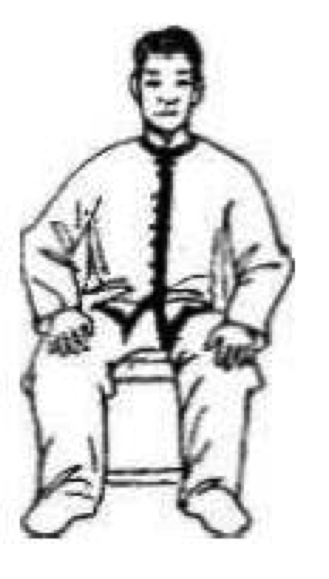
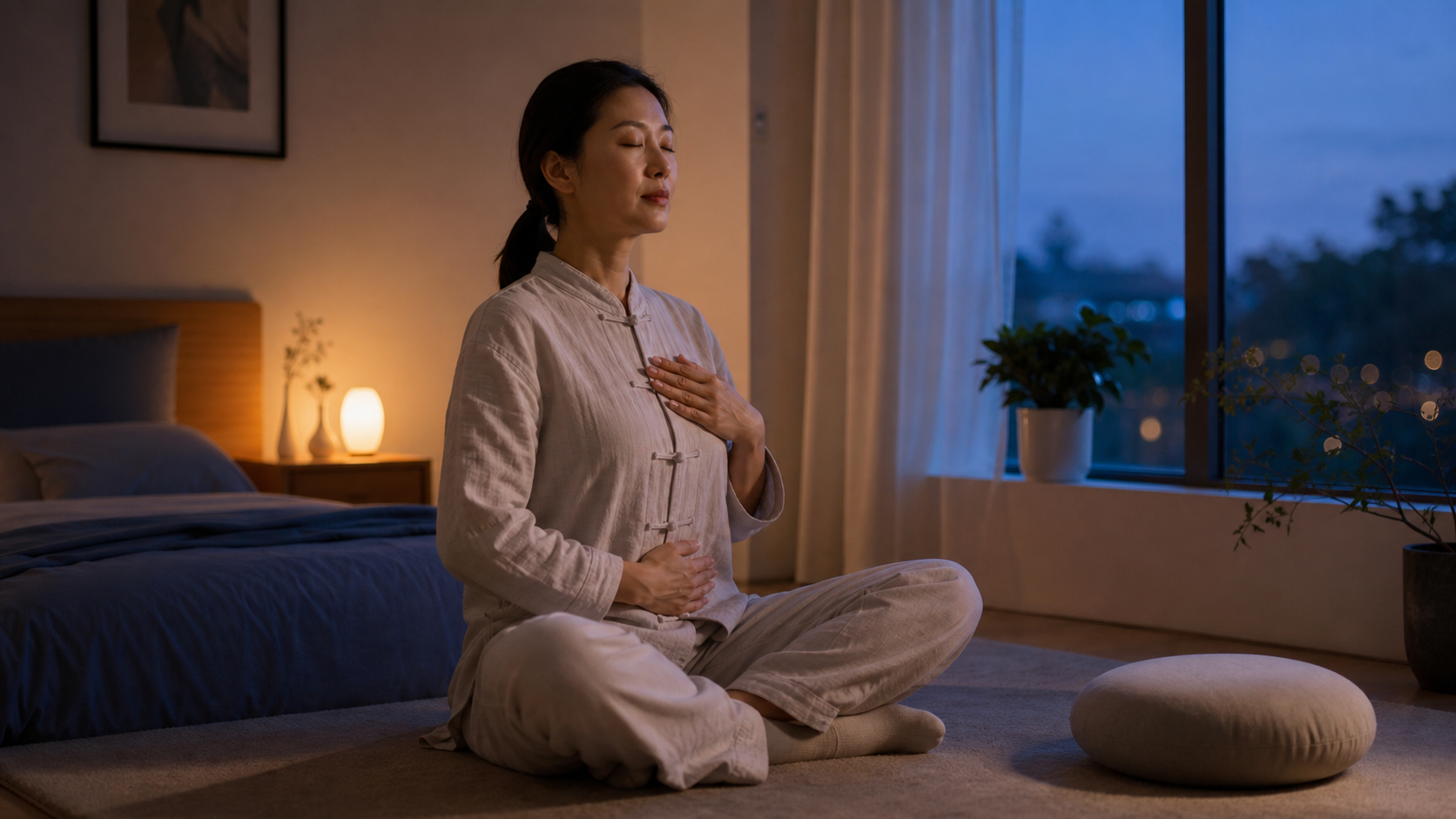
| 2 | Seated long-exhale breathing | 4 min | Sit tall on a chair or cross-legged. Breathe in through the nose for ~4 counts; exhale through the mouth (or nose) for ~6–7 counts. Let the belly do the work. Counting the exhale longer than the inhale is the whole trick — it physically activates the recovery system. |
| 3 | The Inner Smile | 3 min | Close the eyes. Silently “smile” at each area of the body in turn — heart, lungs, belly, kidneys, hands, feet — holding the attention there a few breaths at a time with a feeling of gratitude. It’s the shortest path from an active mind to a quiet one. Complete Inner Smile guide ? |
If you can only do one thing, do part 2. Four minutes of long-exhale breathing is the entire mechanism in miniature. And if you already practise standing qigong in the morning, the evening routine should stay soft — no forceful postures, no “energising” work. The morning builds; the evening stores.
Morning vs evening: the timing rules
- For sleep, practise in the evening, 60–120 minutes before bed. That window lets the calm land while you’re still upright, and the practice itself becomes a cue — your body learns that this routine means “handover to sleep mode”.
- Keep the morning practice separate. A short energising practice (standing qigong, the Eight Brocades) in the morning sets a calm baseline for the day and helps the evening downshift even more. Many people do both.
- Avoid intense internal work late at night. Forceful postures, breath retention, or heavy visualisation close to bed raise arousal in the opposite direction. Evening qigong is the yin side of the practice: slow, long exhales, soft attention.
Qigong for sleep vs melatonin vs CBT-I
Honest positioning, because you deserve it:
- vs melatonin: melatonin is a signal (“it’s night”), qigong is a skill (“my system can downshift”). They don’t compete — but the skill keeps working after you stop taking the pill, and it also addresses the stress that usually causes the problem in the first place.
- vs CBT-I (cognitive behavioural therapy for insomnia): CBT-I is the gold standard for chronic insomnia, and it works on thoughts and habits rather than physiology. The two are compatible: many clinicians now recommend adding a daily relaxation practice — and qigong is as good as any, with the added bonus of the daytime health effects. If your insomnia has lasted more than a few months, do both; don’t substitute.
- vs “just worrying less”: the point of the practice is that you don’t have to succeed at relaxing. You have a structure — counts, postures, an object of attention — and the calm happens as a by-product. That’s why it works when “trying to relax” doesn’t.
How long until it works?
Most students report calmer evenings within a week of daily practice. Measurable changes in sleep — falling asleep faster, fewer awakenings — typically show up in two to four weeks, because the practice is retraining the autonomic handover, which takes repetition to become automatic. The pattern that fails is irregular: do it on the bad nights and skip the good ones, and you’re using a daily skill as a rescue remedy. Consistency is the whole mechanism. Track it simply: one line per morning (fell asleep fast? woke at night? energy?) and you’ll see the trend within a month.
Start here
The full 10-day standing practice (Zhang Zhuang, free guide) is the best foundation if you’re new — the evening routine above then slots in as part 3 of your day. For the complete beginner’s system (posture, breathing method, and the felt sense of energy), Qigong 101 is where most people start. And if sleep problems come with clinical symptoms — apnoea, chronic pain, depression — treat those first, with a doctor, and use qigong as the daily layer on top.
Frequently asked questions
Can qigong help with insomnia?
Yes, as a complementary practice: research on adults with chronic insomnia finds qigong improves sleep quality, with people falling asleep faster and staying asleep longer. It works by shifting the nervous system into recovery mode in the evening — slow breathing, gentle movement and attention practice all reduce the arousal that keeps sleep away. It is not a replacement for medical treatment of serious sleep disorders.
What is the best qigong to do before bed?
A 10-minute sequence: 3 minutes of gentle loosening (shoulder, neck, jaw), 4 minutes of seated slow breathing with long exhales, and 3 minutes of the Inner Smile body scan. Do it 60–120 minutes before bed, in a dim room, and avoid forceful or “energising” internal work late in the evening.
How long before qigong improves my sleep?
Many people report calmer evenings within a week of daily practice and measurably better sleep within 2–4 weeks, because the evening practice retrains the autonomic nervous system to downshift. The pattern that fails is irregular: sleep benefits track consistency, not session intensity.
Should I practise qigong in the morning or at night for sleep?
Primarily in the evening, 60–120 minutes before bed — that’s when the practice directly serves sleep. A short morning practice (5–10 minutes) can still help by setting a calm baseline for the day, and many people do both: energising in the morning, calming at night.
Is qigong a replacement for sleep medication?
No — it is a well-evidenced complement, not a substitute. If you take sleep medication or treat a diagnosed sleep disorder, keep that care and add the daily practice on top; check with your doctor about combining them, and never stop medication because of a meditation practice.