What Is the Dantian? (Lower Dantian) Explained — and How to Activate It Safely

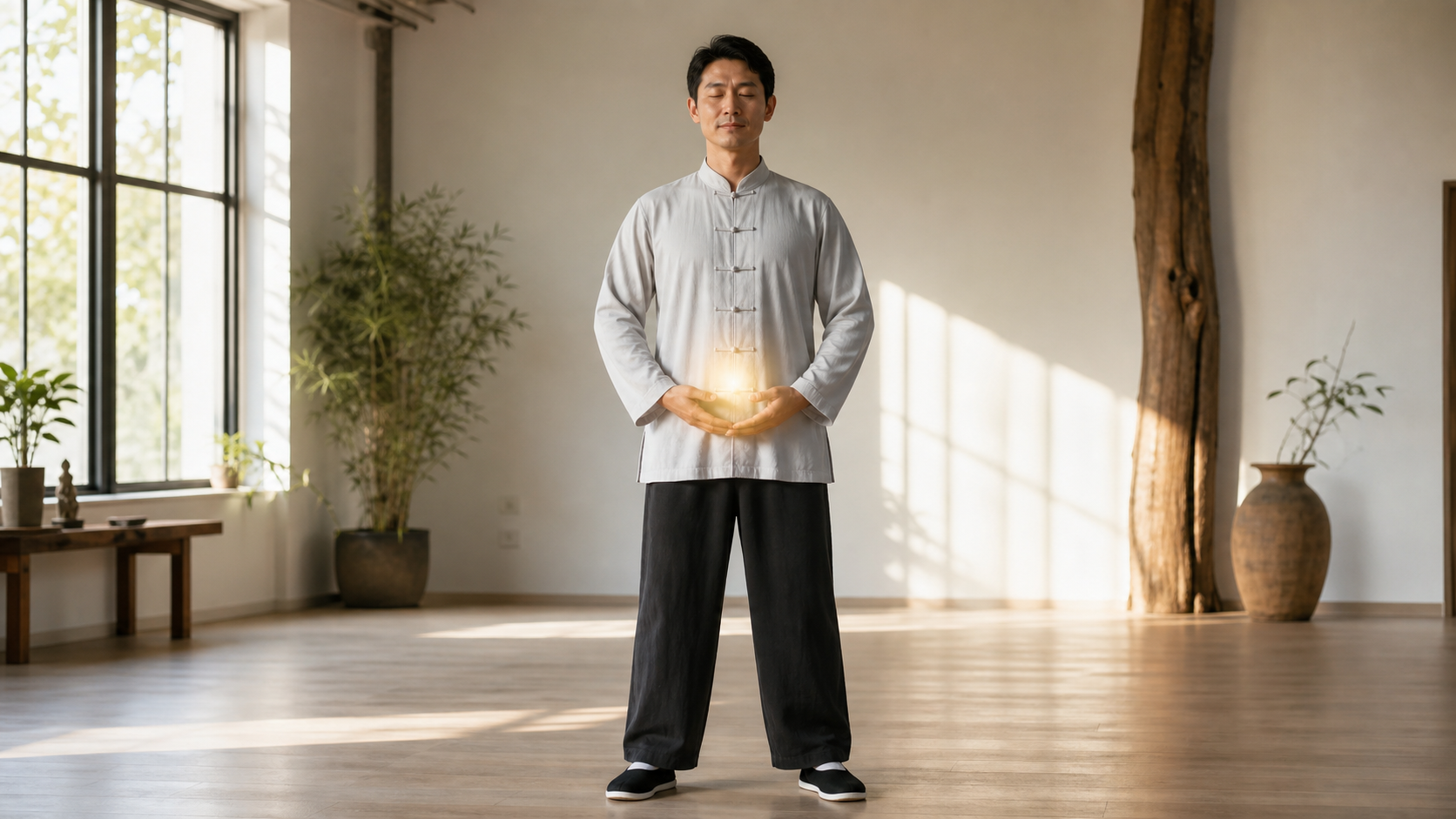
Quick answer: the dantian (??, literally “field of grain”) is the traditional energy center of the body. The lower dantian — the one people usually mean — sits about three finger-widths below the navel, slightly toward the spine, in the body’s center of gravity. In traditional terms it is the storehouse of cultivated energy and the anchor of the breath; in practical terms, it is the place where attention, breath and posture meet — which is why focusing there re-trains diaphragmatic breathing, stabilises the core, and gives the mind a single, quiet anchor. It can be activated gently, in a few weeks of daily practice, without any forcing at all.
Every internal practice on this site — standing qigong, the Ruler Qigong sets, the Inner Smile, the microcosmic orbit — orbits around the dantian in some way. Understanding what it is (and what it isn’t) is the single highest-leverage concept in internal training. This article gives the plain-English version, with no mysticism required.
What the dantian actually is
The word breaks down as d?n (field/cellar) and tián (grain) — a granary. The image: your body’s storehouse of vital energy, the reserve that powers everything above it. In practice, “the dantian” refers to three areas:
| Dantian | Location | Traditional role | Practical use |
|---|---|---|---|
| Lower (most important) | ~3 finger-widths below the navel, toward the spine | Storehouse of qi; root of the breath; seat of stability | Attention anchor for standing/seated practice; the “battery” most beginners cultivate |
| Middle | Chest, around the heart/diaphragm | Residence of emotion and the “true self” | Breath focus for calm; the bridge between lower and upper |
| Upper | Between the eyebrows / center of the head | Mind, perception, spirit (shen) | Used rarely and late in training; beginners should ignore it |
If you only remember one thing: when a teacher says “the dantian,” they mean the lower one — the point in your core, a few centimetres behind the abdominal wall, where the body’s weight gathers.
The physiology under the metaphor
Here’s what actually happens in the body when you “focus on the dantian” — no energy fields required:
- It re-trains the breath. Attention resting below the navel naturally pulls breathing down into the diaphragm. Within a few sessions your breath stops living in the chest and starts living in the belly — and diaphragmatic breathing with long exhales is one of the most well-supported levers for autonomic calm (the same mechanism behind qigong’s documented effects on blood pressure and stress).
- It stabilises posture around the center of mass. The lower dantian is, anatomically, your center of gravity. Attending there recruits the deep core differently than “abs” training: quiet, continuous, low-energy. This is why standing qigong feels easy and yet leaves you standing better all day.
- It gives the mind one job. A single, soft, internal object of attention is easier to hold than an empty “be aware” instruction. The dantian is the traditional mind’s eye — a place to rest attention without gripping it.
“Qi storage” is the traditional language for this integrated state: breath down, core settled, mind anchored. You don’t need to resolve the physics to use the tool — the tool works either way.
How to activate the lower dantian (the safe way)
Three methods, in order of simplicity. All of them: 5–10 minutes daily, a few weeks to feel the change. None of them involve forcing, pushing, or holding your breath.
Method 1: Breathing with the anchor (5 minutes, seated or standing)
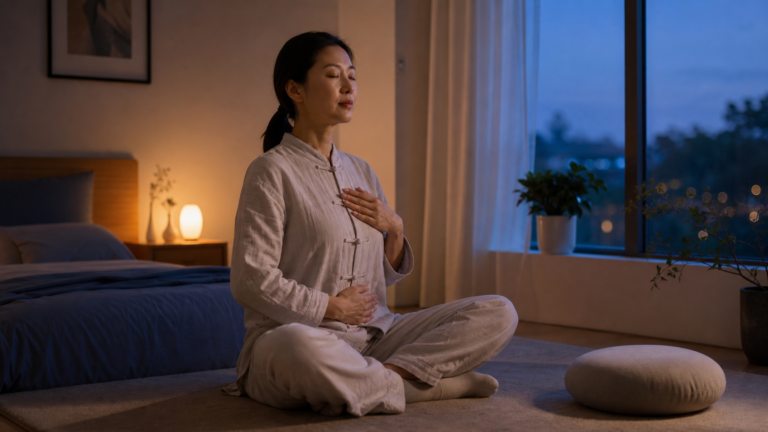
- Stand with knees soft, or sit tall. Hands resting on your lower abdomen (one hand above the other, over the dantian point).
- Breathe in slowly through the nose, letting the belly push the hands out. Breathe out slowly, letting everything settle and sink.
- Keep a soft thread of attention on the area below the navel — not on the sensation (yet), just there.
- Five minutes. When the mind wanders, bring the attention back without commentary.
Method 2: Standing qigong (Zhang Zhuang) — the best activator
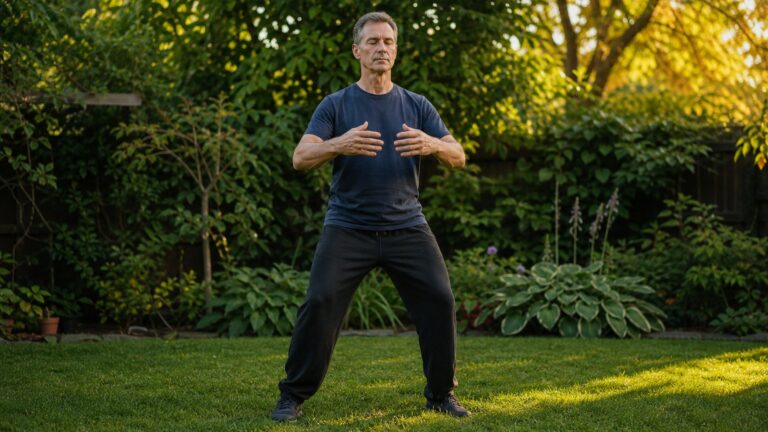
Holding the “hanging like a tree” posture with attention on the lower dantian is the classic activation practice: the posture creates a quiet, structural load in the core, the breath finds the diaphragm on its own, and the attention anchor does the rest. Most people feel warmth or a sense of fullness in the dantian region within the first week or two of daily standing. Our free 10-day standing guide takes you from day one to a stable daily practice — it is, in effect, a 10-day dantian course.
Method 3: The Inner Smile (seated, 5–10 minutes)
Close the eyes and silently “smile” at the lower abdomen — a feeling of warmth and gratitude toward that region, held for several slow breaths. The Inner Smile is a complete practice in its own right (see the Inner Smile & Six Healing Sounds guide); aimed at the dantian, it’s the gentlest activation of the three.
What activation feels like
There is no universal standard — sensations vary between people, and a deep practice can be perfectly quiet. Commonly reported signs, in rough order of appearance:
- A sense of settlement — the breath going down, the shoulders dropping, a feeling of being “in” your body.
- Warmth or gentle fullness below the navel, often appearing in the first few minutes of standing.
- Standing stability — feet feel rooted, wobble decreases, you catch yourself standing better when you’re not practising.
- Occasional tingling or a subtle vibration in the lower abdomen. This is a normal interoceptive signal, not an achievement to chase or amplify.
Timeline: subtle changes within a week or two of daily practice; a stable, noticeable “presence” in the dantian within 4–12 weeks. If you’re practising and feeling nothing, that’s usually fine too — the breath and posture changes are happening whether or not you notice them. For a complete picture of the felt-sense side, see how to feel chi: the complete guide.
What NOT to do (the honest warnings)
Most dantian problems are self-inflicted by people who try to speed things up:
- Don’t push energy. “Directing qi,” “firing the cauldron,” or intense visualisation of energy balls are advanced methods that require a teacher’s supervision. Forcing internal work is what causes the headaches, agitation and chest pressure reported in “qi deviation” accounts.
- Don’t hold your breath. Breath retention in internal practice is a gateway to the same problems. If a practice has you straining or holding, stop.
- Don’t chase sensations. The moment you start hunting for tingling, you’ve moved from practice to performance — and the nervous system reads that as stress, the exact opposite of what we’re training for.
- Stop if something feels wrong. Dizziness, persistent headache, chest tightness, or agitation that doesn’t settle after you stop: pause the practice and, if it continues, talk to a doctor. Qigong should leave you calmer and steadier; if it leaves you wired or unwell, the method (or its intensity) is wrong.
The entire secret of dantian work is that it’s less: soft attention, easy breath, a few minutes a day, and time. That’s also why it works — and why no one can sell you a shortcut to it.
Frequently asked questions
What is the dantian?
The dantian (??, “field of grain”) is the traditional energy center of the body. The lower dantian — the one most people mean — sits about three finger-widths below the navel, slightly toward the spine, in the body’s center of gravity. It functions as the anchor for attention, the storehouse of cultivated energy, and the root of the breath in slow breathing.
Where exactly is the lower dantian?
Roughly two to three finger-widths below your navel, a hand-width deep, slightly behind the abdominal wall toward the spine — the area you’d press if someone asked you to point to your “core”. Physically, this is your body’s center of mass, which is why standing and movement practice there is so stabilising.
How do you activate the lower dantian?
Three gentle methods: (1) slow diaphragmatic breathing with soft attention resting on the area, (2) standing qigong (Zhang Zhuang) with the same attention anchor, and (3) seated practices like the Inner Smile. Give it 5–10 minutes daily for a few weeks; the first sign is usually a sense of warmth, heaviness or settling. Don’t force it — pushing, breath retention, or intense visualization is what causes problems, not the practice itself.
What does an activated dantian feel like?
Commonly reported sensations include warmth or a gentle fullness below the navel, a feeling of the breath “living” in the belly rather than the chest, increased standing stability, and a calmer, more centred mind. There is no universal standard — sensations vary between people, and a deep practice can be perfectly quiet.
Is the dantian real or just a metaphor?
As a metaphor and attention tool, it is extremely useful and real: focusing there re-trains breath to the diaphragm, stabilises posture around the center of mass, and gives the mind a single anchoring point. As a physical “energy storage tank”, it is a traditional model — no scan will show it. You get the practical benefits without needing to settle the physics.
Ready to practise? Qigong 101 teaches the posture, breathing and attention foundations that make lower-dantian practice more approachable.