
Weight Loss and Appetite Suppressant Qigong (Gingwa-Gong): A Free Practice for Diets, Wegovy, Ozempic, Zepbound, Mounjaro and Bariatric Surgery

Quick answer: Gingwa-Gong (the “Jade Frog” or “Jade Toad” practice) is a free, seated Qigong breathing routine from traditional Chinese medicine that is used to calm appetite and support weight loss. It takes about 15 minutes, needs no equipment, and can be done alongside any medically supervised program, whether you are dieting, taking a GLP-1 medication such as Wegovy, Ozempic, Zepbound or Mounjaro, or preparing for or recovering from bariatric surgery (gastric sleeve, gastric bypass or Lap-Band). The complete instructions are below, followed by guidance for each of those situations.
Jump to: The TCM view of obesity · The Jade Frog practice (step by step) · With Wegovy, Ozempic, Zepbound or Mounjaro · Before and after bariatric surgery or Lap-Band · What research says · FAQ · Sources
This article is for education. Qigong is a complement to, not a replacement for, medical care. Do not change a medication dose or a post-surgical plan without talking to your prescriber or surgeon.
Weight, appetite and Qi: the traditional Chinese medicine view
From a traditional Chinese medicine (TCM) perspective, the pathological changes in obesity are mainly spleen (earth) and kidney (water) dysfunctions within the 5 elemental theory. Sluggish flow of the body’s vital energy (Qi) and inhibited ability to refine body fluids results in turbid phlegm obstruction. Energy practice (Qigong) helps to regulate the internal vital energy and blood flow and supports healthy metabolic functions. Over time, this specific Qigong eliminates the blockages caused by the malefic dampness and phlegm. This method produces a calming effect within the stomach and spleen, which relieves and clears the desire for food.
The Jade Frog Practice (also known as The Jade Toad)
This specific breathing and slimming exercise (Gingwa-Gong) is designed to turn the fat storage reserves in your body into energy fuel. Performing this exercise routine will also restrict and regulate the desire for food. In some cases, this non-desire period can last up to a full month. The exercise doesn’t take a lot of time, but should be performed three times each day for maximum weight loss results. Once your weight goals are obtained, the frequency of the routine can be reduced. As with any exercise routine, consult your physician prior to implementing the method herein.
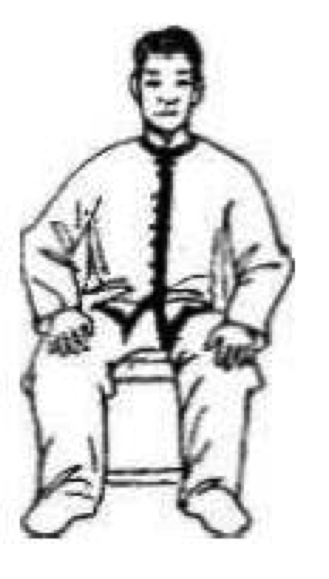
- Sit upright on the front edge of a firm chair. Don’t lean back into the chair. Set your feet on the floor with your toes pointing straight forward. Your thighs should be parallel to the floor and your knees, thighs and shins should form a ninety-degree angle. In other words, your calves and shins are the vertical and your thighs are the horizontal. If this does not work out, then try another chair of different height.
- Relax the shoulders and allow them to drop lower, pull in your coccyx (tail bone) and bend your lower back slightly outwards and pull in your chin. Relax your arms and the rest of your body. Pull in your chest and make sure that your feet are in the same relative spacing as your shoulders, i.e. your feet are shoulder width apart.
- Now take in a deep breath and let out a relaxing sigh of relief. Place your hands as shown in the following illustration. For men, the right hand makes a relaxed (not clenched) fist which is held by the left hand. For women, the left hand makes a fist, which is held by the right hand. After forming the gender appropriate hand position, rest your elbows on top of the knees as shown in the next image. If this position is too difficult at first, you can rest your elbows on a table as long as it is lower than your belly button and allows you to still lean forward.
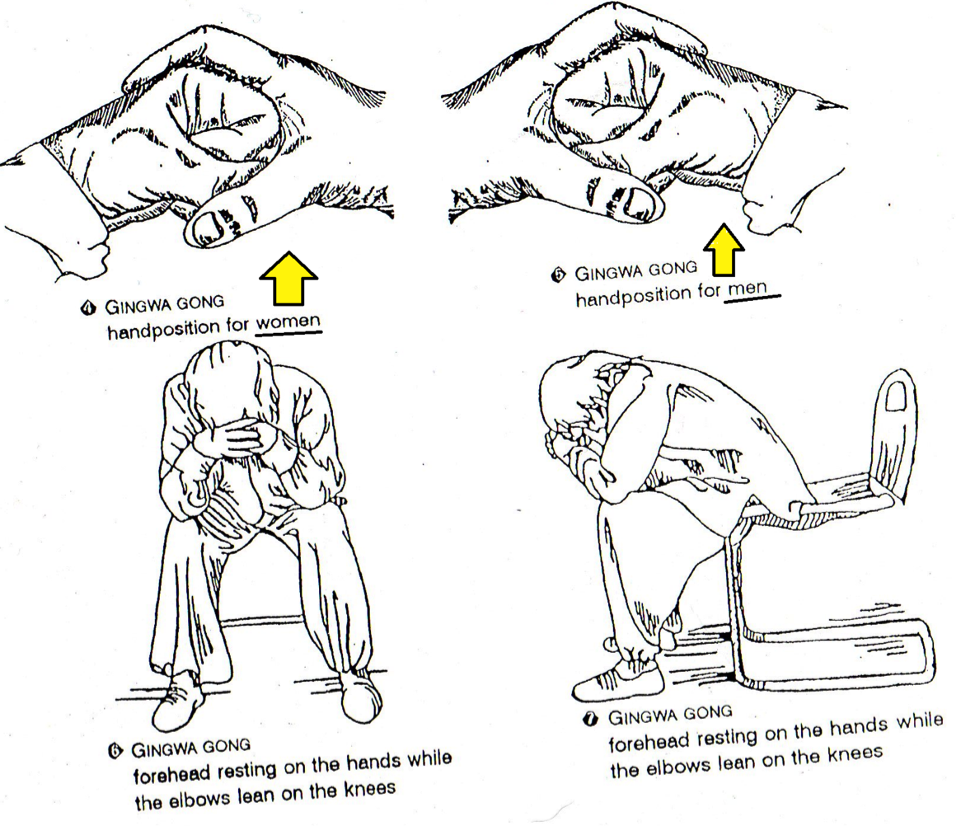
- While holding this posture with fist on the center of your forehead, close your eyes and try to think only of things that make you feel happy and at ease. Gently curl your lips upward into a subtle smile and hold this smile throughout the exercise. Keep thinking of happy and peaceful things for two minutes.
- After two minutes’ elapse, breathe in deeply and slowly (eyes still closed). Inhale through the nose and then slowly exhale through the mouth. Next follows a special breathing exercise that should be performed calmly and in as relaxed a manner as possible. It should not be done urgently or suddenly.
- Breathe in through your nose to approximately 80% or 90% of your inhale capacity. Hold your breath for two counts (one one-thousand, two one-thousand), then inhale again, filling your lungs to full capacity without exhaling in between. Once full of air, exhale in a controlled relaxed manner through your mouth. After exhalation, repeat this step for a total of ten minutes.
- After completing 10-minutes of this double-inhale (nose) single exhale (mouth) exercise, you are ready to do the closing routine. Rub your hands together vigorously so that heat and warmth is generated between your palms. While rubbing your hands, exhale very slowly with the sound “Haaahh” as if you were trying to fog a mirror with your breath. This will aid in warming up the hands. Massage your face with your warmed hands. Keep your eyes closed. Next massage your hair and scalp. With your fingers bent, making a claw like shape, slide your finger tips through your hair from the forehead backwards to the base of your neck in one single fluid movement. Repeat this 10 times. Then open your eyes slowly, stand up and stretch yourself as if you were getting up and out of bed in the morning (The yawn stretch). This weight loss (Gingwa Gong) should be performed three times per day until goals are reached. The routine can be lowered to once or twice per day or stopped all together if you continue to lose additional weight beyond objectives.
Using Gingwa-Gong with Wegovy, Ozempic, Zepbound or Mounjaro
GLP-1 and GLP-1/GIP medications (semaglutide, sold as Wegovy and Ozempic, and tirzepatide, sold as Zepbound and Mounjaro) work largely by quieting appetite and “food noise.” Gingwa-Gong works on the same target from the other direction: it trains the nervous system to settle, so hunger signals lose their urgency. The two are compatible, and there are three specific reasons people on these medications add a daily appetite Qigong practice.
1. Keeping the weight off if you stop or taper the medication
The best-known limitation of these drugs is regain. In the STEP 1 trial extension, people who stopped semaglutide regained roughly two-thirds of the weight they had lost within one year, and similar regain was seen after tirzepatide in SURMOUNT-4. The medication had been doing the appetite work; when it stops, the appetite returns. A practice that you own, that costs nothing, and that you have already made a habit while the medication was doing the heavy lifting is a sensible bridge. Start Gingwa-Gong while you are still on the medication so it is automatic before any taper.
2. Protecting muscle
Between roughly a quarter and 40 percent of the weight lost on semaglutide or tirzepatide is lean tissue rather than fat in the trials that measured it with DXA scans. Qigong is not resistance training and will not replace it, but slow standing Qigong builds leg and postural strength, and the daily habit makes it far more likely that you will also keep up walking and light weights. If you are on one of these medications, pair this seated breathing routine with our standing Qigong 101 forms and a protein target set by your clinician.
3. Nausea, reflux and sluggish digestion
Slowed stomach emptying is how these drugs work, and it is also why nausea, bloating and reflux are the most common side effects. Slow diaphragmatic breathing of the kind used in step 6 of the practice is a long-standing, low-risk tool for settling nausea, and the seated posture with a relaxed belly encourages gentle abdominal movement. If you feel queasy, skip the forward lean, sit upright, and do only the breathing portion.
Before and after bariatric surgery, gastric sleeve, gastric bypass or Lap-Band
Bariatric surgery (sleeve gastrectomy, Roux-en-Y gastric bypass, duodenal switch) and the adjustable gastric band (Lap-Band) change how much you can eat. They do not change the habit of reaching for food when stressed, tired or bored, which is why surgeons and dietitians put so much emphasis on behaviour before and after the operation. Gingwa-Gong is a behavioural practice that fits every stage of that journey.
Before surgery
Most programs require a supervised pre-operative weight-loss phase and want to see that you can follow a daily routine. Three short seated sessions a day is a concrete, reportable habit. The breathing also lowers pre-operative anxiety, which is common and rarely discussed.
After surgery: what to change
- Get clearance first. Any abdominal surgery needs healing time. Ask your surgeon when you may resume deep breathing exercises and forward bending; for most laparoscopic procedures that is a matter of weeks, but only your surgeon can say.
- Drop the breath holds until you are healed. Step 6 asks for a two-count hold. Post-operatively, breathe in and out slowly with no hold and no forceful exhale. Add the hold back only when you are fully cleared.
- Sit upright, not folded forward. Resting the elbows on the knees compresses the abdomen. Until healing is complete, keep the same hand position but rest your elbows on a table, exactly as described in step 3 for people who find the lean difficult.
- Use it against “head hunger.” After surgery the stomach is small but cravings still arrive. A two-minute version (steps 4 and 5 only) is a practical pause between wanting food and eating it.
Lap-Band specifics
Band patients are taught to eat slowly, chew thoroughly and stop at the first sign of fullness. Reflux, regurgitation and discomfort usually come from eating quickly or while tense. A short Gingwa-Gong session before the main meal of the day puts you in the slow, relaxed state the band requires. If the band has been loosened, removed or has slipped, appetite typically returns at once, and this practice gives you something to do about it while your team decides next steps.
Regain years later
A meaningful share of bariatric patients regain part of their weight in the years after surgery, and many are now prescribed Wegovy, Zepbound or Mounjaro to address it. Everything in the GLP-1 section above applies to you as well.
What research says about Qigong, Tai Chi and body weight
Gingwa-Gong itself has not been tested in a clinical trial, and we do not claim otherwise. The broader family of slow mind-body practices has. In a 543-person randomized trial published in Annals of Internal Medicine in 2021, adults over 50 with central obesity who practised Tai Chi three times a week for 12 weeks reduced their waist circumference as much as a conventional brisk-walking and strength program, with the waist and weight benefit still present at 38 weeks; the HDL cholesterol advantage persisted only in the Tai Chi group. Tai Chi and Qigong also have consistent trial evidence for anxiety, stress and sleep, three of the main drivers of overeating; see our anxiety and depression research summary and the full Qigong research overview. The realistic claim for Gingwa-Gong is this: it is a free, safe daily habit that lowers stress, slows you down around food and supports whatever medical treatment you and your clinician have chosen.
Frequently asked questions
Can I do Qigong while taking Wegovy, Ozempic, Zepbound or Mounjaro?
Yes. Gingwa-Gong is a seated breathing practice with no dietary rules and no interaction with medication. Most people use it to build a lasting appetite habit before any taper, and to help with nausea and stress. Keep your prescribed dose and tell your prescriber what you are doing.
Will Qigong stop weight regain after I stop a GLP-1 medication?
No single practice can promise that. Trials show most people regain a large share of lost weight within a year of stopping semaglutide or tirzepatide. A daily appetite practice, combined with strength training, protein and support from your clinician, addresses the appetite return that drives regain. Start it while you are still on the medication.
How soon after bariatric surgery or Lap-Band placement can I start?
Only when your surgeon clears you for deep breathing and forward bending. Until then, use the modified version: sit upright, elbows on a table, slow breathing with no breath holds.
Does the exercise replace diet, exercise or medication?
No. It is a complement that helps regulate appetite and stress. Keep the plan your medical team has set.
How long does one session take, and how often should I do it?
About 15 minutes: two minutes of settling, ten minutes of breathing and a short closing massage. The traditional prescription is three times a day until you reach your goal, then once or twice daily.
Is Gingwa-Gong the same as the Jade Frog or Jade Toad exercise?
Yes. Gingwa (sometimes written Qingwa) means frog or toad, and the routine is known by all three names.
Sources
- Wilding JPH et al. Weight regain and cardiometabolic effects after withdrawal of semaglutide: the STEP 1 trial extension. Diabetes Obes Metab. 2022;24:1553-64.
- Aronne LJ et al. Continued treatment with tirzepatide for maintenance of weight reduction in adults with obesity: the SURMOUNT-4 randomized clinical trial. JAMA. 2024;331(1):38-48.
- Preservation of lean soft tissue during weight loss induced by GLP-1 and GLP-1/GIP receptor agonists. 2025 (summarises DXA data from STEP 1 and SURMOUNT trials).
- Body composition changes after bariatric surgery or treatment with GLP-1 receptor agonists. JAMA Netw Open. 2026.
- Siu PM et al. Effects of Tai Chi or conventional exercise on central obesity in middle-aged and older adults: a three-group randomized controlled trial. Ann Intern Med. 2021;174(8):1050-7.