The Vapor Body: Understanding Greater Kan and Li for Absolute Vitality

TL;DR: Greater Kan and Li is an advanced Taoist inner alchemy practice focused on reversing energy loss and cultivating what practitioners call the Vapor Body for sustained vitality.
What Is 'The Vapor Body: Mastering the Greater Kan and Li for Absolute Vitality'?
'The Vapor Body: Mastering the Greater Kan and Li for Absolute Vitality' is a written work exploring advanced Taoist inner alchemy. The text opens with a chapter titled 'The Entropy of the Soul,' which frames modern life as a state of constant energy depletion. The author compares this depletion to 'the quiet, persistent hiss of a punctured tire' and 'the rhythmic drip of a faucet in an empty house.'
This framing sets up the central problem the text aims to address: people lose vital energy through the demands and distractions of daily existence, and most never notice it happening. The title references two specific concepts from the Taoist tradition. 'Greater Kan and Li' refers to an advanced stage of Taoist internal practice. 'The Vapor Body' appears to describe a refined energetic state the practitioner works toward through these methods.
The document is structured as a guide or treatise, beginning with Chapter 1 and building from a diagnosis of the problem (energy loss, or what the author calls 'entropy of the soul') toward a solution rooted in classical Taoist practice. The language is literary and metaphorical, suggesting the text aims to reach readers beyond strict practitioners. It bridges philosophical reflection with practical instruction.
Greater Kan and Li belongs to a sequence of increasingly advanced practices within the Taoist inner alchemy tradition. The sequence typically begins with foundational energy work and progresses through stages of internal refinement. This text positions Greater Kan and Li as a method for achieving 'absolute vitality,' a state where energy leakage stops and the practitioner operates from a fundamentally different energetic baseline.
What Does 'The Entropy of the Soul' Mean in This Context?
The text's opening chapter uses 'entropy' as a metaphor borrowed from physics. Entropy, in thermodynamics, describes the tendency of ordered systems to move toward disorder and energy dissipation. The author applies this concept to human vitality and consciousness.
According to the text, modern existence produces a constant sensation of leaking. You lose energy to stress, distraction, emotional reactivity, and the sheer pace of life. The author describes this as feeling like 'a punctured tire' or 'a faucet in an empty house.' These images are specific and visceral. They point to something most people recognize but rarely name: the feeling that your energy drains faster than you replenish it.
This chapter appears to serve as the motivational foundation for the practices that follow. Before introducing the solution (Greater Kan and Li), the text forces the reader to sit with the problem. You burn through vitality without awareness. Sleep, food, and stimulants become temporary patches on a structural issue. The leak continues.
The phrase 'entropy of the soul' elevates this beyond physical tiredness. The author suggests the depletion operates at a deeper level, affecting consciousness, emotional resilience, and spiritual clarity. This is a common theme in Taoist literature: the idea that ordinary life, without deliberate cultivation practices, leads to gradual dissolution of one's vital essence.
By framing the problem in scientific language ('entropy') wrapped in poetic imagery, the text speaks to readers who want both intellectual rigor and experiential depth. The chapter title signals that this work takes the problem of energy loss seriously, treating it as a fundamental condition of existence rather than a lifestyle inconvenience.
What Is Kan and Li in Taoist Inner Alchemy?
Kan and Li are terms from the I Ching (Book of Changes) and Taoist cosmology. Kan represents water energy, associated with the kidneys and the qualities of cold, stillness, and depth. Li represents fire energy, associated with the heart and the qualities of heat, activity, and brightness.
In ordinary human physiology, according to Taoist theory, fire rises and water sinks. This is the default pattern. Heat escapes upward through agitation, anxiety, and overthinking. Cool, vital essence drains downward and dissipates. The result is the 'leak' the text describes. You lose energy in both directions simultaneously.
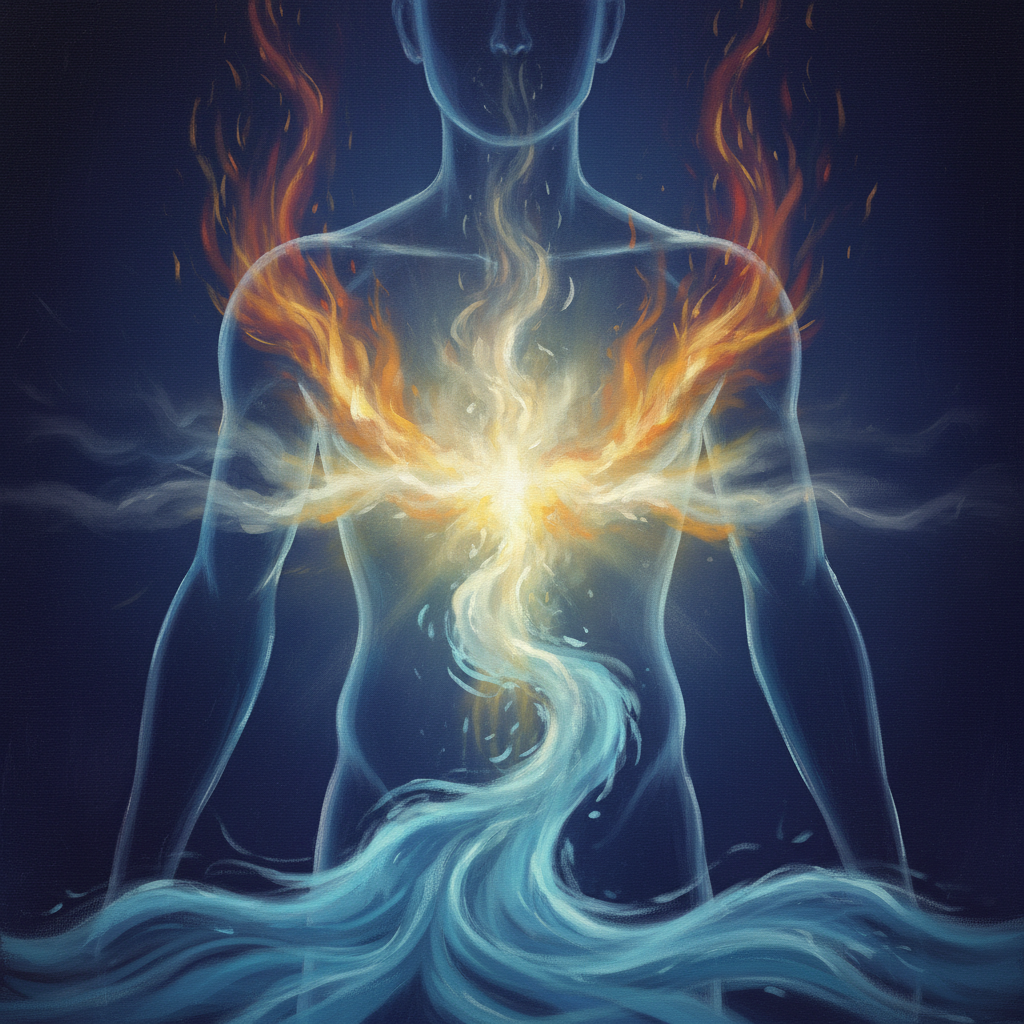
Kan and Li practices aim to reverse this flow. The practitioner learns to bring fire downward and water upward, creating a coupling or steaming effect at the body's center. This internal 'steaming' is where the concept of the Vapor Body likely originates. When water and fire meet under the right conditions, they produce steam, a refined substance that is neither purely liquid nor purely gas.
The Taoist tradition organizes these practices in stages. Lesser Kan and Li typically involves working with energy centers in the lower abdomen. Greater Kan and Li moves the practice to the solar plexus or middle dantian and involves more refined work with consciousness and vital essence. Greatest Kan and Li operates at the level of the heart and upper energy centers.
Each stage demands more skill, concentration, and energetic development from the practitioner. Greater Kan and Li sits in the middle of this progression. It requires a foundation in basic energy circulation but opens the door to the more advanced transformations described in Taoist alchemical literature.
What Is the Vapor Body?
The Vapor Body, as referenced in the text's title, appears to describe a state of energetic refinement achieved through Greater Kan and Li practice. The term 'vapor' points directly to the alchemical process at the heart of these practices: the coupling of water (Kan) and fire (Li) to produce steam.
In Taoist inner alchemy, practitioners work with three primary substances: jing (essence), qi (energy), and shen (spirit). The progression moves from dense to subtle. Jing is the most material. Shen is the most refined. Qi sits between them. The alchemical process converts jing into qi and qi into shen through specific meditative techniques.
The Vapor Body likely refers to an intermediate or advanced stage in this conversion process. When the practitioner successfully reverses the flow of water and fire within their body, the resulting internal 'steam' creates a refined energetic vehicle. This vehicle is less bound by the limitations of the physical body. Practitioners report experiences of expanded awareness, reduced need for sleep, and a qualitative shift in how they experience their own physicality.
The word 'vapor' carries specific connotations. Vapor is visible but intangible. It rises. It fills space differently than solid or liquid matter. As a description of an energetic body, it suggests something that exists and functions but operates by different rules than dense physical tissue.
This concept parallels ideas found in other contemplative traditions. Tibetan Buddhism describes the 'rainbow body.' Certain Hindu yogic traditions reference the 'subtle body.' The Taoist Vapor Body shares the same basic architecture: through sustained internal practice, you develop a refined aspect of yourself that transcends ordinary physical limitations. The text positions this development as the antidote to the 'entropy of the soul' described in Chapter 1.
How Does Greater Kan and Li Differ from Lesser Kan and Li?
Lesser Kan and Li works primarily with the lower dantian, the energy center located roughly two inches below the navel. The practitioner learns to create a coupling of water and fire energies at this foundational level. The focus stays on building a stable energetic foundation, learning to reverse the default downward flow of vital essence, and developing the concentration needed for sustained internal work.
Greater Kan and Li moves the operation higher in the body, typically to the solar plexus or middle dantian. This shift is significant. The middle dantian relates to emotional energy, the heart, and more refined aspects of consciousness. Working at this level demands that the practitioner has already stabilized the lower coupling. You build on the foundation rather than replacing it.
The practical differences show up in several ways. Greater Kan and Li involves working with more subtle energies. The practitioner engages with emotional patterns, ancestral influences, and deeper layers of consciousness that Lesser Kan and Li does not directly address. The 'steam' produced at this level is finer and more potent.
The text's emphasis on 'absolute vitality' suggests that Greater Kan and Li produces results beyond basic health and energy. Lesser Kan and Li addresses the leak. Greater Kan and Li begins to transform the container itself. The vessel changes. Your relationship to vitality shifts from conservation to generation.
This progression mirrors other developmental frameworks. You learn to walk before you run. You stabilize before you refine. Each stage assumes mastery of the previous one. Attempting Greater Kan and Li without the foundation of Lesser Kan and Li would be like trying to distill alcohol without first having fermented the base material. The sequence matters because each stage creates the conditions for the next.
Why Does the Text Frame Vitality Loss as a Modern Problem?
The opening chapter describes the 'sensation of modern existence' as the sensation of a leak. This framing is deliberate. While Taoist practices are thousands of years old, the text connects them to contemporary experience.
Modern life accelerates energy expenditure in ways previous generations did not face. Constant digital stimulation, artificial lighting that disrupts circadian rhythms, sedentary work combined with mental overload, processed food, chronic low-grade stress from information overload: these factors create a unique constellation of energy drain.
The author's choice of metaphors reinforces this point. A punctured tire is a modern object. A dripping faucet in an empty house evokes urban isolation. These are images drawn from contemporary life, not from ancient Chinese monasteries. The text speaks to people living in apartments, working at desks, scrolling through phones, feeling depleted without understanding why.
This approach makes ancient practices accessible to modern readers. Rather than beginning with Taoist cosmology or I Ching trigrams, the text starts with a feeling everyone recognizes. You are tired in a way sleep does not fix. You sense something draining from you, but you have no name for it. The text provides both the name (entropy of the soul) and the solution (Greater Kan and Li).
The framing also implies urgency. Entropy accelerates. The longer you ignore the leak, the more depleted you become. Modern conditions amplify the rate of depletion compared to simpler modes of living. This makes practices like Greater Kan and Li more relevant now, not less, despite their ancient origins. The text positions Taoist inner alchemy as a response to a distinctly modern crisis of vitality.
What Does 'Absolute Vitality' Mean in This Practice?
The title promises 'absolute vitality,' a phrase worth examining closely. 'Vitality' refers to life force, energy, and the capacity for sustained activity and awareness. The word 'absolute' elevates this beyond the ordinary. It suggests a state of completeness, where energy loss has been fully addressed rather than partially managed.
Ordinary vitality fluctuates. You have good days and bad days. Coffee helps in the morning. Sleep helps at night. Exercise gives a temporary boost. These are all forms of relative vitality, energy that rises and falls based on external inputs and conditions.
Absolute vitality, as the text implies, operates from a different foundation. Through Greater Kan and Li practice, the practitioner stops the leak at its source. Energy no longer dissipates through the default patterns of rising fire and sinking water. The reversal creates a self-sustaining internal cycle. Energy generates energy. The system becomes less dependent on external inputs for its basic functioning.
This does not mean the practitioner stops eating, sleeping, or resting. It means the baseline shifts. Where an ordinary person might operate at 30-40% of their potential energetic capacity (with the rest lost to entropy), a practitioner of Greater Kan and Li aims to operate at a fundamentally higher baseline. The floor rises.
The concept also extends beyond physical energy. Absolute vitality includes mental clarity, emotional stability, and spiritual awareness. The Taoist model does not separate these domains. Jing, qi, and shen form a continuum. When you stop leaking at the level of essence (jing), the benefits cascade upward through energy (qi) and spirit (shen). Absolute vitality is a whole-system upgrade, not a targeted fix for one symptom.
What Role Do the Kidneys and Heart Play in Kan and Li Practice?
Kan (water) corresponds to the kidneys in Taoist medical and alchemical theory. The kidneys store jing, the vital essence you are born with and gradually deplete over a lifetime. Kidney energy is cold, deep, and foundational. When kidney energy weakens, you experience aging, fatigue, lower back pain, reduced sexual vitality, and fear.
Li (fire) corresponds to the heart. The heart houses shen, or spirit. Heart energy is hot, bright, and expansive. When heart energy becomes unbalanced, you experience anxiety, insomnia, scattered thinking, and emotional volatility.
The default human pattern sends fire upward (agitation, overthinking, restlessness) and water downward (depletion of essence, loss of foundational energy). Kan and Li practice reverses this. You direct heart fire downward to warm the kidneys. You direct kidney water upward to cool the heart. The meeting point produces the internal coupling that generates the 'steam' of transformation.
This reversal has concrete physiological correlates. Practitioners often report feeling warmth in the lower abdomen, coolness in the chest, reduced anxiety, deeper sleep, and improved kidney function. The practice addresses the organ systems directly, not as an abstraction but as a felt experience in the body.
The Greater Kan and Li stage intensifies this coupling by working at the solar plexus level, where the interaction between heart and kidney energies becomes more refined. The middle dantian serves as a crucible where emotional energy transforms. Old emotional patterns stored in the organs release and convert into usable energy. The practitioner reclaims vitality that was locked up in unresolved emotional material.
Who Is This Text Written For?
Based on the available content, the text targets readers who feel the 'leak' the author describes. The literary quality of the writing, with its careful metaphors and philosophical framing, suggests an audience that values both intellectual engagement and practical application.
The text does not appear to be written exclusively for experienced Taoist practitioners. The opening chapter uses universal language about modern exhaustion rather than specialized Taoist terminology. A reader with no background in internal arts would recognize the feeling of 'the rhythmic drip of a faucet in an empty house' as a description of their own energy state.
At the same time, the subject matter (Greater Kan and Li) is advanced. This creates an interesting tension. The text seems designed to make advanced practices accessible to a broader audience while maintaining the depth and precision these practices demand.
Readers who would benefit most include those who have tried conventional approaches to energy and wellness (exercise, nutrition, sleep optimization) and still feel depleted at a level these interventions do not reach. The text speaks to people who suspect their fatigue has a deeper cause than poor habits. It also speaks to practitioners of meditation, qi gong, or yoga who want to explore more advanced internal work.
The literary tone suggests the author views the reader as intelligent and capable of handling complex ideas without excessive hand-holding. The metaphors do the work of explanation without dumbing down the material. This positions the text as a serious work rather than a casual self-help guide.
How Does the Concept of the Vapor Body Connect to Other Subtle Body Traditions?
The Vapor Body sits within a broader cross-cultural tradition of refined energetic vehicles that exist alongside or within the physical body. Understanding these parallels helps contextualize what the text describes.
In Tibetan Buddhist practice, the 'rainbow body' (jalü) represents the ultimate refinement of physical matter into light. Accomplished practitioners reportedly dissolve their physical bodies at death, leaving behind only hair and fingernails. The rainbow body represents the endpoint of a long process of internal purification and energy cultivation.
Hindu yogic traditions describe multiple sheaths (koshas) surrounding the soul, ranging from the dense physical body (annamaya kosha) to the bliss body (anandamaya kosha). The pranamaya kosha (energy sheath) and vijnanamaya kosha (wisdom sheath) correspond roughly to the stages of refinement Taoist alchemy describes.
Western esoteric traditions reference the 'astral body,' 'etheric body,' and 'body of light.' Hermetic alchemy, which shares structural similarities with Taoist alchemy, describes the creation of a 'philosopher's stone' within the practitioner, a perfected substance that transforms the base material of ordinary consciousness.
The Vapor Body appears to occupy a specific stage in the Taoist progression. It is not the final product but an intermediate state of refinement. The 'vapor' designation suggests something in transition: denser than spirit, more refined than physical matter. This in-between quality makes it practically useful. The Vapor Body is something a living practitioner develops and uses, not an end-state achieved only at death.
These parallels suggest that diverse contemplative traditions independently discovered similar processes of internal refinement. The Taoist framework, with its precise alchemical language and staged progression, offers one of the most systematic approaches to developing these refined energetic capacities.
What Prerequisites Exist for Greater Kan and Li Practice?
Greater Kan and Li does not exist in isolation. It requires a foundation of prior practice and development. Based on the traditional Taoist progression, several prerequisites apply.
First, the practitioner needs a stable microcosmic orbit. This is the foundational energy circulation practice in Taoist internal work. Energy moves up the spine (governing vessel) and down the front of the body (conception vessel) in a continuous loop. Without this circulation established and stable, the more advanced coupling of Kan and Li has no energetic infrastructure to operate within.
Second, Lesser Kan and Li practice should be established. This means the practitioner has experience reversing water and fire at the lower dantian and has felt the results of this coupling in their body. Attempting to work at the middle dantian without this foundation produces confusion at best and energetic imbalance at worst.
Third, the practitioner needs a degree of emotional maturity and stability. Greater Kan and Li works with emotional energy stored in the organs. This process can release old patterns, memories, and feelings with significant intensity. A practitioner without emotional grounding risks being overwhelmed by material that surfaces during practice.
Fourth, physical health matters. The body serves as the laboratory for these practices. Chronic illness, severe depletion, or structural problems in the body limit the practitioner's capacity to sustain the concentration and energy these practices demand.
Fifth, consistent daily practice is essential. Greater Kan and Li is not a weekend workshop skill. It requires sustained engagement over months and years. The internal conditions for the coupling of water and fire develop gradually. Rushing the process or practicing sporadically produces inconsistent results. The text's emphasis on 'absolute vitality' implies a commitment to practice that matches the ambition of the goal.
What Are the Reported Benefits of Greater Kan and Li Practice?
Practitioners of Greater Kan and Li within the Taoist tradition report a range of benefits across physical, emotional, and spiritual dimensions.
Physically, practitioners describe increased energy that does not depend on stimulants or excessive sleep. The body feels lighter and more responsive. Chronic conditions sometimes improve or resolve as energy circulation strengthens. Sexual vitality increases as jing conservation becomes habitual rather than effortful. The aging process appears to slow, with practitioners maintaining physical capacity and appearance beyond what their chronological age would predict.
Emotionally, the practice produces greater stability and resilience. The coupling of water and fire at the middle dantian directly addresses emotional energy stored in the organs. Fear (kidneys), anger (liver), grief (lungs), worry (spleen), and overexcitement (heart) gradually transform into their positive counterparts: courage, kindness, integrity, trust, and calm joy. This transformation happens through energetic process, not through cognitive reframing or talk therapy.
Mentally, practitioners report increased clarity and the ability to sustain concentration for longer periods. The scattered quality of ordinary thinking consolidates. Decisions become easier. Creative capacity expands as energy previously consumed by internal conflict becomes available for productive use.
Spiritually, Greater Kan and Li opens perception to subtler dimensions of experience. Practitioners develop sensitivity to energy in their environment, in other people, and in nature. Meditation deepens. The practitioner begins to experience themselves as an energetic being operating through a physical body rather than as a physical body trying to have spiritual experiences.
These benefits accumulate over time rather than appearing overnight. The text's promise of 'absolute vitality' points toward the cumulative result of sustained practice rather than any single dramatic experience.
How Does This Text Fit Within the Broader Landscape of Taoist Literature?
Taoist inner alchemy has a long literary tradition stretching back over a thousand years. Classical texts like the Cantong Qi (Kinship of the Three) and the Wuzhen Pian (Awakening to Reality) laid the foundation for alchemical practice. These texts used heavily coded language, with chemical substances and laboratory processes serving as metaphors for internal energetic work.
Modern Taoist literature has worked to make these practices more accessible. Teachers like Mantak Chia have published extensively on the Kan and Li sequence, presenting the practices in step-by-step formats with anatomical diagrams and clear instructions. Other authors have focused on the theoretical and philosophical dimensions of the work.
The text referenced here, 'The Vapor Body: Mastering the Greater Kan and Li for Absolute Vitality,' appears to occupy a distinct position. Its literary quality, evident even in the brief excerpt available, sets it apart from purely instructional manuals. The opening chapter reads more like philosophy or contemplative literature than a practice guide.
This approach has value. Many practitioners understand the mechanics of a practice without grasping its deeper purpose. A text that begins with 'The Entropy of the Soul' asks the reader to understand why the practice matters before learning how to do it. Motivation rooted in genuine understanding produces more committed and effective practice than motivation based on curiosity alone.
The text's use of modern scientific metaphor (entropy) alongside classical Taoist concepts (Kan, Li, the Vapor Body) suggests an author working to bridge historical traditions with contemporary understanding. This bridging serves readers who need both intellectual satisfaction and practical guidance to engage with advanced internal practices.
The Core Message of Greater Kan and Li Practice
'The Vapor Body: Mastering the Greater Kan and Li for Absolute Vitality' addresses a problem most people feel but few have language for: the constant, invisible drain of vital energy that defines modern existence. The text names this drain 'the entropy of the soul' and presents Greater Kan and Li, an advanced Taoist inner alchemy practice, as the solution.
The practice works by reversing the default flow of water and fire energies within the body. Kidney water rises. Heart fire descends. They meet and produce an internal coupling that generates refined energy, the 'steam' from which the Vapor Body takes its name. This reversal stops the leak at its source and creates the conditions for self-sustaining vitality.
Greater Kan and Li sits in the middle of the Taoist alchemical progression. It builds on the foundation of Lesser Kan and Li and prepares the practitioner for Greatest Kan and Li. The practice requires established energy circulation, emotional stability, physical health, and sustained daily commitment.
The text's literary approach, blending modern metaphor with classical Taoist concepts, makes advanced practices accessible to contemporary readers while preserving their depth. The opening chapter's vivid imagery of punctured tires and dripping faucets connects ancient wisdom to the felt experience of 21st-century life.
Key Takeaways
- Greater Kan and Li reverses the default flow of water and fire energies to stop vital energy loss.
- The Vapor Body describes a refined energetic state achieved through the internal coupling of Kan and Li.
- The text frames modern fatigue as 'entropy of the soul,' a structural energy leak that conventional remedies do not address.
- Greater Kan and Li requires foundational practices including the microcosmic orbit and Lesser Kan and Li before attempting.
- Benefits span physical vitality, emotional stability, mental clarity, and spiritual sensitivity, accumulating over sustained practice.
Suggested Internal Links
- microcosmic orbit meditation — When discussing prerequisites for Greater Kan and Li practice
- Lesser Kan and Li practice guide — When explaining the progression from Lesser to Greater Kan and Li
- Taoist energy cultivation basics — When introducing Kan and Li concepts for beginners
- jing qi shen transformation — When explaining the three treasures and their refinement process
- emotional alchemy in Taoist practice — When discussing how organ-stored emotions transform through practice