Qigong vs Tai Chi: Which Should You Learn First as a Complete Beginner?

TL;DR: Qigong is simpler, uses stationary movements, and suits total beginners. Tai Chi involves complex sequences learned over months. Start with Qigong to build a foundation, then add Tai Chi when ready.
What Is the Core Difference Between Qigong and Tai Chi?
Qigong and Tai Chi share Chinese roots, breath coordination, and slow movement. They look similar from the outside. The core difference comes down to structure and complexity.
Qigong is a collection of individual exercises. Each exercise stands on its own. You learn one movement, practice it for a few minutes, then move on to another. There is no required sequence. A typical qigong session strings together five to eight separate exercises, each repeated several times. The movements are simple: lifting your arms, shifting your weight side to side, gentle twisting at the waist. You stay mostly in one spot.
Tai Chi is a martial art performed as a continuous choreographed sequence called a "form." A short form has 24 movements. A long form has 108. Each movement flows into the next without pause. You walk, turn, shift direction, and coordinate your hands and feet in specific patterns. Learning the full sequence takes months of regular practice. The martial origins mean each movement has a self-defense application, even if you never use it that way.
Think of it this way: Qigong is a playlist of individual songs. Tai Chi is a symphony you perform from memory. Both use the same instruments (your body, your breath, your attention), but the performance demands are different.
This distinction matters for beginners because it shapes your first few weeks of practice. With Qigong, you walk away from your first class with exercises you can do at home. With Tai Chi, you walk away with a fragment of a longer form and a need to remember where you left off. Neither approach is better. They serve different learning styles and goals. The FAQ on DevelopYourEnergy.net identifies this as a top question from newcomers, confirming the confusion is widespread and normal.
Why Is This Question So Common Among Beginners?
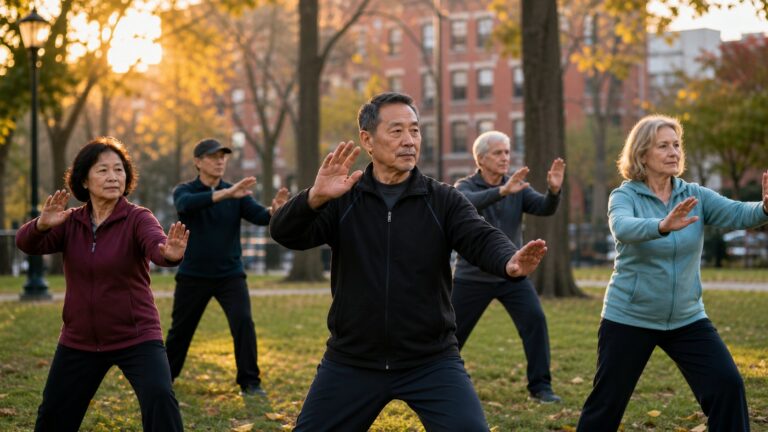
Most people hear about Qigong and Tai Chi at the same time. A friend mentions one, a doctor recommends the other, and a quick search returns results for both. The names appear together on class schedules, YouTube thumbnails, and wellness websites. From the outside, they look almost identical: slow, graceful movements performed by calm people in parks.
The confusion deepens because many teachers offer both. Some classes blend Qigong warm-ups with Tai Chi forms. Studios list "Tai Chi / Qigong" as a single class. Books bundle them together. This packaging makes it hard to tell where one ends and the other begins.
Another factor: the language itself. "Qi" appears in both names. "Qigong" translates roughly to "energy work" or "breath skill." "Tai Chi" (or Taijiquan) translates to "supreme ultimate fist." Unless you read Chinese, those translations don't clarify much.
The result is a beginner standing at a fork in the road without a map. You want to start something, but you don't want to pick the wrong thing and waste three months. That hesitation is reasonable. It's also unnecessary, because the two practices complement each other and switching between them carries zero penalty. But you still need to pick a starting point, and the right starting point depends on your body, your schedule, and your goals.
According to the FAQ resource at DevelopYourEnergy.net, this ranks among the most frequently asked questions from newcomers deciding where to begin. You are not alone in your confusion. The question itself signals good instincts: you want to be intentional about your learning path.
What Does a Typical Qigong Session Look Like?
A standard beginner Qigong session runs 20 to 45 minutes. Here is what to expect.
You start standing with your feet shoulder-width apart, arms relaxed at your sides. The teacher asks you to close your eyes, breathe through your nose, and soften your knees. This takes about two minutes. It feels like doing nothing, but your nervous system is already shifting gears.
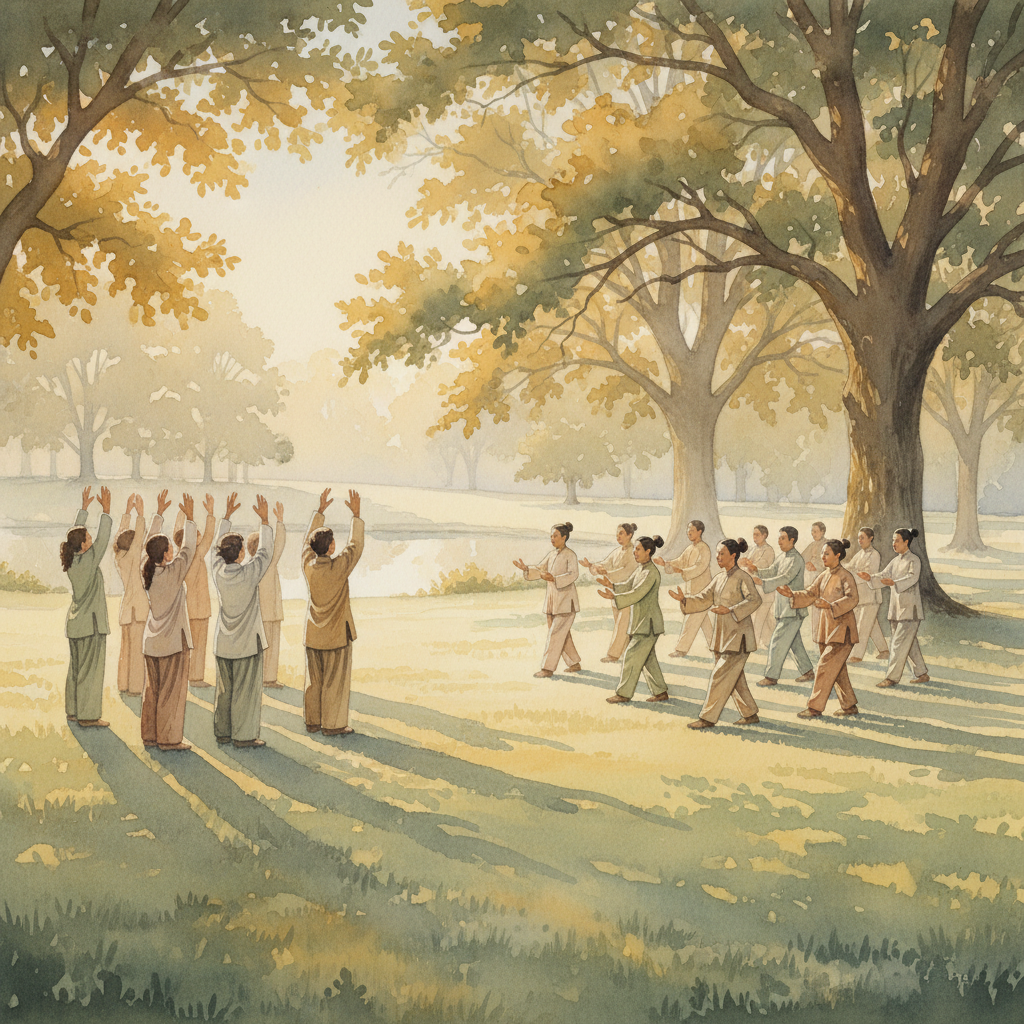
The first exercise might be "Lifting the Sky." You raise both arms in front of you, palms facing up, until they reach overhead. You hold for a breath, then lower them. You repeat this eight to twelve times. The pace is slow, about one full cycle every five seconds.
The second exercise might involve gentle side-to-side twisting, arms swinging loosely. The third might be a standing posture you hold for 60 seconds while breathing deeply. Each exercise targets something specific: spinal mobility, shoulder tension, diaphragm engagement, leg strength.
Between exercises, you pause, stand still, and notice how your body feels. These pauses are part of the practice, not filler.
A full session covers five to eight exercises. The teacher explains each one, demonstrates it, and watches you do it. Corrections are minor: relax your shoulders, bend your knees a little more, slow down your exhale.
By the end of your first session, you own those exercises. You know them well enough to practice alone tomorrow morning. This immediate takeaway is one of Qigong's biggest advantages for beginners. There is no homework of memorizing sequences. Each exercise is self-contained and repeatable.
What Does a Typical Tai Chi Session Look Like?
A beginner Tai Chi class also runs 45 to 60 minutes, but the structure differs from Qigong.
Most classes open with 10 to 15 minutes of warm-ups. These warm-ups are often Qigong exercises, which is part of why the two practices get confused. You do some gentle stretching, weight shifting, and arm circles to loosen up.
Then the main work begins: learning the form. The teacher demonstrates the first three or four movements of the sequence. You follow along, copying the footwork and hand positions. The teacher breaks each movement into parts. "Step left, shift your weight, turn your waist, extend your right hand, sit back." You practice those three movements repeatedly for 15 to 20 minutes.
The next class, you review those movements and add two or three more. Each week builds on the previous one. After four to six weeks, you might know the first eight movements. A full 24-movement short form takes most beginners three to six months to memorize.
The challenge for beginners is the sequential nature. Forget movement number five and you stall. The form doesn't work in pieces the way Qigong exercises do. Each movement sets up the next one. This demands more mental engagement and a longer commitment before you feel competent.
The payoff is substantial. Once you know a Tai Chi form, you carry a complete 10 to 20 minute movement routine in your body. No equipment, no app, no instruction needed. You perform the whole sequence from memory, and the physical and mental benefits compound with each repetition.
Tai Chi also develops coordination, spatial awareness, and balance more aggressively than most Qigong sets because of the walking, turning, and weight-shifting demands.
Which Practice Is Easier for a Total Beginner?
Qigong is easier to start. This is not a matter of opinion. The structural differences make it objectively simpler for someone with zero experience.
Qigong movements are repetitive and stationary. You stand in one place and move your arms, torso, or legs in a pattern you repeat eight to twelve times. Your brain has multiple repetitions within a single session to absorb the movement. If you forget the exact arm angle, it doesn't derail your practice.
Tai Chi movements are sequential and locomotive. You walk, pivot, change direction. Each movement is performed once within the form before moving to the next. Your brain handles new information constantly. Forgetting one transition stops your progress.
Physical demands also differ. Qigong asks for slow, controlled movement within a comfortable range. Tai Chi asks for slow, controlled movement while managing your center of gravity over a changing base of support. The leg strength and balance required for Tai Chi are higher, especially during low stances and one-legged transitions.
Mental demands follow the same pattern. Qigong lets you zone into a meditative state during repetitions. Tai Chi keeps your prefrontal cortex busy with choreography recall.
None of this means Tai Chi is too hard for beginners. Millions of people start with Tai Chi and do fine. Good teachers adapt the form for newcomers by raising the stances and simplifying the footwork. The point is that if you feel overwhelmed by the idea of learning choreography, or if you have limited mobility, Qigong offers a gentler on-ramp.
If you enjoy memorizing sequences and want a physical challenge from day one, Tai Chi will hold your interest better.
What Are the Health Benefits of Each Practice?
Both Qigong and Tai Chi deliver measurable health benefits. Research on both practices has grown significantly since the early 2000s. Here is where each one has the strongest evidence.
Qigong shows strong results for stress reduction, chronic pain management, and blood pressure regulation. The repetitive, meditative nature of the exercises activates the parasympathetic nervous system. Your heart rate drops, your breathing slows, cortisol levels decrease. People with anxiety, insomnia, and chronic fatigue often report improvement within four to six weeks of regular practice.
Tai Chi has the larger research base, partly because it's been studied longer in Western institutions. The strongest evidence supports Tai Chi for fall prevention in older adults, improved balance and proprioception, reduced knee osteoarthritis pain, and cardiovascular fitness. Tai Chi practitioners also show improvements in depression and cognitive function.
Overlap exists because both practices share core elements: slow movement, deep breathing, mental focus, weight shifting. The unique benefits tend to follow the unique demands. Tai Chi's walking and turning patterns build more lower-body strength and dynamic balance. Qigong's stillness and repetition build more relaxation response and breath control.
For a beginner choosing based on health goals: if your primary concern is stress, anxiety, or chronic pain, Qigong gives you faster access to the therapeutic elements. If your primary concern is balance, fall prevention, or joint mobility, Tai Chi's movement vocabulary addresses those more directly.
If your goal is general wellness with no specific condition driving your decision, either practice delivers. Pick the one that appeals to your learning style and personality.
How Much Time Do You Need to Practice Each Week?
Qigong delivers noticeable benefits with 10 to 20 minutes per day, three to five days per week. A single exercise takes two to three minutes. A set of five exercises takes 15 minutes. You feel the effects of a session immediately: calmer breathing, looser shoulders, quieter mind. Cumulative benefits like better sleep and lower resting heart rate show up after two to four weeks of consistent practice.
Tai Chi needs more time per session because you're running a form. A 24-movement short form takes about six minutes to perform at a slow pace. Most practitioners run it two to three times per session, totaling 15 to 20 minutes. But during the learning phase, you spend additional time drilling individual movements and transitions. Budget 30 to 45 minutes per practice session during your first three months.
Weekly frequency matters more for Tai Chi than Qigong during the learning phase. Practice less than three times per week and you'll forget the sequence between sessions. This creates frustration and slows progress. Qigong is more forgiving of irregular schedules because each exercise stands alone.
Once you've memorized a Tai Chi form, the time commitment drops. You run through the form in the morning, spend 10 minutes on it, and you're done. At that point, the maintenance demands are similar to Qigong.
The practical takeaway: if your schedule is unpredictable or you only have 10-minute windows, Qigong fits better. If you have a consistent 30-minute block most days, Tai Chi is viable from the start.
Do You Need Any Equipment or Special Clothing?
Neither practice requires equipment. No mats, no weights, no resistance bands. You need a space roughly six feet by six feet for Qigong and about eight feet by eight feet for Tai Chi (the walking patterns need more room).
Clothing should be loose enough to allow full arm raises and deep knee bends. Athletic wear works fine. Traditional loose-fitting Chinese practice clothes exist but are entirely optional. Flat-soled shoes are ideal. Many practitioners go barefoot indoors. Avoid running shoes with thick heels because they interfere with balance and ground feel.
You don't need a studio or gym membership. Both practices work in living rooms, backyards, parks, hotel rooms, and office break rooms. This portability is one of the strongest selling points for both. Your practice goes wherever you go.
The only investment worth considering early on is instruction. A good teacher accelerates your learning dramatically and prevents you from developing habits that limit your progress later. Group classes run $10 to $25 per session in most cities. Private instruction runs $50 to $150 per hour. Online courses range from free YouTube channels to $200 structured programs.
For Qigong, video instruction works well because the movements are simple and repetitive. For Tai Chi, in-person instruction helps more during the first few months because the teacher needs to see your footwork and posture from multiple angles.
What If You Have Physical Limitations or Chronic Pain?
Both practices adapt well to physical limitations. This is one of their greatest strengths compared to conventional exercise programs.
Qigong exercises modify easily. Every standing exercise has a seated version. Arm movements scale down to smaller ranges of motion. Breathing exercises work regardless of mobility level. People in wheelchairs practice Qigong. People with severe arthritis practice Qigong. People recovering from surgery practice Qigong. The adaptability is built into the system because traditional Chinese medicine prescribed these exercises to sick people, not athletes.
Tai Chi also adapts, but the modifications change the practice more significantly. Seated Tai Chi exists, but it removes the walking and weight-shifting elements that provide the balance and lower-body benefits. Standing Tai Chi with higher stances reduces knee and hip strain while preserving most of the coordination benefits. A skilled teacher makes these adjustments without losing the essence of the practice.
If chronic pain drives your decision, consider this: Qigong gives you direct control over intensity from day one. Each exercise has a clear on/off switch. Feeling pain in your shoulders? Skip the overhead movements and do the waist rotations instead. Tai Chi's connected form makes it harder to skip sections without disrupting the flow.
Physical therapists increasingly recommend both practices. If you have a specific condition, ask your healthcare provider which movements to avoid, then share that information with your Qigong or Tai Chi teacher. A good teacher works around your limitations without making you feel singled out.
Start conservative. Both practices reward patience. Pushing through pain violates the foundational principles of both systems.
What Age Group Benefits Most from Each Practice?
Age doesn't gatekeep either practice. Children as young as six learn Tai Chi forms in China. Adults in their 90s practice Qigong daily. The question is more about life stage and what your body needs right now.
People under 40 often gravitate toward Tai Chi because it offers more physical challenge and a sense of progression. Learning the form feels like building a skill, similar to learning an instrument. The martial applications interest some younger practitioners. The coordination demands keep the mind engaged in a way that appeals to people accustomed to stimulating workouts.
People over 60 often gravitate toward Qigong because the entry point is gentle and the immediate benefits address their most pressing concerns: stiffness, poor sleep, stress, low energy. The standing postures build leg strength gradually without stressing joints. The breathing exercises improve lung capacity.
The 40 to 60 range splits evenly. Personal preference matters more than age here. Some 45-year-olds want the martial art framework. Others want the meditative simplicity.
Research on fall prevention focuses heavily on adults over 65, and Tai Chi dominates that evidence base. If fall risk concerns you or a family member, Tai Chi deserves serious consideration despite its longer learning curve.
The honest answer: try both. Most communities offer introductory classes or free first sessions. One session of each tells you more about your preference than any article or video. Your body's response to the movements gives you data no comparison chart provides.
How Do You Find a Good Teacher?
Finding a good teacher matters more than choosing between Qigong and Tai Chi. A great Tai Chi teacher serves you better than a mediocre Qigong teacher, and vice versa.
Start local. Search for classes at community centers, YMCAs, senior centers, martial arts studios, and parks departments. These venues offer affordable group classes and attract experienced teachers who prioritize accessibility over mysticism.
Watch a class before joining. A good teacher demonstrates clearly, corrects students individually, and explains the purpose behind each movement. Red flags include teachers who talk more than they move, claim miraculous health cures, or discourage questions.
Ask about the teacher's training background. Reputable teachers name their lineage: the teacher who taught them, the style they practice, and how many years they've been teaching. Certifications vary in quality because no single governing body regulates Qigong or Tai Chi instruction. Years of practice and teaching experience matter more than certificates.
Online instruction works well as a supplement. Several respected teachers offer structured video courses. For Qigong, online-only learning is viable because the movements are simple enough to self-correct with a mirror. For Tai Chi, start in person if possible, then use online resources to reinforce what you learn in class.
Ask fellow students about their experience. Long-term students who show up week after week signal a good teacher. High turnover signals the opposite. Trust the social proof of consistent attendance over any marketing material.
Is It Possible to Practice Both at the Same Time?
Yes. Many practitioners do both, and the two practices reinforce each other.
A common approach: learn Qigong first for two to three months. Build a daily routine of five to six exercises. Develop your breathing patterns, your ability to stand still, and your body awareness. Then add Tai Chi classes while maintaining your Qigong practice.
The Qigong foundation helps your Tai Chi in specific ways. You already know how to coordinate breath with movement. You already know how to relax your shoulders while engaging your legs. You already understand the concept of slow, intentional movement. These skills transfer directly into Tai Chi and shorten the awkward beginner phase.
Some practitioners use Qigong as a warm-up before Tai Chi practice. Five minutes of Qigong exercises prepare the body and focus the mind. Then 20 minutes of Tai Chi form practice follows. This combination takes 25 to 30 minutes and covers both practices in a single session.
Other practitioners separate them entirely. Qigong in the morning for calm focus. Tai Chi in the evening for physical practice. The separation works well for people who prefer shorter, more frequent sessions.
The only caution: during your first month with either practice, give it your full attention. Learning two new movement systems simultaneously confuses muscle memory. Let one practice settle into your body before introducing the second. After the initial learning phase, combining them is seamless and beneficial.
What Is the Recommended Starting Path for Most Beginners?
For most people with no experience in either practice, this path works well:
Weeks 1 through 4: Learn a basic Qigong set of five to eight exercises. Practice three to five days per week, 15 to 20 minutes per session. Focus on breathing coordination and physical relaxation. By the end of month one, these exercises should feel natural and require no mental effort to perform.
Weeks 5 through 8: Continue daily Qigong practice. Attend your first Tai Chi class. Expect to feel clumsy and confused during Tai Chi. This is normal. Your Qigong experience will help with breathing and relaxation, but the choreography is new territory. Practice the Tai Chi movements you've learned for 10 to 15 minutes on non-class days.
Weeks 9 through 16: Your Qigong practice is now habitual. Reduce it to 10 minutes as a warm-up. Increase your Tai Chi practice time as you learn more of the form. By week 16, you'll know enough of the Tai Chi form to practice it as a continuous sequence.
Weeks 17 onward: Run your Tai Chi form two to three times per session. Use Qigong exercises for days when you need a gentler practice or when time is short. You now have two complementary practices that serve different needs on different days.
This path works because it builds skills progressively. Qigong establishes the foundation. Tai Chi adds complexity on top of that foundation. You avoid the frustration of starting with Tai Chi's steep learning curve before your body understands the basics of slow, coordinated movement.
Adjust this timeline to your reality. Some people spend three months on Qigong before touching Tai Chi. Others jump into Tai Chi after two weeks. Neither approach is wrong. The right pace is the one that keeps you practicing.
Your Decision Simplified
Qigong and Tai Chi are siblings, not rivals. They share principles, complement each other, and many practitioners do both. Your choice of where to start depends on three factors: your learning style, your physical condition, and your available time.
Choose Qigong first if you want immediate, standalone exercises you perform from day one. Choose Qigong if you have physical limitations, an unpredictable schedule, or a strong preference for meditative simplicity. Qigong's low barrier to entry makes it the safer default for anyone unsure where to begin.
Choose Tai Chi first if you enjoy learning choreography, want a stronger physical challenge, and have 30 or more consistent minutes most days. Choose Tai Chi if balance and fall prevention are your primary health concerns, since the research base for those outcomes is deep.
The best decision is the one that gets you moving this week. Neither choice locks you in. You switch, combine, or adjust at any point. The practices reward consistency over perfection, patience over intensity. Start with one, give it a genuine month of effort, and let your body tell you if it's the right fit. If it is, keep going. If it isn't, try the other. Both paths lead to better health, calmer breathing, and a body that moves with more ease than it does today.
Key Takeaways
- Qigong uses standalone exercises; Tai Chi uses connected choreographed forms. This structural difference shapes the beginner experience.
- Qigong offers a faster on-ramp with exercises you practice independently after a single session.
- Tai Chi builds more balance, coordination, and lower-body strength but takes months to learn a complete form.
- Starting with Qigong for one to two months builds a foundation that makes learning Tai Chi easier.
- The best choice is whichever practice you will do consistently. Try both and let your body decide.
Suggested Internal Links
- beginner qigong exercises — Link when describing simple qigong movements like Lifting the Sky
- tai chi forms explained — Link when discussing the 24-movement short form structure
- breathing techniques for stress relief — Link within the health benefits section discussing parasympathetic activation
- fall prevention exercises for seniors — Link in the age group section when discussing balance training for older adults
- how to find a tai chi class near you — Link in the finding a teacher section