
The Greater Kan & Li Meditation Ultimate Guide to Practice

Greater Kan and Li is an advanced Taoist inner-alchemy practice, so understanding its framework matters more than chasing dramatic sensations. If you are considering this path, you need a clear distinction between spiritual teachings and established health evidence. Internal alchemy is a Taoist framework that describes refining and transforming bodily, mental, and spiritual energies.
This introduction can help you understand the tradition’s terms, the practice’s place in its progression, and sensible boundaries for learning. It does not promise visions, immortality, or a particular energetic experience. Descriptions of inner alchemy belong to a spiritual framework, not a proven medical treatment, so use them as traditional teachings rather than clinical claims.
Key Takeaways
- Greater Kan and Li belongs to Taoist spiritual practice.
- Its symbols describe traditional ideas, not literal anatomy.
- The practice is presented as an advanced level.
- Experiences alone cannot prove spiritual progress.
- Research on other meditation programs does not test this formula.
- Treat any instruction involving intense breathwork or sexual-energy exercises as something to learn directly from a qualified teacher.
What Is The Greater Kan & Li Meditation?
Greater Kan and Li is an advanced form of Taoist inner alchemy associated with Mantak Chia’s Universal Healing Tao system. It develops ideas introduced in earlier formulas, using a spiritual framework to describe refinement and transformation. It is a contemplative tradition, not a verified medical treatment.
Mantak Chia and Andrew Jan coauthored The Practice of Greater Kan and Li: Techniques for Creating the Immortal Self. The book presents this practice as an advanced stage within the system. Readers may encounter terms about the body, energy, and consciousness that carry meanings specific to Taoist inner alchemy.
Read claims about spiritual attainment as tradition-specific teachings, not as measurable promises about your body or future.
The Universal Healing Tao places this work within a wider path of practices. Its language can sound literal, especially when it refers to an “immortal self.” In this setting, that phrase expresses a spiritual idea about transformation, rather than a confirmed physiological outcome.
That distinction can help you read descriptions carefully. The tradition may describe subtle energies or spiritual development, but those descriptions are not established scientific measurements. A personal experience can matter deeply to you without proving a medical effect or a particular stage of attainment.
Earlier formulas introduce concepts that later practices develop in different ways. Learning the names and context can make a book easier to follow, but written instructions do not necessarily provide the individual guidance needed for advanced work. Read claims about an “immortal self” as part of the practice’s spiritual vocabulary, not as a promise of a measurable result.
What Do Kan and Li Represent?
In the system discussed here, Kan is the water symbol and Li is the fire symbol. These are symbolic correspondences, not literal water and fire inside your body. The symbols help describe relationships within Taoist cosmology, not physical substances.
Kan is associated with water and yin, while Li is associated with fire and yang. The pairing offers a way to discuss qualities understood as different but related. In this account, their relationship is used as a method for adjusting yin and yang.
| Symbol | Elemental association | Symbolic quality |
|---|---|---|
| Kan | Water | Yin |
| Li | Fire | Yang |
| Qi | Vital energy | Mediating force |
Kan as water and Li as fire
Water and fire offer a compact symbolic language for contrasting qualities. The word “heart,” for example, may point to a traditional center or quality rather than the physical organ alone. Similar care applies when a teaching refers to kidneys or other parts of the body.
Qi is often rendered as vital energy in this framework. The table gives a simple orientation to the symbols, not a complete account of Taoist cosmology. Correspondences can vary by level and lineage, so a teacher may explain additional meanings or different emphases.
How yin and yang shape the symbolism
Yin and yang describe complementary qualities that can be considered in relation to one another. They are not simply labels for good and bad, or a claim that one quality should always dominate. Their interaction gives the symbols meaning within the practice’s spiritual model.
Different texts and lineages may explain these ideas with more detail. A simple chart is useful for getting oriented, but it cannot capture every symbolic layer. Keep the symbols distinct from literal anatomy, especially when a practice uses words such as “heart” or “kidneys” symbolically.
How Does Taoist Inner Alchemy Frame the Practice?
Taoist inner alchemy treats body, mind, and spirit as connected aspects of a process of refinement. It gives practitioners a spiritual map for describing change, rather than a settled scientific account of human biology. Use its language within its cosmological setting.
A common three-part set is Shen, Jing, and Qi, often rendered as spirit, essence, and vital energy. Jing refers to essence in this tradition; Qi is its vital-energy concept; Shen refers to spirit or spiritual awareness. These translations are helpful starting points, not exact substitutes for every traditional meaning.
Some teachings also use Early Heaven and Later Heaven. These terms describe unmanifest existence and embodied existence within Taoist cosmology. They are philosophical and spiritual concepts, not scientific descriptions of stages that research has established.
The tradition connects ideas about consciousness and the physical body through a shared language of refinement. This can help practitioners organize their understanding of inner experience. It does not mean that each term corresponds directly to a measurable organ, hormone, or brain process.
The Book of Changes is associated with Kan and Li in this tradition. Lu Dongbin discussed their meditative use about 1,000 years ago. Those historical and spiritual associations help place the practice within a longer tradition, without establishing modern clinical effects.
As you encounter these terms in books or classes, ask how a teacher uses them in that particular context. One English translation may not carry every layer of meaning. Use these terms as a map of the tradition’s ideas, not as one-to-one labels for modern anatomy.
How Does Greater Kan and Li Build on Lesser Kan and Li?
Lesser Kan and Li begins the sequence by reversing the traditional fire-over-water arrangement. In this teaching, the reversal is an inner-alchemy image that starts a process of transformation. The progression describes spiritual practice, not a clinical scale of improvement.
The traditional account gives Lesser Kan and Li a primary emphasis on healing organs and dissolving blockages. Those phrases belong to the system’s spiritual language; they should not be read as evidence that the formula treats disease or physically clears an obstruction.
| Formula | Place in progression | Traditional emphasis | How it relates to the previous stage |
|---|---|---|---|
| Lesser Kan and Li | Starting formula | Initiate transformation, healing, and dissolving blockages | Begins the process |
| Greater Kan and Li | Further development | Develops the transformation | Builds on Lesser |
| Greatest Kan and Li | Later development | Reinforces and extends the transformation | Follows Greater |
The reversal introduced by Lesser Kan and Li
The arrangement serves as a traditional way to express a change in how water and fire relate. It is not a direction to move body fluids or organs. The formula is presented as initiating work that subsequent practices continue.
Words such as “healing” and “blockage” can have different meanings in spiritual teachings and health care. A traditional description does not establish that a meditation can diagnose, prevent, or cure a medical condition.
What Greater Kan develops
Greater Kan and Li is described as further developing the transformation begun by Lesser Kan and Li. Greatest Kan and Li and Sealing of the Five Senses are also presented as later practices that extend or reinforce this work. This is the system’s stated progression, not a guaranteed sequence of personal results.
Practitioners may learn these formulas at different points within a teacher’s curriculum. The progression describes a system of spiritual practice, not a guaranteed timetable for personal change.
How Do Greater, Greatest, and Sealing of the Five Senses Differ?
These names refer to related practices in a progression, rather than three interchangeable labels for one exercise. The tradition presents Greater Kan and Li, Greatest Kan and Li, and Sealing of the Five Senses as further developments of earlier transformation. There is no universal sensation checklist for moving between them.
Greater Kan and Li is one named practice; Greatest Kan and Li is another, and Sealing of the Five Senses has its own name and place. The labels signal distinct teachings within the Universal Healing Tao system, but they do not by themselves explain every method or prerequisite.
Greater and Greatest Kan and Li
The terms “Greater” and “Greatest” indicate related levels in the tradition’s progression. They do not establish a fixed ranking of sensations, spiritual powers, or achievements that every practitioner must experience. Descriptions of transformation are part of the system’s spiritual framework.
A student’s path may depend on the teacher’s curriculum and instruction. The label of a practice alone is not enough to determine whether a person is prepared to learn it. A steady foundation and clear guidance matter more than trying to match another student’s account.
Sealing of the Five Senses
Sealing of the Five Senses is presented alongside the later Kan and Li practices as another way to develop the transformation begun earlier. Its name may sound like a literal instruction to block sight, hearing, or other senses. Do not infer a method from the title alone.
Descriptions do not establish signs that apply to every practitioner or a universal point at which everyone should advance. Ask your instructor what the next practice involves, which foundations it assumes, and how to pause if it feels unsuitable. Use the teacher’s curriculum and your readiness to practice steadily as the basis for progression, not a sensation checklist.
What Preparation Helps Before a Session?
Preparation should make the body and mind feel settled, not strained or intensely activated. Choose a comfortable, quiet setting and a posture you can maintain without forcing yourself. A warm-up does not replace learning an advanced formula from a qualified instructor.
Some teachers include the Inner Smile or Fusion of the Five Elements as warm-up practices. Begin them only when they are part of the instruction you have received. Fusion of the Five Elements is a preparatory practice in this system, not an automatic requirement for every student.
Settle the body and mind
Use a chair, cushion, or lying position that feels stable and comfortable. Let your attention arrive without demanding a special mood or level of energy. A quiet place can help, but the room does not need to be elaborate or perfectly silent.
- Choose a quiet space.
- Set aside interruptions.
- Sit or lie in a stable, comfortable position.
- Begin only with practices you have been taught.
Use the preparatory practices
The Inner Smile and Fusion of the Five Elements may help some students enter a session in a familiar way. Their role depends on the teacher’s instructions. Do not treat a warm-up as permission to experiment with advanced exercises you have not learned.
Preparation should leave room for ordinary comfort. You do not need to create a dramatic bodily response before beginning. If a warm-up increases discomfort, stop and return to ordinary breathing.
What Happens During a Greater Kan and Li Session?
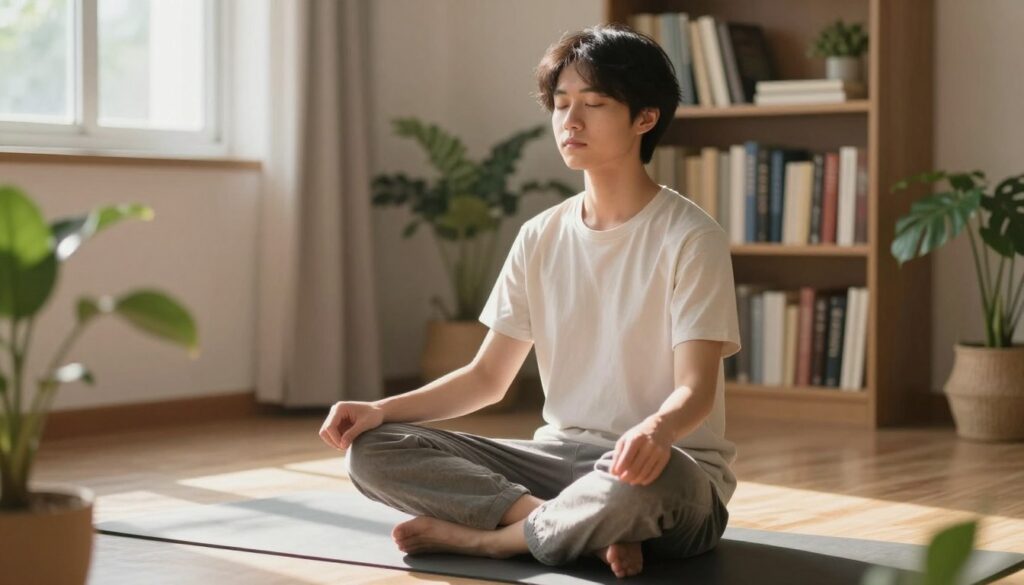
A session is better understood as a guided sequence of attention and imagery than as a single dramatic event. Descriptions may use a symbolic cauldron as a center of attention and involve the solar plexus and heart center. Your own teacher should supply the exact sequence and methods.
Some practice descriptions include energies associated with the Sun, Moon, Earth, North Star, and Big Dipper. These references belong to the system’s imagery and spiritual framework. They are not instructions to expect a visible event or a physical force from the sky.
The cauldron and centers of attention
The cauldron functions as a symbolic center in some descriptions. Attention may also involve the solar plexus and heart center. These terms guide contemplative focus within the practice, and should not be confused with medical directions about organs or treatment.
Imagery can be vivid for one practitioner and faint for another. A quiet session can still be meaningful within a contemplative routine. There is no need to manufacture a sensation to make the practice seem authentic.
Working with symbolic energies
The Sun, Moon, Earth, North Star, and Big Dipper may appear in instructions as parts of a wider symbolic landscape. How a teacher uses them can depend on the lineage and the level being taught. Follow the wording and limits of the instruction you have received.
- Prepare with a taught warm-up.
- Settle your attention.
- Follow the instructor’s taught imagery.
- Close by resting and returning to ordinary awareness.
This outline is intentionally high level; it is not a substitute for specific teaching. Do not add breath holds, forceful contractions, or extra energy techniques to fill gaps in an instruction.
How Do Breath and Attention Work Together?
In this breathing approach, inhalation is described as drawing Qi inward and exhalation as guiding it outward. That is the system’s traditional language for working with energy and attention. Gentle awareness is different from forceful breath manipulation.
The traditional account says inhalation leads Qi inward and preserves it, while exhalation leads Qi outward and dissipates excess energy. These descriptions express a contemplative model. They are not a measurement of energy moving through the body in a medically established way.

| Breath phase | Traditional direction of Qi | Traditional purpose |
|---|---|---|
| Inhalation | Inward | Preserve Qi |
| Exhalation | Outward | Dissipate excess energy |
| Resting awareness | No directed change | Keep breathing comfortable |
The final row is a practical comfort cue, not a separate classical formula. It helps distinguish natural breathing from an instruction to control each breath. Attention can notice breathing without making it deeper, slower, or stronger.
If you feel strain, dizziness, or unease, stop trying to direct the breath and return to ordinary breathing. Do not add a breathing technique based on a description you only partly understand. Let breathing remain comfortable and natural unless a qualified teacher gives you a specific, safe instruction.
What Does the Water-and-Fire Reversal Mean?
The reversal changes the symbolic relationship between water and fire, not the physical position of organs. In the traditional correspondence, fire is associated with the heart and water with the kidneys. These are traditional images, not anatomical instructions.
The usual symbolic arrangement places fire above water. Lesser Kan and Li reverses that arrangement by placing water above fire. The terms describe an alchemical relationship within the practice, not a literal movement of fluids inside the body.
| Image | Arrangement | Traditional interpretation |
|---|---|---|
| Usual polarity | Fire above water | Energies remain divided |
| Kan-and-Li reversal | Water above fire | The symbols are brought into relation |
| Alchemical reading | Water and fire interact | Transformation is represented |
In this account, the heart-and-kidney associations describe traditional correspondences. They do not tell you to change your posture, manipulate an organ, or move bodily fluids. Treating metaphor as a physical instruction could cause confusion.
The reversal can be read as bringing contrasting qualities into relation. That interpretation belongs to the system’s spiritual language; it is not a claim that the body’s organs literally change position or function. Different teachers may offer further nuance.
A diagram can make the arrangement seem like a mechanical recipe. It is better understood as a symbolic image unless your teacher explains a specific practice in context. Treat “water above fire” as an alchemical image unless a teacher explains its specific meaning within your lineage.
What Outcomes Do Practitioners Seek?
Practitioners may approach Greater Kan and Li for spiritual development, while the tradition’s larger claims are not guarantees. Some descriptions name an integrated spirit body and realization of Wu Wei as spiritual aims. Longevity, healing, astral flight, and immortality are not established outcomes.
Wu Wei is a Taoist idea often described in terms of action that does not rely on forcing. Its meaning belongs to a wider philosophical tradition. A practitioner may take it as a spiritual orientation rather than a result that can be confirmed by one unusual session.
Spiritual aims in the tradition
The book description lists mental and physical health, longevity, astral flight, and realization of Wu Wei among the tradition’s aims. These claims express the practice’s spiritual worldview. They do not establish that a specific outcome will occur, or that the practice can replace health care.
Ideas about cultivating a spirit body are also tradition-specific. You may find them meaningful as spiritual language, but they are not verified physical changes. Keeping that distinction clear helps you engage with the teaching without treating belief as clinical evidence.
Everyday aims and reasonable expectations
You can set a modest goal that does not depend on supernatural experiences. For example, you might aim to build a regular contemplative habit, focus your attention for a personally comfortable period, or learn Taoist ideas with care.
Track something you can observe, such as whether you practiced or how settled you felt afterward. A log cannot prove a spiritual claim, but it can help you notice whether the routine fits your life. Set a personal goal you can observe, such as keeping a calm, consistent practice, rather than judging success by supernatural experiences.
Which Sensations Count as Progress?
No single sensation can reliably certify that a spiritual stage has been completed. Warmth, tingling, imagery, or unusual feelings can occur during contemplative practice, but they are not proof that an “immortal embryo” has formed. Experience is not a spiritual scorecard.
Lesser Kan and Li, Greater Kan and Li, and Greatest Kan and Li are distinct named stages in the practice. “Immortal embryo” is a spiritual-alchemy term used in descriptions of the practice, not a medically verified body structure.
A strong image or physical sensation may feel important, but it does not confirm a particular level. Attention, expectation, sleep, and stress can all shape how a session feels. Avoid turning someone else’s account into a standard you must reproduce.
- Note what happened without embellishment.
- Consider sleep and stress.
- Avoid comparing experiences with others.
- Seek qualified help if an experience is distressing or disrupts daily life.
A neutral record can keep an experience in perspective. Write down the date, general circumstances, and what you noticed, without deciding what it means immediately. A trusted teacher can help interpret it within the tradition, while a health professional can address distressing symptoms.
Record experiences neutrally and let a trusted teacher help interpret them within the tradition.
Is Greater Kan and Li Safe for Everyone?
Meditation is not free of risk, and a distressing response is a reason to pause rather than push through. A 2020 review of 83 meditation studies involving 6,703 participants found that 55 studies reported negative experiences. Researchers estimated that about 8 percent of participants experienced a negative effect, most commonly anxiety or depression.
Those results concern meditation broadly, not Greater Kan and Li specifically. An analysis limited to three mindfulness-based stress reduction studies involving 521 participants found the practices were not more harmful than receiving no treatment. That finding also does not test this advanced Taoist formula.
What meditation safety research can and cannot show
Research on meditation includes practices that differ in structure, duration, and teaching. The results cannot show that every method has the same risks or benefits. In particular, general meditation findings should not be treated as direct safety evidence for Greater Kan and Li.
That distinction matters when a practice includes advanced imagery or other methods taught within a specific tradition. A study of one program does not establish the safety of every contemplative exercise. Your own response is still important, even when research findings describe groups.
When to pause and seek support
Stop a session if distress is increasing. Pause advanced methods and seek help if symptoms continue or begin to disrupt daily life. A meditation practice should not take the place of appropriate mental or physical health care.
- Stop if distress escalates.
- Return to ordinary breathing.
- Contact a qualified health professional if symptoms persist.
- Seek instruction from an experienced teacher before resuming advanced methods.
Consult a health professional about persistent anxiety, depression, or other symptoms, and do not use this practice in place of care.
Make room for help from both a qualified health professional and an experienced teacher when appropriate. The roles differ: one addresses health needs, while the other can explain the practice within its tradition.
How Can You Build a Mindful Routine?
A routine is easier to sustain when it fits the rest of your day instead of competing with it. Choose a repeatable time and comfortable location that work with your responsibilities. A manageable habit is more useful than a schedule that leaves you strained.
Keep a simple practice log with the date, the practice you did, and a brief note about how it felt. You can use a short, familiar routine on busy days rather than trying to make every session long or elaborate. Let your teacher guide any advanced work.
Participation in meditation among U.S. adults rose from 7.5 percent in 2002 to 17.3 percent in 2022. That national statistic offers social context, not proof that Greater Kan and Li is effective or suitable for everyone.
A routine should leave room for sleep, work, and relationships. If an evening session makes it harder to sleep, choose a different time or use a familiar, gentler practice. A change in schedule can be a sensible adjustment, not a failure of commitment.
Your log can show whether the habit fits your life over time. Keep entries brief enough that recording them does not become another obligation. Keep the habit manageable and adjust it if practice begins to interfere with sleep, work, or relationships.
How Should You Choose a Teacher or Book?
Choose guidance that explains prerequisites and limits as clearly as it explains the practice. Clear instruction matters when a method is presented as advanced. A book can support study, but it cannot provide individualized guidance.
The Practice of Greater Kan and Li: Techniques for Creating the Immortal Self is a 245-page guide coauthored by Mantak Chia and Andrew Jan, originally published in Thailand in 2012. It is a resource on the practice, not a substitute for personal instruction.
When considering a teacher, find out how classes introduce prerequisites and respond to students who feel discomfort. A careful instructor should explain what a method involves before asking you to try it. You should be able to ask questions without pressure to agree with every spiritual claim.
- Look for clear prerequisites.
- Choose gradual instruction.
- Expect explicit permission to pause.
- Avoid promises of guaranteed healing or supernatural outcomes.
Books can explain terms and offer a record of a system’s teachings. They cannot observe how you respond or adapt instruction to your needs. Be especially cautious when a resource presents intense exercises without clear explanations of preparation and limits.
Ask what a course assumes you already know, and how an instructor handles distress or unexpected experiences. Compare the answer with your own comfort and readiness before joining. Before joining a course, ask what preparation it assumes and how the instructor handles distress or unexpected experiences.
What Does Research Say About Meditation and Mindfulness?
Evidence about mindfulness-based stress reduction cannot be assumed to apply to Greater Kan and Li. Mindfulness-based stress reduction is a defined program, while this formula belongs to Taoist inner alchemy. Evidence for one practice cannot establish the efficacy of another.
A systematic review describes evidence that mindfulness-based stress reduction can improve psychological outcomes such as anxiety and depression. Those findings concern that studied program, not every practice called meditation or mindfulness.
Different practices can vary in their aims, instructions, and structure. A result from one program cannot confirm a separate method’s health effects. This distinction is important when a spiritual practice uses language about healing, energy, or transformation.
For medical concerns, use established health care rather than relying on an advanced spiritual practice. You can still explore Taoist ideas as part of your personal or religious life, while keeping health claims separate from tradition-specific beliefs.
Greater Kan and Li should be approached as a spiritual practice, not as an evidence-based treatment. Be cautious about claims that promise a specific medical result or treat a spiritual experience as proof of healing.
Use established health care for medical concerns and approach claims about this specific formula with appropriate caution.
Conclusion
Greater Kan and Li makes the most sense when its traditional symbols are understood before its experiences are judged. It is an advanced Taoist inner-alchemy practice, and its symbols and aims belong to a spiritual tradition. Keep spiritual teachings distinct from established health evidence.
You do not need to pursue intense sensations to learn about the practice. A grounded next step is to study its foundations with a qualified teacher who can explain prerequisites and answer questions in context.
Start by learning the foundations from a qualified teacher and keep your practice comfortable and grounded.