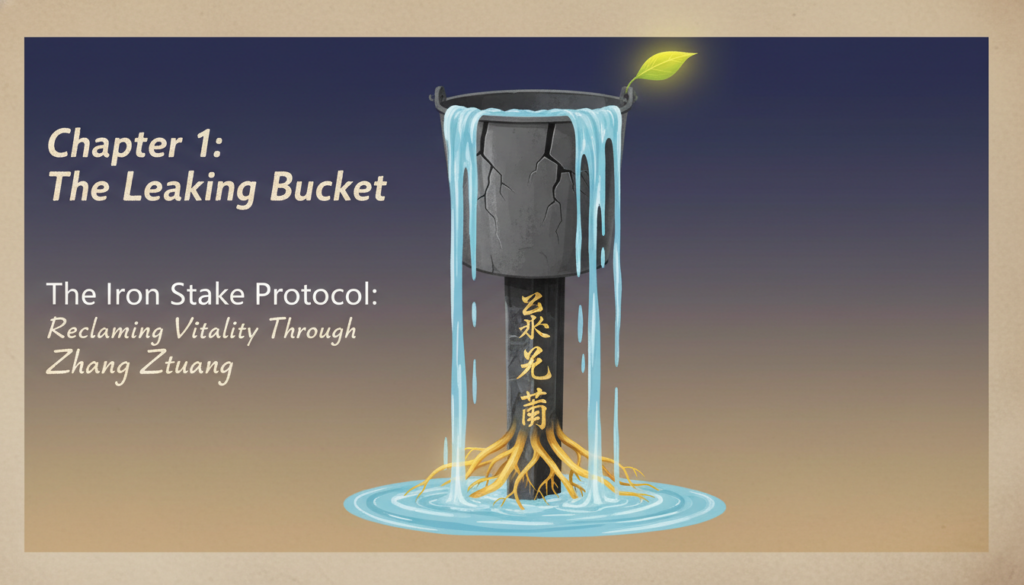
Chapter 1: The Leaking Bucket
Remix
# Chapter 1: The Leaking Bucket
You wake up at 7:00 AM, but your brain is still stuck in a late-night buffer.
Your eyes feel heavy, your neck is a knot of cold iron, and despite “getting eight hours,” you feel like you’ve been run over by a slow-moving freight train. You reach for the coffee—the first of many—hoping to jump-start the system. It works, for an hour. But then the jittery hum sets in, that “wired but tired” vibration where your heart rate is up, but your cognitive clarity is nowhere to be found.
This is **The Glitch**.
It is the signature state of the 21st century: a chronic, low-grade burnout that transforms your body from a high-performance vehicle into a piece of fragile glassware. You feel it in the mental fog that clouds your afternoons and the physical “stiffness” that makes you move like a man twice your age. You feel it in the way your patience snaps over a minor email.
We’ve been told the fix is more sleep, better supplements, or stronger espresso. But if the problem was just a lack of fuel, those fixes would have worked by now. The truth is far more structural.
The problem isn’t that your battery is empty. It’s that your battery is cracked.
### The Myth of the Recharge
Imagine you have a bucket. Your goal is to keep it full of water (your vitality, or *Qi*). Most people spend their lives frantically trying to pour more water into the bucket. They sleep more, they eat “superfoods,” and they chase the next bio-hack.
But if that bucket has ten holes in the bottom, it doesn’t matter how fast you pour. The water level will always drop.
In the world of *Zhang Zhuang* (Standing Meditation), we call this “leaking.” You are leaking energy through three primary holes:
1. **Structural Leaks:** Your posture is a series of collapses and compensations. When your head leans forward to look at a screen, your neck muscles have to work ten times harder to keep you upright. This constant “micro-tension” is a massive drain on your nervous system.
2. **Mental Leaks:** Your brain is in a state of sympathetic overdrive—the “fight or flight” response. Even when you are sitting still, your body thinks it’s being hunted by a predator because of the unrelenting stream of notifications and deadlines.
3. **Joint Leaks:** In traditional Zhang Zhuang theory, the joints are like electrical substations. When they are “gripped” tight by stress, the current can’t flow. Instead of power moving through you, it gets stuck, creating inflammation and fatigue.
Caffeine doesn’t fix a leak; it just increases the pressure of the water you’re pouring in. Sleep doesn’t fix a leak; it’s just a temporary pause in the pouring. To truly reclaim your vitality, you don’t need to “recharge.” You need **structural repair.**
### Enter the Iron Stake
*Zhang Zhuang*—translated literally as “standing like a post” or “standing like a stake”—is often called “meditation.” But that word is misleading. For the beginner, Zhang Zhuang is not about finding “zen” or thinking happy thoughts.
It is **Structural Engineering for the Human Body.**
Think of your body as a high-tension electrical grid. If the towers are leaning and the wires are frayed, the grid will blow a fuse the moment you try to run high voltage through it. Zhang Zhuang is the process of straightening the towers and reinforcing the lines.
When you stand in the “Iron Stake” protocol, you aren’t just standing still; you are engaging in a sophisticated process of *alignment*. By holding specific, gravity-defying postures, you force the body to stop relying on its exhausted “outer” muscles and start engaging its deep, resilient connective tissues (fascia).
You are closing the leaks.
By aligning the skeleton so perfectly that gravity passes through you instead of crushing you, you release the chronic “grip” of your muscles. This shifts your nervous system from “Survive” to “Restore.” For the first time in years, the “human battery” stops losing charge.
This book is not about “relaxing” in the way you’ve been taught. It’s about becoming a stake driven deep into the earth—immovable, integrated, and finally, leak-proof.
Before we can build power, we must stop the waste. We must fix the bucket. It’s time to stand.
Chapter 2: The Paradox of Power
## Chapter 2: The Paradox of Power
In the modern world, we are conditioned to believe that power is the byproduct of friction. We think of sweat, heavy iron, and the explosive exertion of the “hustle.” We are taught that to gain anything, we must first spend ourselves. But in the realm of *Zhan Zhuang*—the art of Standing Meditation—we encounter a radical inversion of this logic. Here, we discover the **Paradox of Power**: that the greatest strength is not found in the heat of movement, but in the cold, dense potential of absolute stillness.
### The Core Philosophy: Movement and Stillness
In the classical internal arts, there is a fundamental law of bio-energetics: **”Movement creates exhaustion; Stillness creates accumulation.”**
When we move—whether we are running a marathon or simply pacing a room—our internal battery is in a state of discharge. Energy (Qi) is pushed to the extremities to facilitate action, and in that process, it is dissipated. While movement is necessary for life, excessive or “noisy” movement leaks our vitality.
*Zhan Zhuang* (literally “Standing like a Stake”) is the practice of plugging those leaks. By assuming a fixed, structurally perfect posture and holding it, you cease the outward expenditure of energy. The body becomes a closed circuit. Within this “Stake” position, the energy that usually fuels movement begins to turn inward, sinking into the bones, saturating the organs, and pooling in the lower *Dantian* (the body’s energetic center).
In stillness, you are not merely “doing nothing.” You are engaging in a process of **accumulation**. You are the vessel being filled, rather than the fountain being drained.
### The Gym Mentality vs. The Internal Mentality
To understand the rationality behind standing, we must contrast it with the prevailing “Gym Mentality.”
* **The Gym Mentality (Expenditure):** Most Western exercise is catabolic. We go to the gym to “break down” muscle so it can rebuild. We judge a workout by how much we have *spent*—calories burned, sweat lost, fatigue earned. It is a philosophy of sacrifice: you give up your current energy in hopes of a future return.
* **The Internal Mentality (Accumulation):** The *Zhan Zhuang* practitioner views the body as a precious reservoir. The goal of the “Internal Mentality” is to cultivate a surplus. Instead of breaking the body down, we are reinforcing it. We are training the nervous system to be calm under pressure and the fascia to support the weight that muscles usually struggle to carry.
While the gym-goer leaves their session feeling “spent,” the *Zhan Zhuang* practitioner aims to finish their session feeling “full.” It is the difference between spending your paycheck every Friday versus putting it into a high-yield savings account.
### Why “Doing Nothing” is the Hardest Workout
If you have ever tried to stand perfectly still for twenty minutes, you know the secret: it is arguably the most grueling physical challenge a human can face.
How can doing nothing be so hard? The answer lies in **Structural Integrity**. In a typical workout, the “mobilizer” muscles (the big, visible ones) take the brunt of the work. When we stand in *Zhan Zhuang*, we purposefully bypass these mobilizers and force the “stabilizer” muscles and the skeletal structure to take the load.
This shift triggers a “rebellion” in the body. Within minutes, the legs may begin to shake—a phenomenon known as the “shaking of the bones.” This isn’t just fatigue; it is your nervous system recalibrating. It is your body realizing it cannot rely on its usual, inefficient patterns of tension. To survive the posture, the body is forced to “let go” of superficial tension and sink the weight into the fascia and the bone marrow.
You are working at a cellular level. You are training the very fabric of your being to hold weight without stress. It is a workout of the spirit as much as the flesh.
### Defining “Kinetic Silence”
The ultimate goal of this stillness is a state we call **Kinetic Silence**.
Kinetic Silence is not the absence of power; it is the presence of *total potential*. Imagine a bow that is fully drawn. To an outside observer, the bow is perfectly still. There is no movement, no noise, no “work” being done. But beneath that silence is a terrifying amount of stored kinetic energy.
When you stand as an “Iron Stake,” you are that drawn bow. Your body is aligned, your joints are “open” but connected, and your intent is sharp. You are practicing the art of being “full” yet quiet. In this state, you develop a type of power that is explosive and effortless because it doesn’t need to be “generated” from a standstill—it is already there, waiting in the silence.
By mastering the paradox—by choosing stillness over movement—you stop the leak of your life force. You begin the journey of reclaiming a vitality that doesn’t fade with age, but thickens with every minute spent in the silence of the Stake.
Chapter 3: Zero Point – The Wuji Stance
# Chapter 3: Zero Point – The Wuji Stance
Before a single punch is thrown, before a form is executed, and before energy can be directed, there must be a return to the void. In the tradition of Zhang Zhuang, this is known as *Wuji*—the state of “no extremity” or “absolute nothingness.”
If your life feels like a chaotic whirlwind of movement, the Wuji stance is your eye of the storm. It is the architectural foundation of the Iron Stake Protocol. To the outside observer, you are merely standing. Internally, however, you are undergoing a structural revolution. You are learning to stand before you earn the right to move.
### The Architecture of Stillness
Wuji is not “natural” standing. Most of us stand by leaning into our joints, locking our knees, and tensing our lower backs. Wuji replaces these unconscious habits with a deliberate, high-performance alignment.
Follow these steps to enter the Zero Point:
**1. The Foundation (Feet and Knees)**
Begin with your feet exactly shoulder-width apart. Ensure they are perfectly parallel, with your toes pointing straight ahead—not flared out. Distribute your weight evenly across the “nine points” of the feet (the heel, the outer edge, the balls of the feet, and all five toes).
Now, **unlock your knees**. This is not a squat; it is a “release.” Imagine the backs of your knees becoming soft. By simply removing the lock, you transition the weight from the joint onto the musculature and, eventually, the bone structure.
**2. The Pillar (Spine and Tailbone)**
The most common energy leak in the human body is the curve of the lower back. To fix this, imagine your tailbone is a heavy plumb bob pulling toward the center of the earth. This “tuck” should be subtle, flattening the lumbar spine without tensing the glutes.
Simultaneously, imagine a silver thread attached to the very crown of your head (the *Baihui* point), pulling you toward the heavens. This creates a “double-pull” effect: the tailbone sinks while the crown rises, elongating every vertebra.
**3. The Gateway (The Kua)**
The *Kua*—the fold of the hip—is the “bucket” of the torso. As you stand, imagine your hips are sitting down on a high barstool. This creates a small “hollow” in the groin area, allowing the torso to rest on the legs like a heavy stone resting on a solid pillar.
### Gravitational Rooting
In the Iron Stake Protocol, we do not simply stand “on” the ground; we “root” into it. This is the phenomenon of **Gravitational Rooting**.
Imagine that your body is a lightning rod. Tension is the “static” that prevents the energy from reaching the earth. Gravitational Rooting is the process of consciously surrendering your weight to the floor. Most people “hold” their weight in their chest or shoulders. In Wuji, you must let it pass through you.
As you stand, visualize roots extending from the bubbling well (*Yongquan*)—the soft spot just behind the ball of your foot—deep into the soil. Every time you exhale, feel your center of gravity sink an inch lower into the earth. You are no longer fighting gravity; you are using it to anchor yourself.
### Dropping the Flesh off the Bones
The most transformative sensation in Wuji is the feeling of **”Bones Up, Flesh Down.”**
Think of your skeleton as a high-quality coat hanger made of polished steel. Now, imagine your muscles, skin, fascia, and internal organs are a heavy, wet wool coat draped over that hanger.
The goal of this stance is to allow the “coat” (your flesh) to literally drop off the “hanger” (your bones).
* **The Shoulders:** Let them slide down your back. Do not pull them; let gravity take them.
* **The Chest:** Allow it to “hollow” and soften. Do not puff it out.
* **The Face:** Release the jaw and the brow. Let the skin of your face feel heavy.
When done correctly, you will feel a strange paradox: your skeleton feels light and buoyant, suspended from above, while your flesh feels like it is melting toward your feet. This internal “stretch” opens the meridians and allows the *Qi* to flow without the interference of muscular “noise.”
### The Protocol of the First Minute
Your first few sessions will be a battle against the “Monkey Mind” and the “Shaking Body.” When you stop moving, your nervous system finally has to face the tension it has been carrying for years.
* **The Tremble:** You may feel your thighs begin to shake. This is good. It is the sound of chronic tension breaking.
* **The Heat:** You may feel warmth in your hands or feet. This is the blood and energy finally reaching the extremities without obstruction.
**Your Task:** Stand in Wuji for five minutes. Do not adjust your clothes. Do not scratch your nose. Simply be the Iron Stake—immovable, rooted, and empty. To move with power, you must first master the art of standing still.
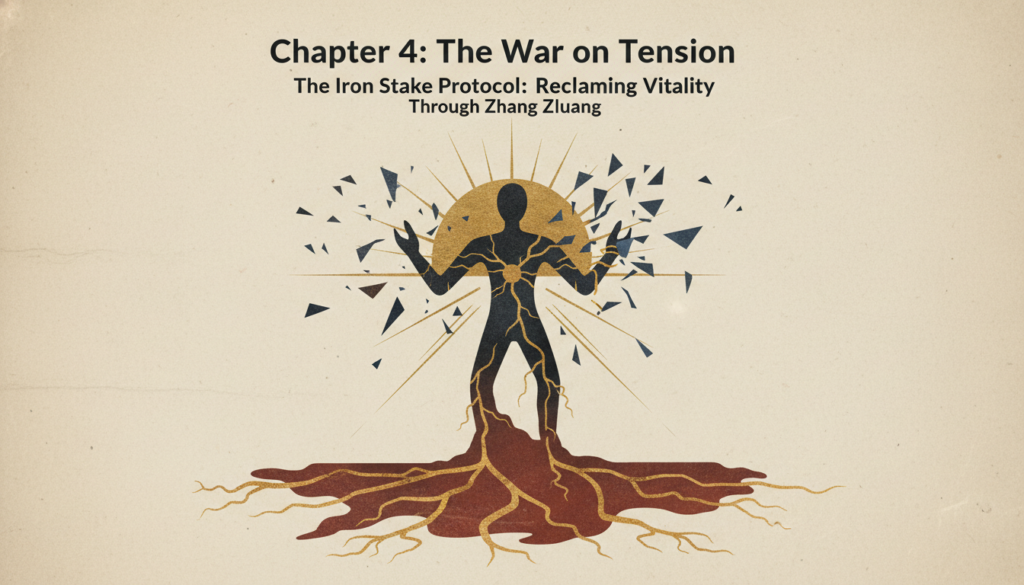
Chapter 4: The War on Tension
Remix
# Chapter 4: The War on Tension
To the uninitiated, Zhang Zhuang looks like doing nothing. To the practitioner, it is an active battlefield. The enemy in this conflict is not an external foe, nor is it the passage of time or the weight of gravity. The enemy is **Unconscious Tension**.
Most of us navigate our lives in a state of “structural debt.” We are perpetually over-leveraged, using massive amounts of muscular force to perform the simplest tasks, including the act of simply existing in an upright position. This chapter identifies the strongholds of this enemy and provides the tactical maneuvers necessary to dismantle it.
### The Primary Enemy: Unconscious Tension
Unconscious tension is the energy you are spending without your permission. It is a parasitic drain on your system, a background process running in your biological “software” that consumes battery life while providing zero utility.
We call it unconscious because you likely don’t even know it’s there. You only notice it when it graduates into chronic pain—a stiff neck at 4:00 PM, a recurring ache in the lower back, or a headache that seems to bloom from the base of the skull. By then, the tension has already won the initial skirmish. In Zhang Zhuang, we go to the root of the problem. We stop treating the symptom and start identifying the “leak” in your vitality.
### The Body’s Trauma Vaults
The human body is an expert at record-keeping. It does not just experience stress; it archives it. When we face a psychological threat or a physical trauma, our nervous system triggers a contraction response. If that stress is never fully processed or released, the contraction remains “locked” in the fascia and muscle fibers.
There are three primary “vaults” where the body stores this structural baggage:
1. **The Jaw:** The gateway of suppressed expression. We clench when we are frustrated, when we are holding back words, or when we are bracing against the world. Chronic jaw tension sends a constant signal to the brain that we are in a state of “threat,” keeping the sympathetic nervous system on high alert.
2. **The Shoulders:** The seat of burden. We “carry the weight of the world” here. When we feel overwhelmed, our shoulders creep toward our ears in a primal shrug—a protective reflex to guard the neck. Over time, this becomes a permanent armor that restricts breathing and cuts off circulation to the brain.
3. **The Hips (The Psoas):** The center of fight or flight. The psoas muscle, deep within the core and hips, is the only muscle that connects the spine to the legs. It is the primary muscle of the startle reflex. If you spend your life in a high-stress environment, your hips are likely “locked,” keeping your body in a perpetual state of readiness to run—even when you’re just sitting at your desk.
### Tactical Maneuver: The Scan and Dissolve Method
To reclaim your energy, you must first locate where it is being held hostage. In the *Iron Stake Protocol*, we use the **Scan and Dissolve** method. This is not a passive relaxation technique; it is a precision-guided systematic release.
While standing in your Zhang Zhuang posture, perform the following:
* **The Internal Scan:** Start at the very crown of your head. Imagine a beam of awareness—like a slow-moving CT scan—moving down through your body.
* **Locate the Grip:** As the scan passes through your jaw, feel for the “grip.” Is the tongue pressed against the roof of the mouth? Is the jaw tight? Move to the shoulders. Are they “hanging” on the skeleton, or are they being “held” up by effort?
* **Breathing Into the Knot:** When you find a pocket of tension, do not fight it. Fighting tension only creates more tension. Instead, bring your *Yi* (intent) and your breath to that specific spot.
* **The Dissolve:** Imagine the tension is a block of ice and your breath is a warm spring wind. On the exhale, visualize that ice melting into water, and that water sinking down through your body, through your legs, and into the ground.
You are not “relaxing” in the sense of collapsing; you are **opening**. In the internal arts, this is called *Sung*. You are stripping away everything that is unnecessary so that only the “Iron Stake”—your true structural integrity—remains.
### The Reframe: Vitality as Recovered Energy
The “War on Tension” is not about building new energy from scratch; it is about **reclaiming what is already yours**.
Think of your vitality like a financial budget. Most people believe they are “tired” because they lack funds. In reality, they are broke because they have a thousand tiny, recurring “subscriptions” to tension that they’ve forgotten to cancel.
When you successfully dissolve a knot in your shoulder or release the bracing in your hips, that energy doesn’t just vanish. It is released back into your central system. This is the “Reframe” of vitality: **Strength is not the ability to exert force; strength is the absence of unnecessary resistance.**
By winning the war on tension, you stop fighting yourself. You move from a state of “effortful standing” to a state of “effortless power.” The energy that was once used to hold your shoulders up is now free to fuel your brain, your immune system, and your life’s purpose. You aren’t just standing; you are refueling.
Chapter 5: Embracing the Tree
# Chapter 5: Embracing the Tree
In the previous chapters, we laid the foundation of the *Wuji* posture—the state of “primordial nothingness” where we aligned the spine and settled the mind. Now, the real work begins. We move from the passive to the active-static, shifting into the primary posture of the Iron Stake Protocol: **Cheng Bao**, commonly known as “Holding the Balloon” or “Embracing the Tree.”
If *Wuji* is the soil, “Embracing the Tree” is the sapling breaking through the earth. It is here that your internal alchemy truly begins to cook, and where your physical limits will be tested, broken, and reforged.
### The Geometry of the Circle
To enter the posture, begin in your basic standing stance. Slowly float your arms up in front of your chest as if you are gently gathering a large, fragile paper lantern or an inflated beach ball.
The mechanics must be precise. This is not a casual lift; it is a structural realignment:
1. **The Rounded Arms:** Your arms should form a near-perfect horizontal circle. Your fingers point toward each other, separated by the width of about two or three fists. The palms face your chest. Crucially, your elbows must remain slightly lower than your wrists and shoulders. Imagine two small balloons tucked under your armpits, preventing your arms from collapsing against your ribs, and two more balloons resting under your elbows, buoying them up from the floor.
2. **The Open Scapula:** As your arms reach forward, do not pull from the shoulder joints. Instead, feel your shoulder blades (scapula) slide outward and away from the spine. This “wraps” the back, creating a broad, powerful curve across your upper shoulders. In martial circles, this is known as “rounding the back to pull the chest.”
3. **The Sunk Chest:** As the back rounds, the chest must naturally “sink” or become slightly concave. Do not slump; rather, imagine the sternum softening and dropping toward the navel. This hollows the chest, allowing your center of gravity to fall into the lower *Dantian* and freeing the diaphragm for deep, unrestricted breathing.
### The Bone Shield Concept
As you hold this position, you will quickly encounter the “Wall.” Your deltoids will burn, your triceps will quiver, and your mind will scream for you to drop your arms. This is the moment of truth in the Iron Stake Protocol.
To endure—and eventually thrive—you must move beyond muscular effort and engage the **Bone Shield**.
Most people stand using their *phasic* muscles—the fast-twitch fibers meant for lifting and moving. These muscles fatigue rapidly. In Zhan Zhuang, we aim to bypass these muscles and transfer the entire weight of the posture onto the skeletal frame.
The Bone Shield is the realization that your skeleton is a self-supporting architectural marvel. When the scapula is open, the chest is sunk, and the joints are “locked” into their natural bio-mechanical grooves, the weight of your arms is no longer held up by the bicep or the shoulder. Instead, the weight travels through the bones of the forearm, into the humerus, through the spread of the back, and straight down the spine into the legs and the floor.
Imagine your muscles are like wet rags hanging off a wooden clothes-horse. The clothes-horse (the skeleton) does all the supporting; the rags (the muscles) simply hang, heavy and relaxed. By “opening” the joints—feeling a sense of space in the elbows and shoulders—you allow the Bone Shield to take the strain. When the skeleton holds the weight, the muscles can finally *Song* (release).
### Entering the Fire
This is where the physical demand of the Iron Stake Protocol increases. In the beginning, the Bone Shield will feel like a myth. You will feel nothing but the leaden weight of your limbs. You may experience the “sewing machine” effect—uncontrollable shaking in the legs or arms as the nervous system resets its tension patterns.
Do not shy away from this heat. The shaking is the sound of your old, inefficient patterns breaking down. When the muscles can no longer hold the weight and they begin to fail, the body is forced to find a better way. It is forced to align the bones.
Embrace the tree, but more importantly, let the tree embrace you. Sink into the structural integrity of your own frame. You aren’t just standing; you are building a fortress of bone that requires no effort to maintain. Stay in the fire until the muscles stop fighting and the Bone Shield takes over. This is the birth of the Iron Stake.
Chapter 6: The Friction Phase
# Chapter 6: The Friction Phase
Up until now, your practice of *Zhan Zhuang* may have felt like a novel experiment—a quiet exploration of alignment and breath. But as you push past the ten-minute mark and into the deep waters of the protocol, you will encounter a wall. In internal martial arts, we call this the **Friction Phase**.
It is the moment the honeymoon ends and the “Iron Stake” begins to earn its name. You are no longer just standing; you are being forged. And the primary sign of that forging is a phenomenon that terrifies most beginners: **The Shakes.**
### The Anatomy of the Tremor
You’re standing in the “Holding the Balloon” posture. Your alignment is perfect. Your breath is deep. Then, without warning, a micro-quiver starts in your quadriceps. Within seconds, it’s no longer a quiver—it’s a full-blown seismic event. Your legs are vibrating like a tuning fork, your knees feel like they might buckle, and a strange, buzzing heat begins to radiate from your marrow.
Physiologically, your legs are shaking because of two things: **muscular fatigue** and **neuromuscular recruitment.** Your large, superficial muscles (the ones used to “holding” tension) are giving up. As they fatigue, the body is forced to recruit deeper, stabilizing muscles and connective tissues that have likely been dormant for years. The shaking is the “handoff” of the weight from your exhausted muscles to your skeletal structure and deep fascia.
### Why the Mind Panics
As your legs begin to tremble, your brain’s survival center—the amygdala—sends out an emergency broadcast. You will experience a sudden surge of “sympathetic panic.” Your heart rate may climb, your breath may become shallow, and a voice in your head will scream: *Something is wrong. We are failing. Stop now before we collapse.*
This panic isn’t a sign of danger; it’s a sign of **proprioceptive confusion.** Your brain has spent a lifetime associating shaking with weakness or imminent injury. It hasn’t yet learned that in the Iron Stake Protocol, shaking is the sound of the engine turning over.
### Reframing: The System Debug
To master this phase, you must adopt a new mental model. Stop viewing the shakes as a failure of strength. Instead, view them as **System Debugging.**
Imagine your body as a high-performance computer running on outdated, buggy code. Over years of sitting in office chairs and carrying stress, you’ve developed “lag” in your nervous system. You have energy blockages (bugs) and inefficient postural habits (memory leaks).
When you stand and the shakes begin, the “Iron Stake” is running a diagnostic. The trembling is your nervous system recalibrating. It is “deleting” old tension and “rewriting” the way your brain communicates with your limbs.
* **The Shaking is the Debugging:** Your nerves are firing rapidly to find the most efficient way to support your weight.
* **The Heat is the Processing Power:** You are burning through the “bad code” of chronic tension.
* **The Weakness is Leaving the Body:** As the old, brittle strength of the muscles fails, the resilient, “wiry” strength of the tendons and fascia begins to take over.
When your legs shake, tell yourself: *“The system is updating. Do not cancel the installation.”*
### Vertical Willpower: The Art of Not Quitting
In most forms of exercise, willpower is “horizontal”—it’s about moving forward, pushing through the next mile, or hitting the next rep. In *Zhan Zhuang*, we practice **Vertical Willpower.**
Vertical Willpower is the art of staying upright when every fiber of your being wants to sit down. It is a quiet, unyielding stubbornness. You aren’t “fighting” the shakes; you are simply refusing to move. You are becoming a stake driven so deep into the earth that no storm can dislodge you.
To cultivate Vertical Willpower:
1. **Drop the Breath:** When the panic rises, exhale long and slow. Direct the air “down” through your legs and into the floor. This signals the nervous system to switch from “Fight or Flight” to “Rest and Digest” even while the body is under stress.
2. **The Ten-Breath Rule:** When you feel you absolutely must quit, tell yourself: *“Ten more breaths.”* Often, by the eighth breath, the “shaking storm” will peak and then suddenly settle into a profound, heavy stillness.
3. **Find the Eye of the Storm:** Observe the shaking as if it were happening to someone else. You are the mountain; the shakes are just the wind on the slopes.
The Friction Phase is where the “gold” is buried. Every second you spend in the shakes is a second spent upgrading your vitality. Don’t fear the tremor—it is the evidence that the protocol is working. Stand still, let the system debug, and watch as your weakness evaporates into the air.
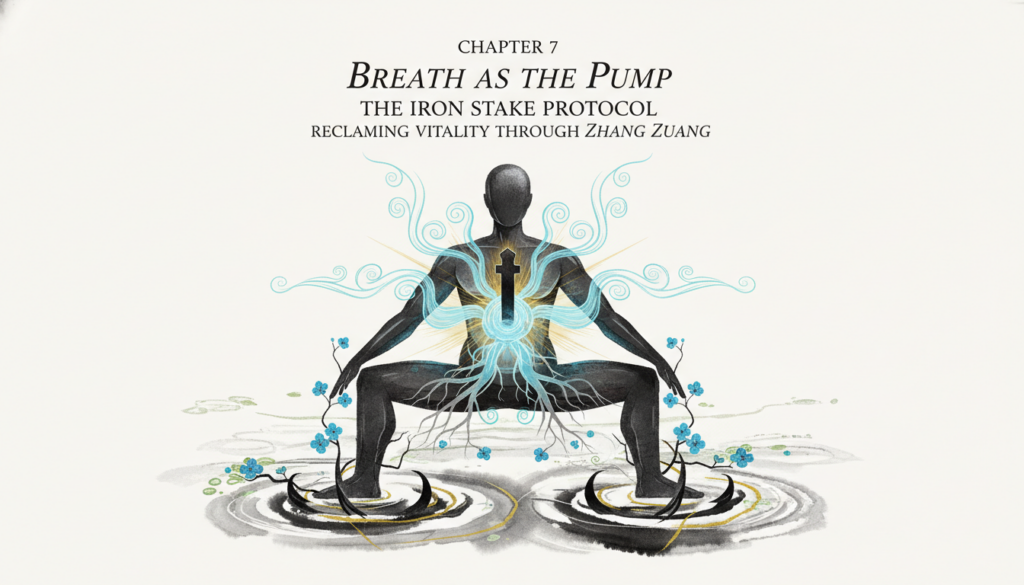
Chapter 7: Breath as the Pump
Remix
### Chapter 7: Breath as the Pump
In the stillness of the *Zhang Zhuang* stance, the body appears to be a statue. To the casual observer, you are merely a person standing in a park or a quiet room, motionless and silent. But beneath the surface, a massive industrial process is underway. If the skeleton is the framework and the fascia is the wiring, then the breath is the pump—the central engine that circulates the “fuel” of vitality through every vessel of your being.
Most modern humans are “starving” for air, even as they take 20,000 breaths a day. We have become a culture of shallow chest-breathers, trapped in a physiological state of perpetual emergency. To master the Iron Stake, you must first reclaim your birthright: the power of the deep abdominal breath.
#### The Great Shift: From Anxiety Mode to Power Mode
Watch a predator in the wild or a newborn in a crib. Their chests are still, but their bellies expand and contract with rhythmic, effortless power. This is “Power Mode”—the natural state of a grounded human being.
Conversely, most adults operate in “Anxiety Mode.” Under the pressure of deadlines, digital pings, and social stress, our breathing migrates upward. We use the small muscles of the neck and upper chest to pull air into the top third of the lungs. This triggers the sympathetic nervous system (the “fight-or-flight” response), telling the brain that we are under attack. This creates a feedback loop: shallow breathing causes anxiety, and anxiety causes shallow breathing.
In *Zhang Zhuang*, we break this loop. By consciously sinking the breath into the *Lower Dantian* (the area three finger-widths below the navel), we flip the switch to the parasympathetic nervous system. We move from a state of “reaction” to a state of “resource.”
#### Mechanics of the Internal Pump
The “pump” isn’t a metaphor; it is a mechanical reality centered on the diaphragm. The diaphragm is a dome-shaped muscle that separates your heart and lungs from your digestive organs.
1. **The Downstroke (Inhalation):** As you breathe in through the nose, the diaphragm contracts and flattens, moving downward. This creates a vacuum in the chest that pulls air deep into the lower lobes of the lungs, where oxygen exchange is most efficient. Simultaneously, it pushes the abdominal organs downward and outward, causing the belly to expand.
2. **The Upstroke (Exhalation):** As you breathe out, the diaphragm relaxes and domes upward. This gentle pressure helps expel carbon dioxide and creates a “lift” that supports the heart and lungs.
In the *Iron Stake* protocol, we don’t force this movement. Instead, we remove the obstacles—the tight belts, the “sucked-in” stomachs, and the rigid midsections—and let the pump prime itself.
#### The Internal Massage: Vitality from the Inside Out
One of the most profound “secrets” of standing meditation is the internal organ massage. In normal life, our internal organs (the liver, stomach, spleen, and intestines) can become stagnant. They sit in a cavity of static pressure, which can lead to sluggish digestion and poor circulation.
When you breathe into the Dantian while holding the stance, the descending diaphragm acts like a gentle, rhythmic piston. It compresses and releases the organs with every cycle. This “visceral massage” stimulates blood flow to the digestive tract, moves the lymph, and encourages the organs to function at peak efficiency. You aren’t just standing; you are “washing” your internal systems from the inside out.
#### Circulating the Stake: Moving Energy with Air
In *Zhang Zhuang*, we generate a significant amount of internal heat and bio-electric “charge” (often referred to as *Qi*). Without the pump, this energy pools and stagnates, often leading to tension in the shoulders or a “heavy” feeling in the head.
The breath is the medium that circulates this generated power. Think of the breath as the current in a river. As the diaphragm moves, it creates pressure changes in the torso that “push” the energy down the legs into the earth and “pull” it up the spine. The deeper and smoother the breath, the more effectively this energy can reach the extremities. When the pump is working correctly, you will feel a distinct tingling or warmth in your fingertips and the soles of your feet—a sign that the “Iron Stake” is fully energized.
#### The Bridge: Linking Structure to Mind
The breath is unique because it is the only bodily function that is both autonomic (it happens on its own) and voluntary (you can control it). This makes it the ultimate bridge.
* **To the Physical:** The breath informs your structure. If your breath is jagged, your muscles will be brittle. A deep, fluid breath “softens” the fascia, allowing you to maintain the stance for longer periods without fatigue.
* **To the Mental:** The breath is the remote control for the mind. You cannot “will” yourself to be calm, but you can *breathe* yourself into calmness. By tethering your awareness to the rise and fall of the abdomen, the “monkey mind” finds a branch to hold onto.
When the structure is aligned and the pump is primed, the distinction between the body and the mind begins to dissolve. You are no longer “trying” to stand; you are being stood by the rhythm of the universe, one breath at a time.
Chapter 8: Dissolving the Monkey Mind
# Chapter 8: Dissolving the Monkey Mind
The moment you find the perfect posture—shoulders dropped, knees unlocked, spine suspended—you expect a wave of Zen to wash over you. Instead, you get a riot.
Within sixty seconds of absolute physical stillness, the “Monkey Mind” begins its frantic acrobatics. Your brain, deprived of its usual movement-based distractions, starts screaming. It presents you with a list of emails you haven’t answered, that embarrassing thing you said in 2014, and a sudden, inexplicable curiosity about whether you left the oven on. This is the first great hurdle of the Iron Stake Protocol: the realization that while your body has become a stake, your mind is still a hurricane.
## The Energy Thief in the Attic
In the world of the “Glitch”—that modern state of being perpetually uninspired and low-frequency—we often mistake mental activity for productivity. We think that by worrying, planning, and over-analyzing, we are “doing something.” In reality, we are just short-circuiting our own battery.
The human brain is an expensive piece of hardware. While it only accounts for about 2% of your body weight, it consumes roughly 20% of your total energy. When the Monkey Mind is in full swing—swinging from branch to branch of anxiety and distraction—it creates a massive “background drain.” It is the equivalent of having fifty high-def apps running on your phone while you’re trying to charge it.
If you want to reclaim your vitality, you must learn to close the apps. When the mind is quiet, the metabolic cost of existence drops. Only then does the energy you are cultivating through Zhang Zhuang stop leaking out of your head and start filling your reservoir.
## Technique 1: Casting the Anchor
To stop the mind from racing, you cannot fight it. Fighting a thought only gives it more energy. Instead, you must give the mind a job that is so grounded in reality that it has no choice but to descend. We call this **Anchoring**.
In Zhang Zhuang, your primary anchor is the **Yongquan**, or the “Bubbling Well” point. This is located on the sole of each foot, just behind the ball of the foot.
**The Practice:**
As you stand, shift your mental focus from your forehead (where thoughts usually “live”) down to the Bubbling Wells. Feel the weight of your body pressing into that specific spot on the floor. Imagine your mind is a heavy lead weight attached to a chain, sinking through your torso, through your legs, and finally resting in the earth beneath your feet.
Whenever a thought arises, don’t banish it. Simply notice it and say to yourself, *”Back to the feet.”* By anchoring the mind into the lowest point of the body, you physically lower your “center of gravity” and drain the frantic energy from the skull.
## Technique 2: Sensation Over Thought (The ‘Ting’ Method)
The Monkey Mind thrives on abstractions: “What if?”, “I should,” and “Why did they?” To dissolve it, you must replace **abstraction** with **sensation**. This is the art of *Ting*, or internal listening.
Instead of thinking *about* your arm, try to *feel* the blood pulsing in your fingertips. Instead of thinking *about* your breath, feel the subtle expansion of your lower ribs.
When you focus on a raw sensation—the temperature of the air on your skin, the slight ache in your quads, the vibration of your own heartbeat—the prefrontal cortex shifts its activity. You move from the “Default Mode Network” (the home of rumination and the Glitch) into a state of “Alert Relaxation.”
**The Protocol:**
1. **Scan for Tension:** Start at the jaw and “listen” for tightness. Move to the back of the neck, then the tops of the shoulders.
2. **Translate to Sensation:** If you find tension, don’t think “I am tense.” Instead, feel the *texture* of the tension. Is it hard? Is it buzzing?
3. **The Dissolve:** As you feel it, breathe “into” that sensation. Watch as the awareness of the sensation causes the thought-loop to evaporate.
## Recharging the Battery
When you successfully anchor the mind, something miraculous happens: the “Glitch” begins to lift.
The “depressed and uninspired” state is often nothing more than extreme energetic poverty. You are too tired to be inspired. You are too drained to feel joy. By quieting the Monkey Mind, you stop the leak. You will notice that after a session where the mind was quiet, you don’t just feel relaxed—you feel *bright*.
Stillness of the mind is the fastest charger in the world. When the internal chatter stops, the Qi you have been “staking” through your posture has nowhere to go but inward, nourishing the organs and sparking the dormant fires of your creativity. You aren’t just standing; you are becoming an iron stake in a world of static, and for the first time in a long time, the lights are coming back on.
Chapter 9: The Surplus State
# Chapter 9: The Surplus State
In the preceding chapters, we focused on the architecture of the “Stake”—the grueling process of aligning the skeleton and purging the “false strength” of muscular tension. But as the structural alignment of *Zhan Zhuang* becomes second nature, the experience of the practice shifts. You move away from the phase of structural renovation and into the phase of energetic accumulation.
This is the birth of the **Surplus State**.
In most of modern life, we operate in a state of energetic deficit. We spend our vitality faster than we can replenish it, fueled by adrenaline and caffeine until we collapse into a shallow, restorative sleep. *Zhan Zhuang* reverses this economy. By standing still and unblocking the “pipes” of the body, you stop the leaks. Eventually, the body begins to fill.
### The Sensory Benchmarks of Progress
As you enter the Surplus State, you will encounter specific sensory benchmarks. These are not mystical hallucinations; they are the physiological feedback of a nervous system that is finally coming online.
**1. The Furnace in the Palms**
One of the first signs that your practice is “taking root” is the sensation of intense heat in the hands. As the shoulders drop and the chest softens, the brachial plexus opens, allowing blood and bio-electrical signals to flow unimpeded to the extremities. You may feel a pulsing, a magnetic “thickness” between your palms, or a heat so intense it feels as though you are holding a warm coal. This is the first indicator of *Qi* (vitality) moving from the core to the periphery.
**2. The Heavy Object**
As your alignment reaches a threshold of efficiency, your subjective experience of your own body will change. You will begin to feel remarkably “heavy”—not the sluggish heaviness of fatigue, but the dense, immovable weight of a cast-iron statue. Practitioners often describe feeling as though they are “melting” into the floor while simultaneously being supported by an invisible, solid structure. You are no longer “standing”; you are an object of mass through which gravity is flowing perfectly to the earth.
**3. The Clarity of Vision**
When the internal “noise” of muscular tension and frantic thought subsides, the sensory organs receive a surplus of nourishment. You may finish a session and find that the colors in the room are more vivid, the edges of objects sharper, and your peripheral vision expanded. This “high-definition” perception is a sign that the energy usually wasted on internal friction has been redirected to the brain and the optic nerves.
### The Reframe: From Doing to Being
This transition marks a critical “Reframe” in your training. In the beginning, *Zhan Zhuang* is something you *do*—you fight the clock, you adjust your knees, you correct your neck. In the Surplus State, the practice becomes something you *allow*.
You are no longer building a stake; you *are* the stake. The effort moves from the external (holding the pose) to the internal (observing the state). This reframe is where the true vitality is reclaimed. You stop trying to generate energy and start realizing that energy is always present; you are simply providing it with a stable, unobstructed vessel.
### Closing the Practice: The Iron Vault
The Surplus State is a fragile thing if not handled correctly. Beginners often finish a powerful session and immediately walk away, check their phones, or rush into a high-stress task. This is the equivalent of filling a bucket with water and then kicking it over.
To retain the vitality you have cultivated, you must follow the **Closing Protocol**. This “seals” the energy into the *Lower Dantian* (the center of gravity just below the navel), turning a temporary high into a permanent reservoir.
**The Closing Sequence:**
1. **Lower the Arms:** Slowly allow your hands to sink from the “Embrace the Tree” position down to your sides. Do this with the same deliberation you used during the standing itself.
2. **Generate Heat:** Rub your palms together vigorously until they are hot. This draws the cultivated energy back into the surface of the skin.
3. **The Seal:** Place your palms directly over your lower abdomen, two inches below the navel.
* *For Men:* Place the left hand against the skin, and the right hand on top of the left.
* *For Women:* Place the right hand against the skin, and the left hand on top of the right.
4. **The Storage:** Close your eyes and visualize the heat from your hands melting into your core. Imagine a bright, dense point of light at the center of your body. Gently massage the area in 36 small circles (clockwise), then 24 circles (counter-clockwise).
5. **Grounding:** Take three deep, silent breaths into the belly. Feel the energy settle, heavy and warm, like lead being poured into a vault.
When you step away from the stake, do not rush. Walk slowly for a minute. You are now carrying a surplus. Guard it, and over time, this reservoir will become the “Iron” that supports every action of your life.
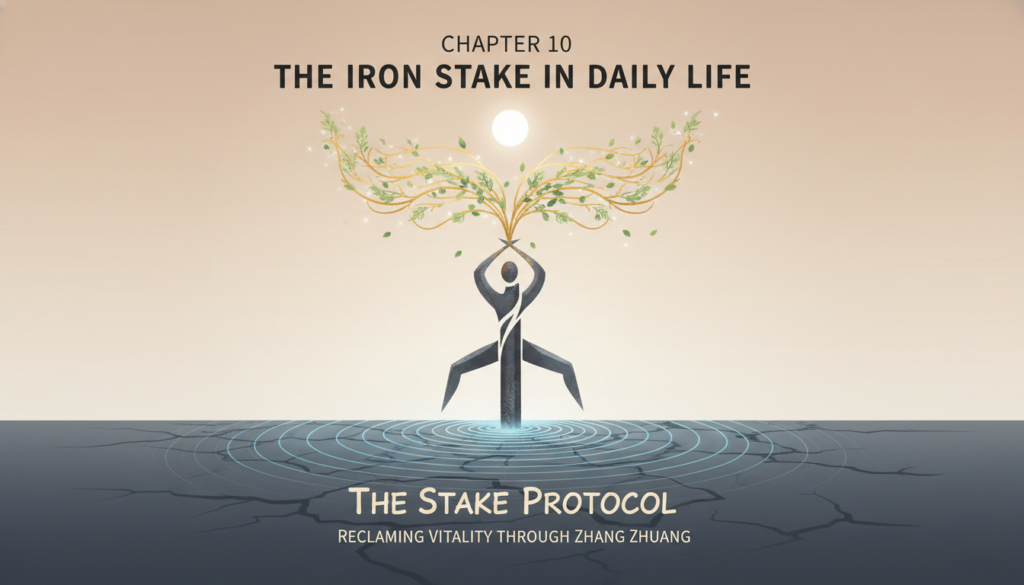
Chapter 10: The Iron Stake in Daily Life
Remix
# Chapter 10: The Iron Stake in Daily Life
The true test of a warrior is not how they perform in the sanctuary of a dojo or a quiet meditation room; it is how they maintain their center when the world begins to pull at them. If your practice of Zhan Zhuang—the *Iron Stake Protocol*—remains confined to the twenty minutes you spend standing in your living room, it is merely an exercise. To reclaim your vitality, the Iron Stake must become your default setting.
In this final chapter, we explore the integration of the vertical path into the horizontal chaos of modern existence. We shift from “doing” Zhan Zhuang to “being” the Iron Stake. This is where your training transforms from a habit into a superpower.
### The Invisible Stake: Waiting in Line and Idle Moments
Most people view waiting in line at the grocery store or standing on a subway platform as “dead time.” Their bodies reflect this: they slump, shift their weight onto one hip, check their phones with a rounded spine, and leak energy through fidgeting or frustration.
As a practitioner of the Iron Stake Protocol, you no longer wait. You *stand*.
The next time you are caught in a queue, engage the invisible stake:
1. **Find Your Root:** Secretly distribute your weight evenly through the “bubbling springs” of your feet. Feel the floor beneath the concrete.
2. **Unlock the Joints:** Soften your knees and sink the tailbone just a fraction. This is the “hidden sit.” To the outside world, you look like a person standing still; internally, you are a pressurized column of vitality.
3. **Suspend the Crown:** Imagine the invisible thread pulling the back of your head toward the sky.
By doing this, you turn a moment of boredom into a moment of recharging. While others are growing tired and irritable, you are using the gravitational pull of the Earth to fill your internal battery. You are no longer an impatient victim of the clock; you are a monument of presence.
### Breathing Through the Boardroom: The Meeting as a Meditative Field
Stress is nothing more than a collapse of your internal structure. When a deadline looms or a difficult conversation turns heated in a meeting, the body typically reacts in two ways: it tenses up (the “Fight/Flight” armor) or it withers (the “Victim” collapse). Both states drain your Qi and cloud your judgment.
In these moments, your breath is your anchor. Use the *Iron Stake Breathing* to navigate the boardroom:
* **The Lower Dantian Reservoir:** Instead of shallow, chest-based “panic breathing,” direct your inhale deep into the belly. Feel the expansion in your lower back.
* **The Exhale of Release:** As you breathe out, mentally scan for tension in your jaw, shoulders, and brow. Release the “Song” (the internal loosening) without losing your upright posture.
When you breathe this way during a stressful encounter, you send a signal to your nervous system that you are safe. This allows you to stay in the “Executive Brain,” making clear, powerful decisions while everyone else is reacting from fear. You become the eye of the hurricane—unmoved, observant, and formidable.
### Vertical Willpower: Standing Tall During Life’s Storms
We often speak of willpower as a mental muscle that we “flex” until it tires. The Iron Stake Protocol offers a different model: **Vertical Willpower.**
Vertical Willpower is the ability to maintain your integrity—both physical and moral—when external forces try to bend you. It is the refusal to “slump” when life delivers a blow. Whether it is a personal loss, a professional setback, or a health challenge, the Iron Stake mentality teaches you that as long as your vertical axis is intact, you cannot be defeated.
When life gets heavy, remember the “Standing Like a Tree” analogy. A tree doesn’t fight the wind with rigid force; it maintains its root and its upward reach, allowing the wind to pass through its branches. Vertical Willpower is the quiet, stubborn persistence of the stake. It is the realization that you don’t need to “push back” against the world—you simply need to remain unshakeable in your own space.
### The Final Transformation: From Victim to Architect
We began this journey by addressing the “Weak Victim”—the version of yourself that feels drained by the environment, overwhelmed by stress, and disconnected from your own power. Through the Iron Stake Protocol, you have systematically dismantled that identity.
The transformation is now complete. You are no longer a passive recipient of reality; you are the **Architect of your own reality.**
* **The Charged State:** You no longer wake up hoping for energy; you generate it through alignment.
* **The Grounded Presence:** You no longer seek external validation to feel stable; you are rooted in the Earth.
* **The Powerful Intent:** You no longer drift; you move with the *Yi* (Intention) of a master.
The Iron Stake is not just a posture; it is a declaration. It says to the world: *I am here. I am centered. I am unbreakable.*
Go out into the world. Stand your ground. Let the vitality you have cultivated in stillness become the fire that fuels your action. The stake is driven; the foundation is set. Now, build your life upon it.

No comments yet.